Ryūkou-ji Temple: A Shingon Buddhist Temple on the Shikoku Pilgrimage


Site at a Glance
- Rating
- 3.9
- Popularity
- Low
- Country
- Japan
- Primary era
- Early Modern
- External website
- Open
- Eras represented
- Early Modern, Modern
- Civilizations
- Japanese, Tokugawa
- Site type
- Religious
- Remains
- Temple
On this page12 sections
History
Ryūkou-ji Temple in Uwajima, Japan, is a Shingon Buddhist temple of the Omuro-ha branch, traditionally founded in 807 by Kūkai, also known as Kōbō Daishi. Shingon is an esoteric Buddhist tradition, while the Omuro-ha branch belongs to the Omuro lineage. The temple is formally called Inarizan Gokokuin Ryūkōmitsu-ji and is also known as Inari Temple. It is the forty-first temple on the traditional Shikoku 88-temple pilgrimage, a Buddhist circuit linking temples associated with Kūkai across Shikoku.
Foundation and early history
Temple tradition connects Ryūkou-ji with an encounter between Kūkai and a white-haired old man carrying rice. Kūkai recognized the figure as an incarnation of the Five Grains Great Deity and carved an image of Inari Myōjin, a kami associated with rice, grain, fertility, and prosperity. He also carved an eleven-faced Kannon as the principal Buddhist image. Kannon is the bodhisattva of compassion, and its eleven-faced form represents different compassionate aspects. Fudō Myōō, a Buddhist wisdom king associated with immovable resolve, and Bishamonten, a guardian deity associated with protection and military power, served as attendant deities.
Kūkai established the temple as the guardian temple of the Shikoku pilgrimage. During the early Edo period, the institution became a jingū-ji, a shrine-temple complex in which Buddhist institutions and kami worship were integrated, under the name Rikkō-ji. Its original site was in Inarida, approximately 0.5 kilometres southeast of the present precincts.
Fire and relocation
The original complex was destroyed by fire. When the pilgrim Chōzen visited in 1653, only a small hall remained in the middle of a rice field. In 1688, the complex was moved to its present location, a site formerly occupied by Hirota Grove. The new arrangement placed an Inari shrine on an upper terrace, with a Kannon Hall to its east and a Daishi Hall on the lower terrace.
By the middle of the Edo period, the present landscape had largely taken shape. Around the publication of the Illustrated Guide to Famous Pilgrimage Sites in Shikoku in 1800, the complex was widely revered as “Mima’s Inari.” Its organization reflected the coexistence of Shinto and Buddhist traditions, with shrine worship and Buddhist images occupying a connected religious landscape.
Separation of the complex
The Meiji government’s policy separating Shinto and Buddhism ended the former institutional arrangement. The complex was divided into Inari Shrine and Ryūkou-ji Temple. The former Main Hall became the shrine building, while the Inari image was moved to the right side of a newly built lower Main Hall. The Eleven-faced Kannon from the former Kannon Hall was moved to the centre and became the temple’s principal image.
This reorganization also changed the wording used in pilgrimage registers. Earlier entries identified the Main Shrine as Inari Myōjin and the principal Buddhist image as the Eleven-faced Kannon. After the division, the entry identified the Eleven-faced Kannon as the principal image. Ryūkou-ji remains associated with both pilgrimage traditions: it is the third site on the Nanyo Seven Lucky Gods pilgrimage, where it is linked with Ebisu, a deity traditionally associated with prosperity, commerce, and fishing.
Historic designation
The precincts of Inari Shrine and Ryūkou-ji cover 2.749453 hectares and form part of the nationally designated historic Iyo Pilgrimage Route. The Butsumokuji Path in front of the temple and an approximately 450-metre mountain path crossing the western ridge toward Prefectural Road 31 are also included. The ridge path received designation in 2016, and the area in front of the Main Hall was added in 2017. The Inari Shrine Main Sanctuary was designated a tangible cultural property by Uwajima City in 2003.
Remains
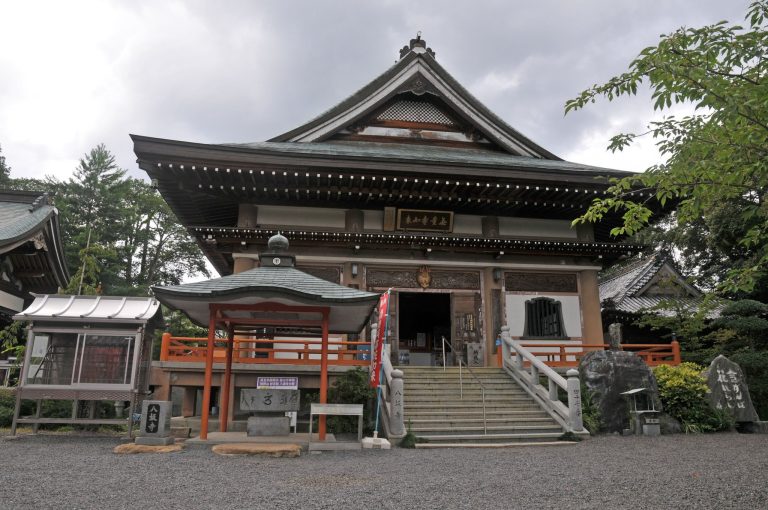
The surviving complex is arranged along a rising approach. A stone torii, the traditional Shinto gateway to a sacred precinct, stands at the beginning of the route, which passes between houses before reaching stone steps and the temple grounds. Guardian dog statues mark the entrance. In the lower grounds, the bell tower stands on the left and a stone Mizuko Jizō stands on the right. Mizuko Jizō is a form of Jizō associated with the remembrance and protection of deceased, miscarried, or aborted children.
Lower temple grounds
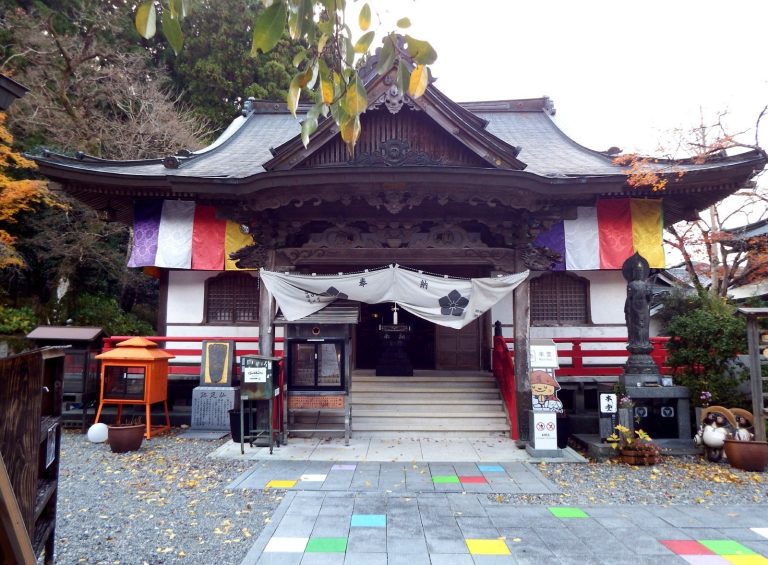
Farther uphill, the Main Hall stands on the left and the Daishi Hall on the right, with the pilgrimage office beside the Main Hall. The grounds also contain representations of the Seven Lucky Gods. The arrangement preserves the principal Buddhist buildings below the upper Inari Shrine and reflects the layered organization formed after the complex moved to the site in 1688.
Main Hall
The Main Hall contains the temple’s principal image. The original Eleven-faced Kannon is a standing statue, while the image currently available for viewing is a painted seated statue. The original Kannon, the Inari Myōjin image traditionally said to carry the Five Grains, and a stone regarded as a dragon’s eye are treated as hidden sacred objects. The current head priest is said never to have seen them.
Daishi Hall
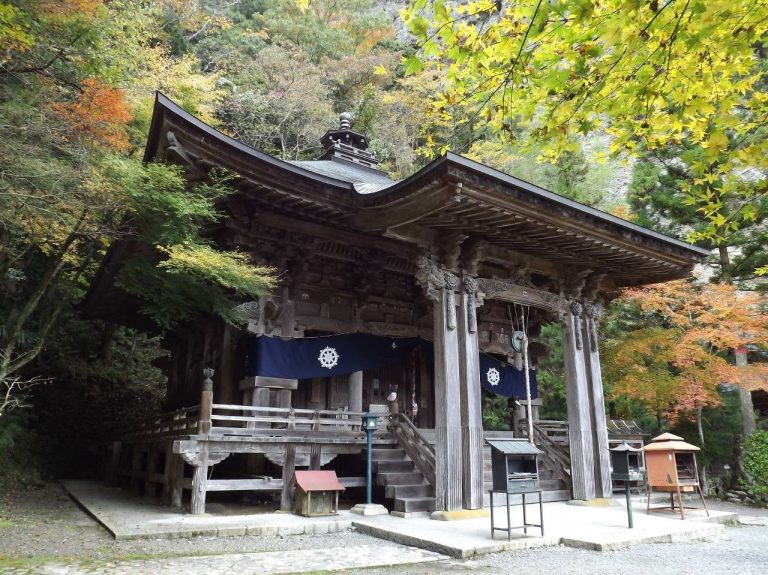
The Daishi Hall contains a viewable statue of Kōbō Daishi and a golden image of the Peacock King. The Peacock King is a Buddhist protective deity associated with warding off poisons and calamities. Stairs on the right side of the hall lead to a corridor.
Upper Inari Shrine
A further flight of stone steps passes through a red torii and reaches the Inari Shrine on the upper terrace. The shrine precinct contains the Main Sanctuary, a worship hall, a small shrine, a miniature shrine, and Hirota Shrine, which occupies the former Kannon Hall. The former Main Hall survives as the Inari Shrine building, while the former Kannon Hall survives as Hirota Shrine. Together, these buildings preserve the physical reorganization that followed the separation of Shinto and Buddhism.
Inari Shrine Main Sanctuary
The Main Sanctuary is enclosed within a protective shelter and is described as being in excellent condition. It is an early-eighteenth-century building with a three-bay frontage and a nagare-zukuri, or stream-style, design. In this shrine-building form, the front slope of the gabled roof extends forward to create a covered entrance. The sanctuary has a kokera-buki roof, made from thin wooden shingles. Its principal deity is Toyoukehime-no-Mikoto, a kami associated with food and sustenance. Sarutahiko-no-Mikoto and Omiyanome-no-Ōkami serve as subsidiary deities.
Dragon’s-eye stone
A black stone approximately 10 centimetres high is regarded as the dragon’s eye. Local tradition says that a village headman was attacked by a dragon and that his sword flew by itself, piercing the creature’s eye. The eye then became stone. The object is treated as one of the hidden sacred objects associated with the temple’s Inari tradition.