Aragonese Castle, Ischia: A Historic Fortress and Cultural Landmark
Visitor Information
Google Rating: 4.7
Popularity: High
Official Website: www.castelloaragonese.it
Country: Italy
Civilization: Early Modern, Medieval European, Modern
Site type: Military
Remains: Castle
History
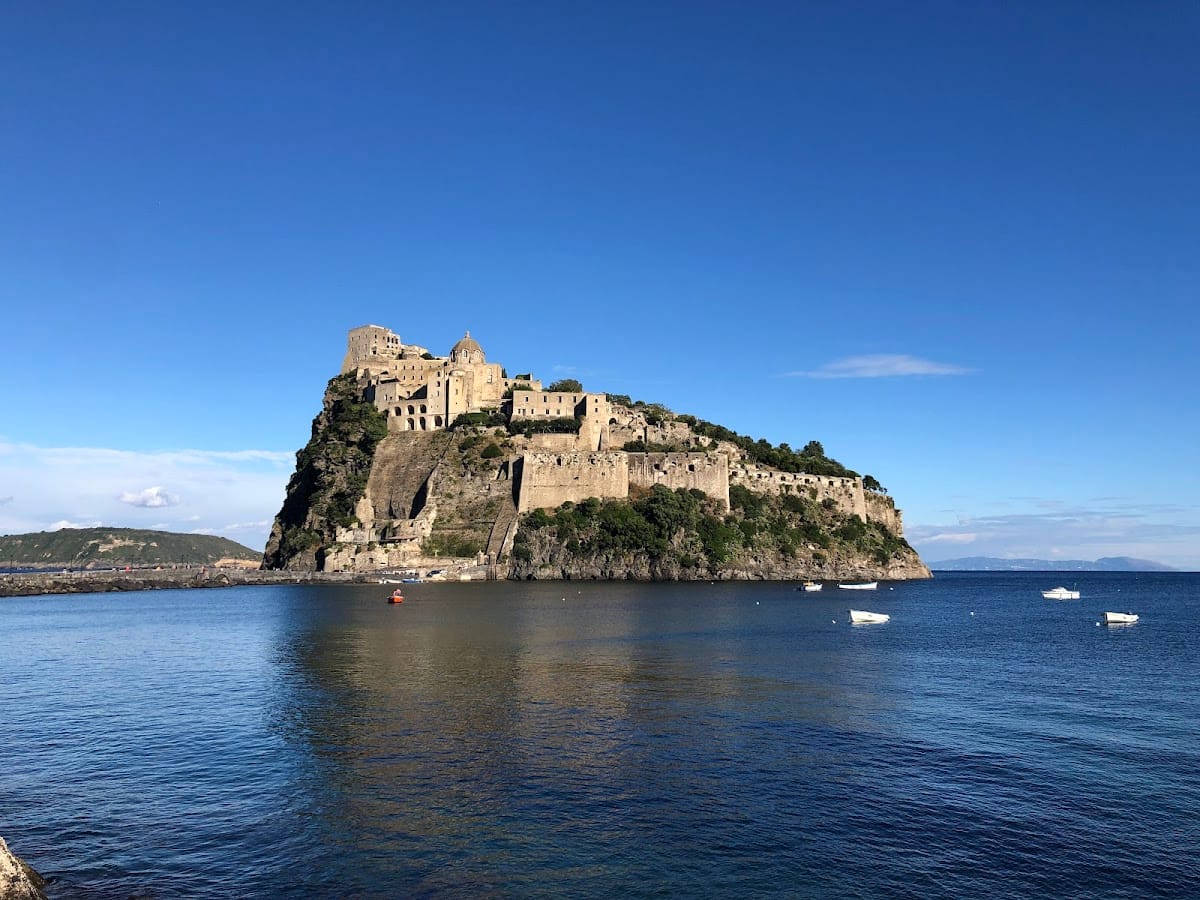
The Aragonese Castle stands on a small volcanic islet near the island of Ischia, Italy. It was first built in 474 BCE by Hiero I, the Greek tyrant of Syracuse. After aiding the Cumaeans against the Etruscans, Hiero was granted the entire island of Ischia, then known as Aenaria. The fortress was originally called Castrum Gironis and served as a strategic stronghold in the Tyrrhenian Sea.
Following its Greek origins, the castle came under the control of the Parthenopaeans before the Romans conquered it in 315 BCE. The Romans established the colony of Aenaria and used the castle as a defensive fortification. It included residential buildings and watchtowers to monitor enemy ships, securing the island against maritime threats.
Over the centuries, the castle was repeatedly modified to protect the local population from invasions and raids. Groups such as the Visigoths, Vandals, Ostrogoths, Arabs, Normans, Swabians, and Angevins occupied or attacked the fortress. Each wave of conquest brought changes to its structure and function, transforming it into a refuge during times of conflict.
In 1301, a volcanic eruption destroyed the nearby city of Geronda. Survivors sought shelter within the castle, which then became a secure refuge and a small urban settlement. This event marked a turning point, as the fortress evolved from a military outpost into a community center.
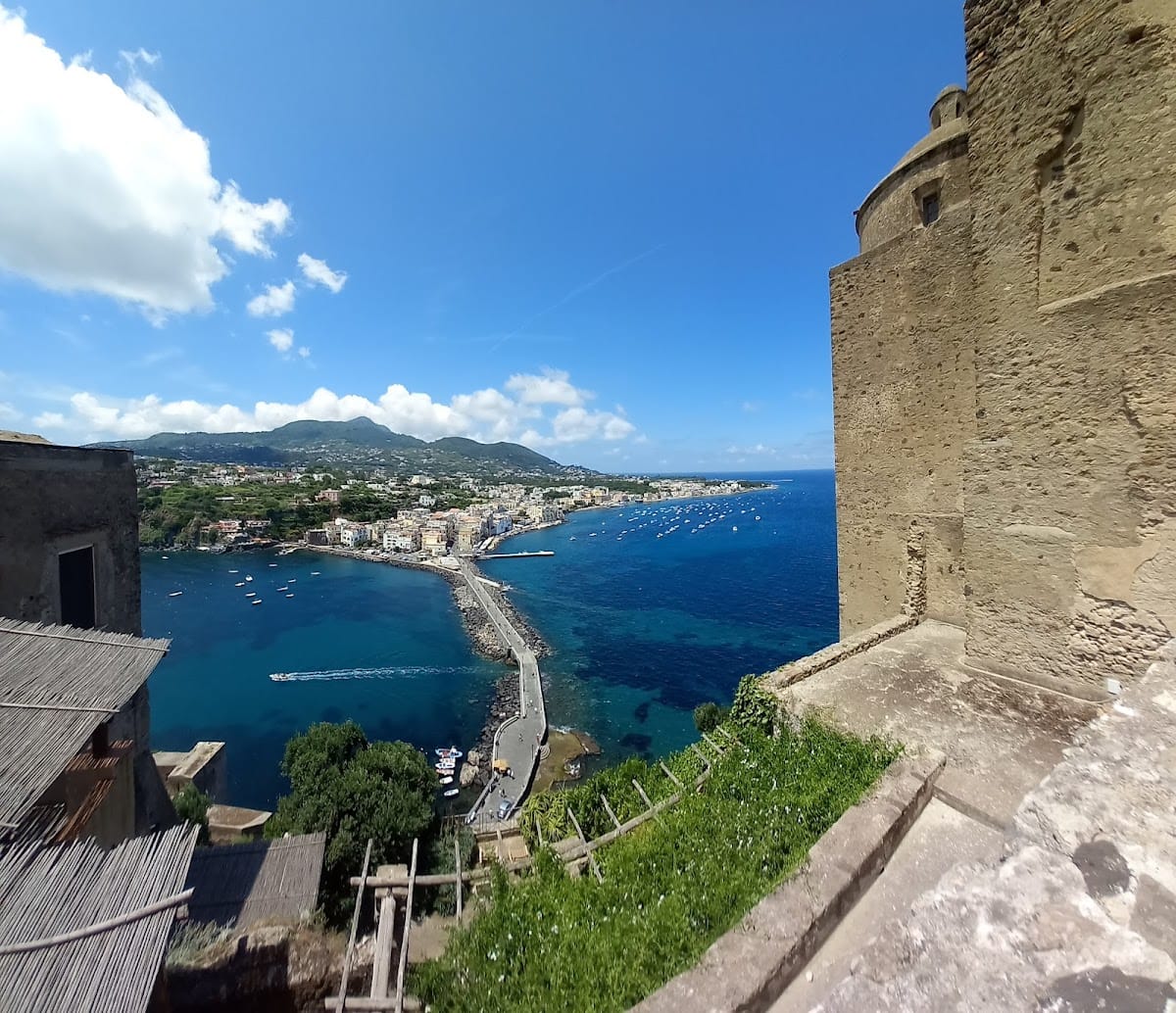
The castle’s current quadrangular shape with four towers was established in 1441 by Alfonso V of Aragon. He modeled it after the Maschio Angioino castle in Naples and constructed a wooden bridge connecting the islet to Ischia, later replaced by stone. Alfonso also commissioned a tunnel carved into the rock to improve access and defense.
By the late 16th century, the castle had grown into a thriving community with nearly 1,900 families. It housed thirteen churches, including a cathedral, a monastery of the Poor Clares, a Basilian abbey, a bishopric, and the prince’s residence with its garrison. This period marked the castle’s peak as a fortified urban center.
From 1501 to 1536, the poet Vittoria Colonna lived in the castle. Her presence attracted Renaissance artists and intellectuals such as Michelangelo, Ludovico Ariosto, and Jacopo Sannazaro, making the fortress a cultural hub during the Renaissance.
In the late 18th century, as pirate threats diminished, residents began leaving the castle for more accessible parts of Ischia to focus on agriculture and fishing. This gradual abandonment reflected changing social and economic conditions on the island.
In 1809, British forces besieged the castle, subjecting it to heavy bombardment that nearly destroyed the fortress. This military action severely damaged the structure and its community.
King Ferdinand I of the Two Sicilies expelled the remaining inhabitants in 1823 and converted the castle into a prison. It housed life-sentenced inmates and political prisoners, including notable figures from the Italian unification movement such as Carlo Poerio and Luigi Settembrini.
The prison closed in 1860 after Ischia was annexed to the Kingdom of Italy by Giuseppe Garibaldi. The castle then passed into private hands in 1912, beginning a new phase focused on restoration and preservation.
Since the 1970s, the castle has hosted exhibitions and cultural events, continuing its long history as a place of significance on Ischia.
Remains
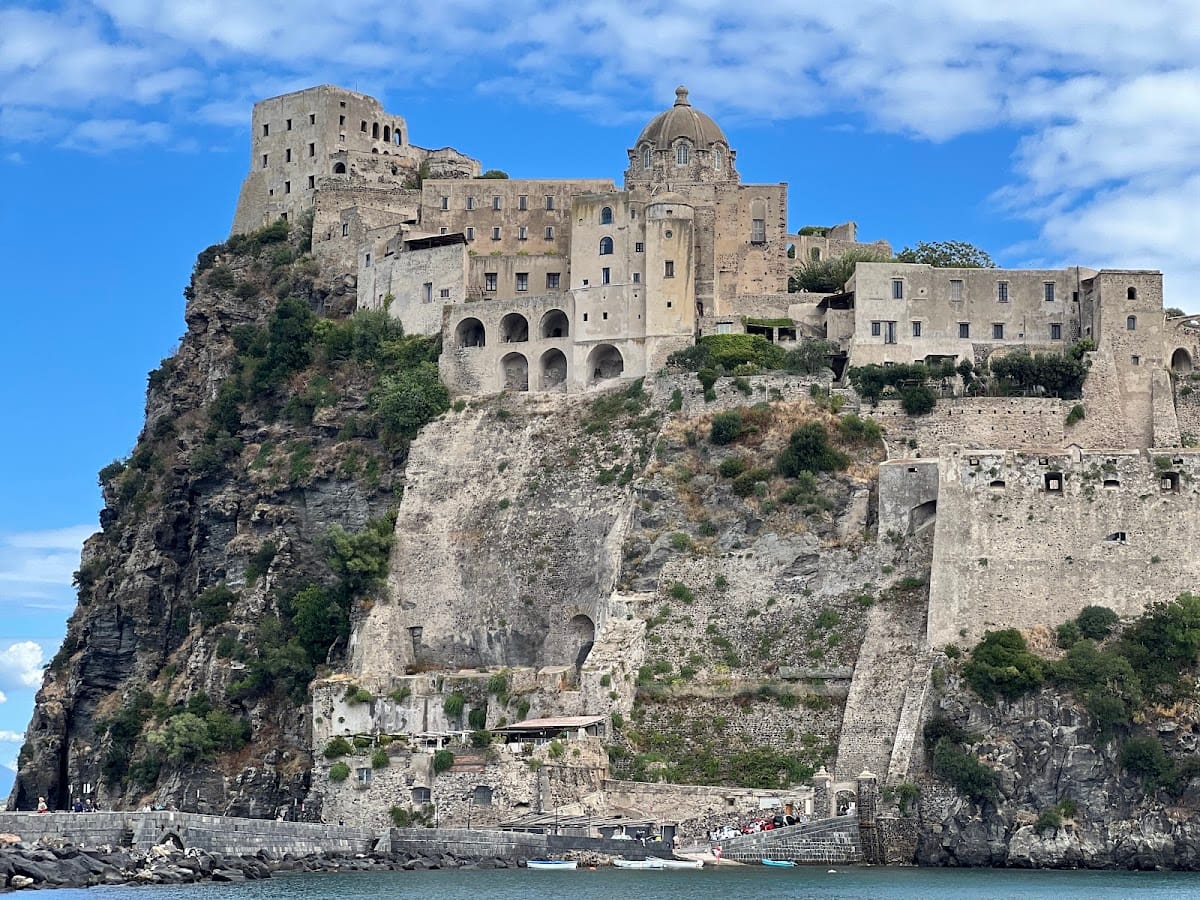
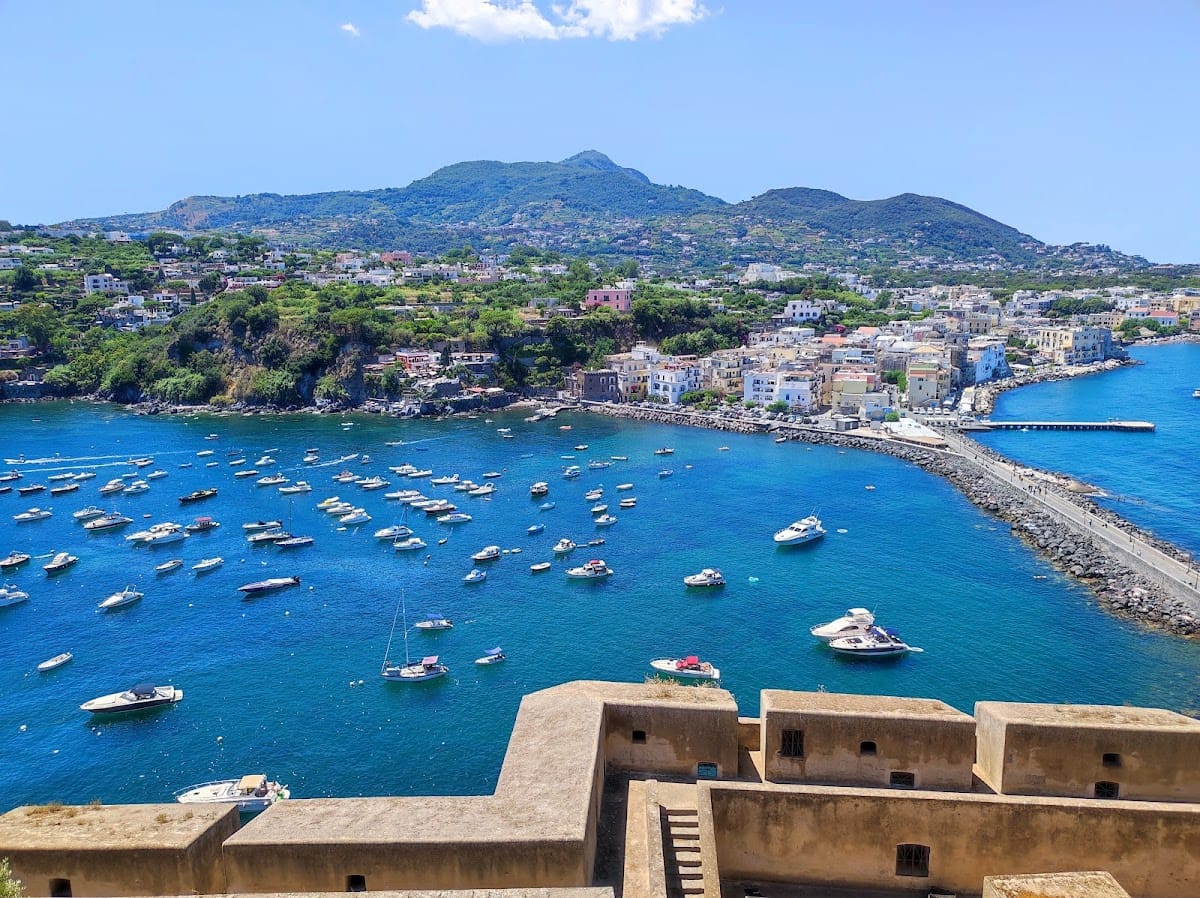
The Aragonese Castle occupies a volcanic rock islet rising 113 meters above sea level and covering about 56,000 square meters. Its layout is quadrangular, featuring four towers and massive defensive walls. These walls include narrow slits called “piombatoi,” designed for dropping molten lead, boiling water, stones, and other projectiles on attackers.
Access to the castle is provided by a 400-meter tunnel carved into the rock in the mid-15th century under Alfonso V. The tunnel is illuminated by tall skylights that also served as defensive openings for pouring boiling substances on enemies. From the tunnel, a mule track ascends openly to the summit, branching into paths leading to various buildings and gardens. Since the 1970s, a rock-cut elevator has operated, reaching 60 meters above sea level.
Inside the castle, royal apartments and quarters for courtiers, troops, and servants are arranged around the central area. At the base lies a casemate, a fortified chamber housing the garrison responsible for operating the drawbridge.
Within the tunnel is a votive chapel carved in 1441. It contains a small altar originally dedicated to Saint Leonard Abbot and later features a 19th-century painting of Saint John Joseph of the Cross.
The Church of the Immaculate Conception, begun in 1737 by the Poor Clares, has a Greek cross plan with a presbytery and entrance pronaos. Its large dome dominates the castle skyline and offers panoramic views. The church remains unfinished with plain white walls and was restored in 1980 for use as an exhibition space.
The Poor Clares Monastery, founded in 1575, included an underground cemetery where deceased nuns were placed upright on stone seats to mummify naturally. The monastery closed in 1810 and was later partially converted into a hotel.
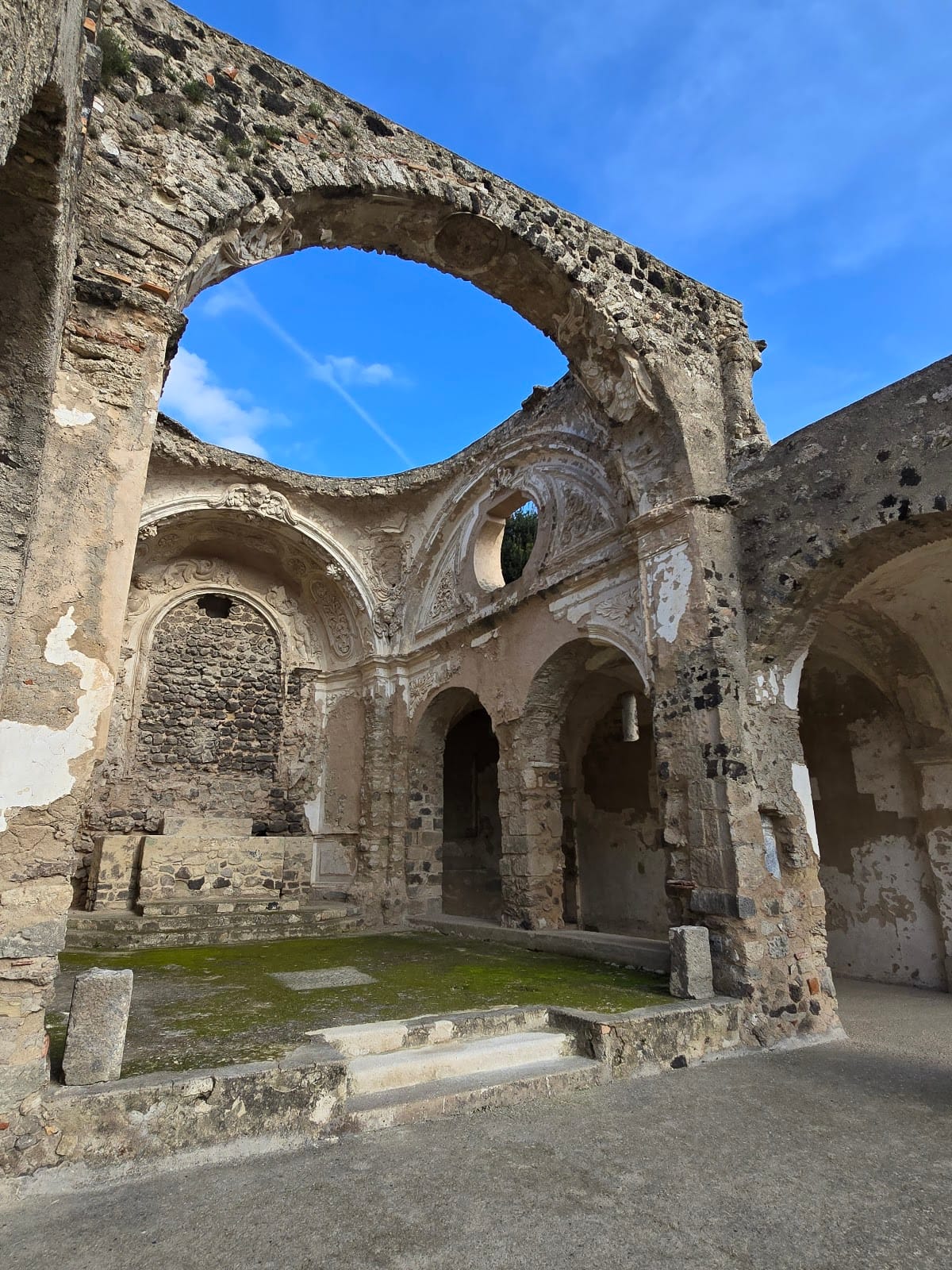
The Cathedral of the Assumption, built in 1306 to replace a previous cathedral destroyed by the 1301 eruption, is a three-nave basilica. Originally Romanesque, it underwent Renaissance and Baroque modifications. The cathedral was heavily damaged by British cannon fire in 1809 and now serves as an open-air venue for concerts and readings.
Beneath the cathedral lies a crypt dating from the 11th to 12th centuries. It consists of a central vaulted chamber surrounded by seven barrel-vaulted chapels. Each chapel represents a noble family of the islet and is decorated with frescoes from the 13th to 17th centuries.
The Church of San Pietro a Pantaniello, attributed to Renaissance architect Jacopo Barozzi da Vignola in the 16th century, is austere and lacks clear evidence of its original design. Its construction cost was recorded as 500 ducats.
Other notable structures include the Church of Santa Maria delle Grazie from the 16th century, the Basilian Abbey, political prisons built under Ferdinand I of Bourbon, and the Maschio tower.
Much of the islet remains covered by ruins, gardens, vineyards, and steep cliffs. Many buildings suffered destruction during 19th-century warfare and subsequent neglect. Restoration efforts by private owners have gradually rehabilitated parts of the complex, preserving its historical and architectural heritage.
Nearby sites