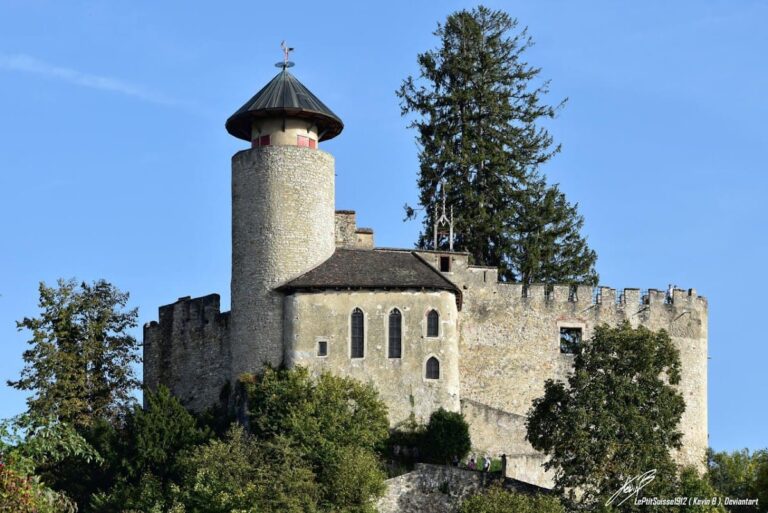
Angenstein Castle: A Historic Fortress in Switzerland
Visitor Information
Google Rating: 4.4
Popularity: Very Low
Official Website: www.baselland.ch
Country: Switzerland
Civilization: Early Modern, Medieval European
Site type: Military
Remains: Castle
History
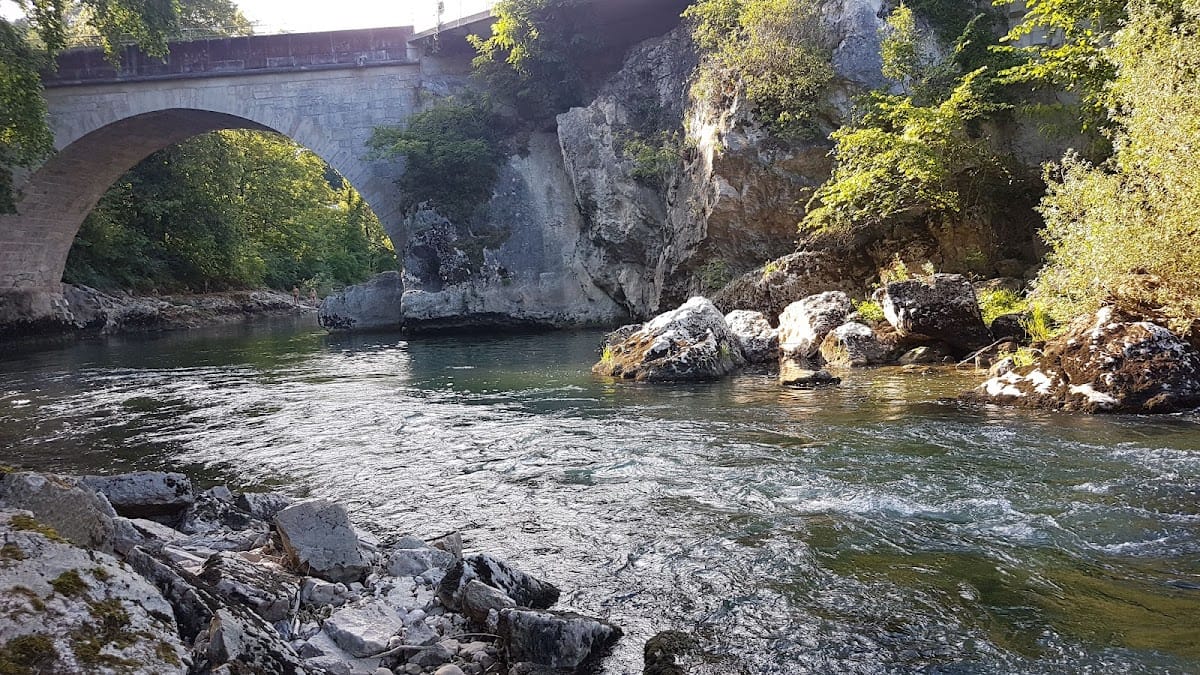
Angenstein Castle stands on a rocky spur above the Birs river gorge near Duggingen in Switzerland. It was constructed around the mid-13th century, likely by local noble families to assert control over their lands rather than to collect tolls. The exact original builders remain uncertain, with possibilities including the Counts of Pfirt or the episcopal ministeriales Münch family. By 1271, half of the estate belonged to the Bishop of Basel, who granted it as a fief to the Counts of Thierstein.
Before the mid-14th century, the castle was jointly held by the Habsburg-Laufenburg family and the Bishop of Basel, who together enfeoffed it to the Counts of Thierstein. The Thierstein then granted the castle to the Münch of Landskron branch. After the 1356 Basel earthquake damaged the fortress, it was quickly repaired and remained in Münch hands until their family line ended in 1460.
Following the Münch extinction, the Thierstein family reclaimed the fief and enfeoffed Veltin von Neuenstein, who was involved in conflicts with the city of Basel. Due to pressure from Basel, the fief was transferred in 1486 to Friedrich Kilchmann and Elisabeth Offenburg. The castle suffered two major fires, in 1494 and 1517. After the second fire, the owner Wolfgang von Lichtenfels was killed. When the Thierstein line ended in 1519, a dispute arose between Solothurn and the Bishop of Basel over the ruins and associated rights. This was settled in 1522 in favor of the bishop, with the condition that the fortress not be rebuilt.
Around 1560, Chancellor Wendelin Zipper, granted the castle by Bishop Melchior von Lichtenfels, began reconstructing it. He transformed the fortress into a residential castle with timber-framed buildings and a chapel, but did not restore the defensive tower. The castle remained with the Zipper family until 1751, except for a Swedish occupation from 1637 to 1640 during the Thirty Years’ War, when it served as headquarters for Duke Bernhard of Weimar.
Afterward, ownership passed to the Noël and de Grandvillars families. The castle remained private and escaped damage during the revolutionary period. Following the 1815 Congress of Vienna, the castle came under the canton of Bern but stayed in private hands, later owned by the Bertschi family from the mid-19th century. Since 1951, the canton of Basel-Stadt has owned Angenstein Castle. It suffered a fire in 1984 but was restored by 1991. Two chapel bells from 1826, lost in the fire, were rediscovered in a nearby forest in 2010.
The castle chapel is dedicated to St. Anna and St. Wendelin. In 1562, a stained-glass triptych was installed, depicting scenes from Good Friday, Christmas, and Pentecost. The castle is recognized as a Swiss heritage site of national significance and is linked to local organizations, including a scout group named after it. Below the castle, a World War II infantry fortification was built in the 1960s, consisting of camouflaged concrete bunkers maintained by a local officers’ society.
Remains
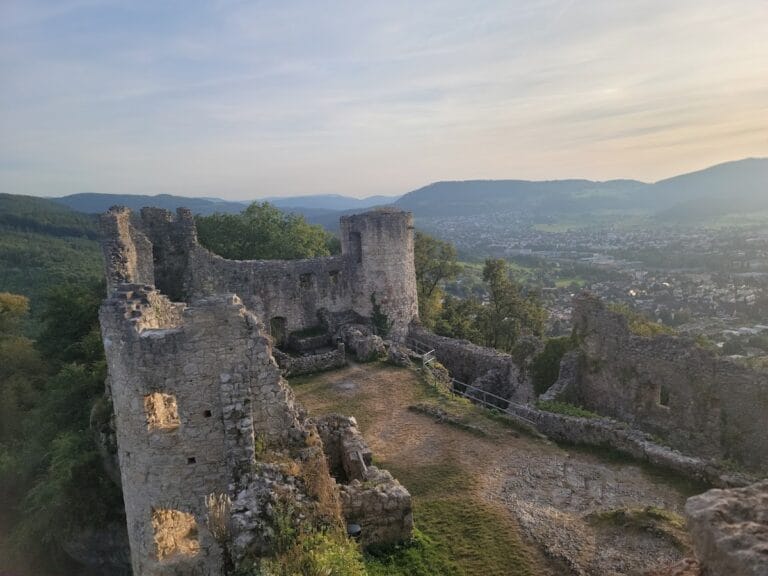
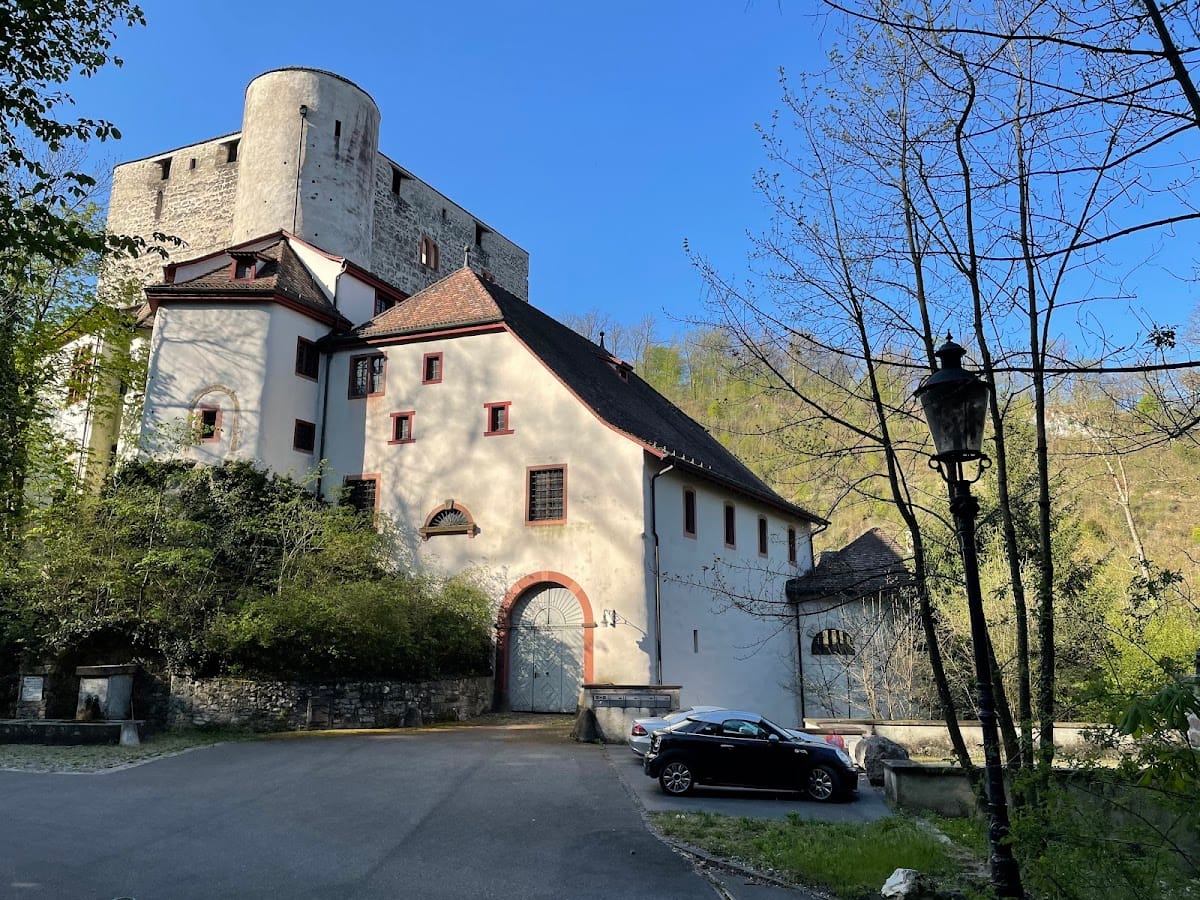
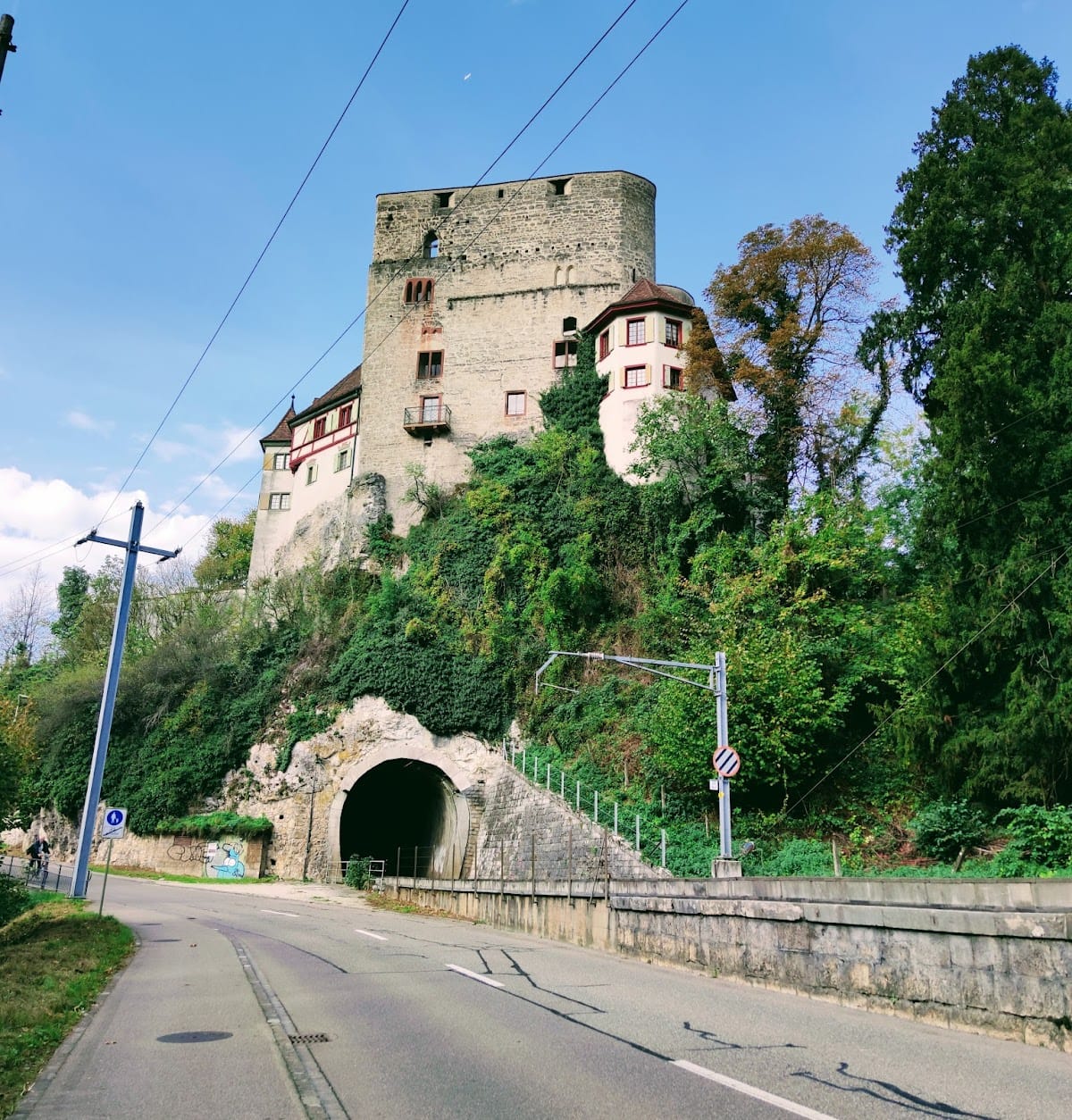
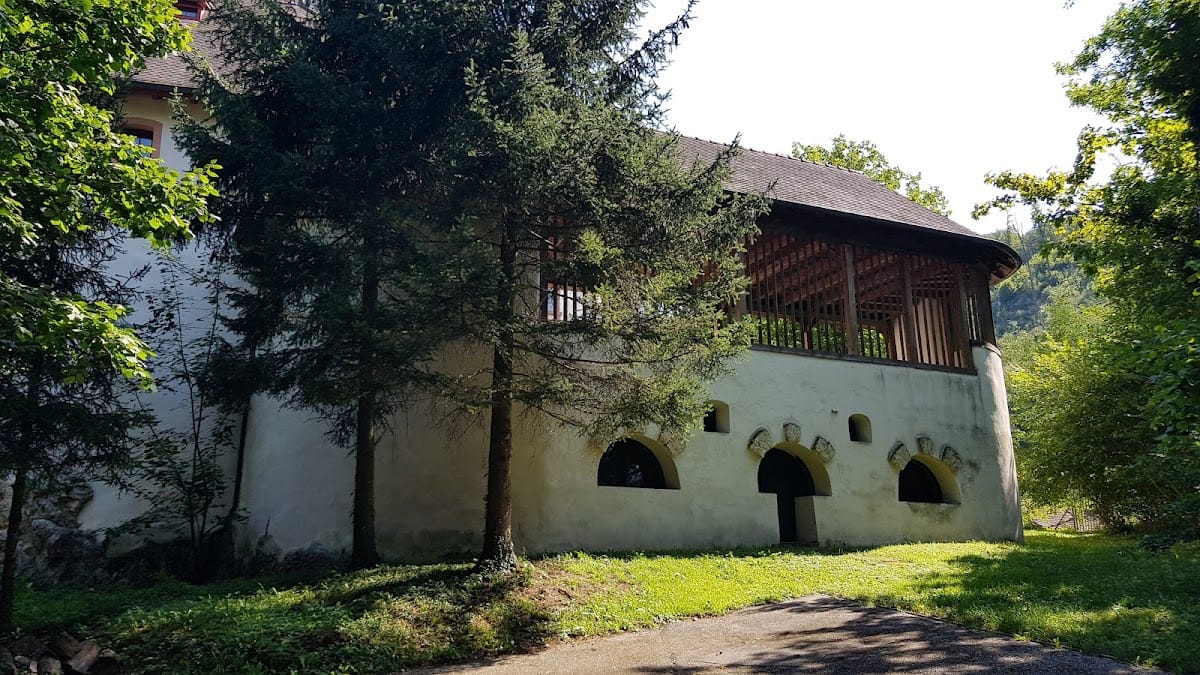
Angenstein Castle occupies a narrow rocky spur overlooking the Birs river gorge, controlling the passage along the Basel–Delsberg road. The Jura railway runs through a 64-meter tunnel beneath the castle, constructed in 1870. The original entrance was on the west side, ascending from the Birs bridge through a small defensive courtyard called a zwinger, now lost. The current entrance on the northeast side is a modern addition.
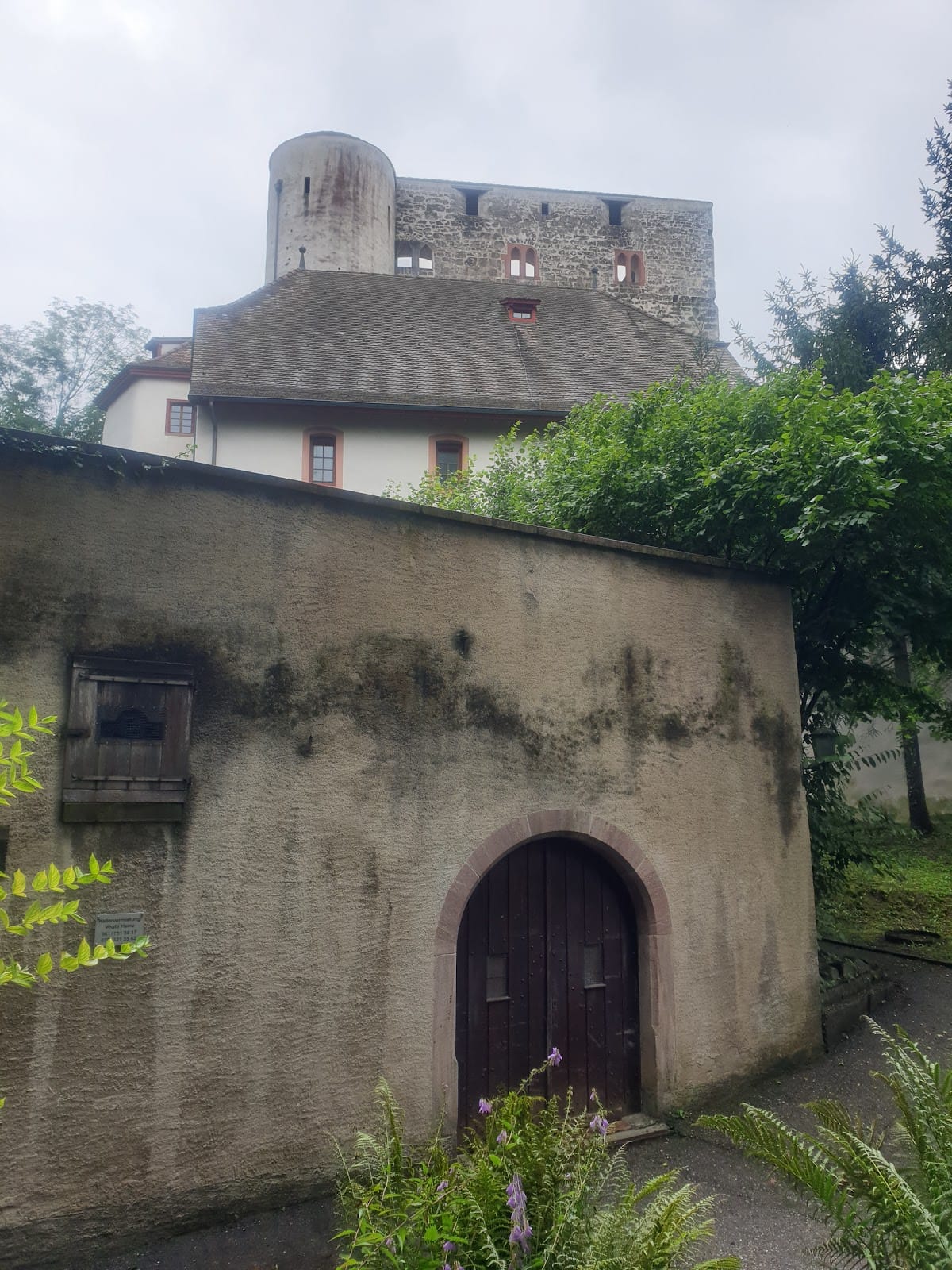
The castle’s outer ring wall once featured loopholes—narrow vertical openings for archers—and a battlement walkway but was mostly lowered to garden wall height during its conversion into a residence. The inner ring wall protected the donjon, or main tower, on three sides and was accessed through a second gate on the west. Timber-framed residential buildings dating from about 1560 were built atop this inner wall. These contain two apartments still inhabited today, limiting public access.
The donjon measures roughly 16 by 19 meters with walls about two meters thick. Its masonry remains intact up to the full height of the original five stories. The exterior walls show numerous beam holes that once supported a wooden gallery. A battlement walkway ran along the top, with a pyramidal roof set on the inner edge of the wall crown. The castle chapel, accessible from the donjon, is dedicated to St. Anna and St. Wendelin and contains a stained-glass triptych from 1562 illustrating key Christian festivals.
Across the Birs river, the castle complex includes a former customs house, now used as housing, and a tavern that continues to operate as a restaurant. Below the castle, World War II infantry fortifications consist of camouflaged concrete bunkers with gun openings. These form the Angenstein A 3476 main eastern work and the Muggenberg A 3476 western counterwork. They are accessible from the southwest or through the railway tunnel beneath the castle. The castle’s exterior is well preserved and can be studied from outside despite limited interior access.
Nearby sites