Aksaray Mausoleum: A Timurid Family Tomb in Samarkand


Site at a Glance
- Rating
- 4.6
- Popularity
- Low
- Country
- Uzbekistan
- Primary era
- Medieval
- Eras represented
- Medieval
- Civilizations
- Timurid
- Site type
- Burial
- Remains
- Tomb
On this page6 sections
History
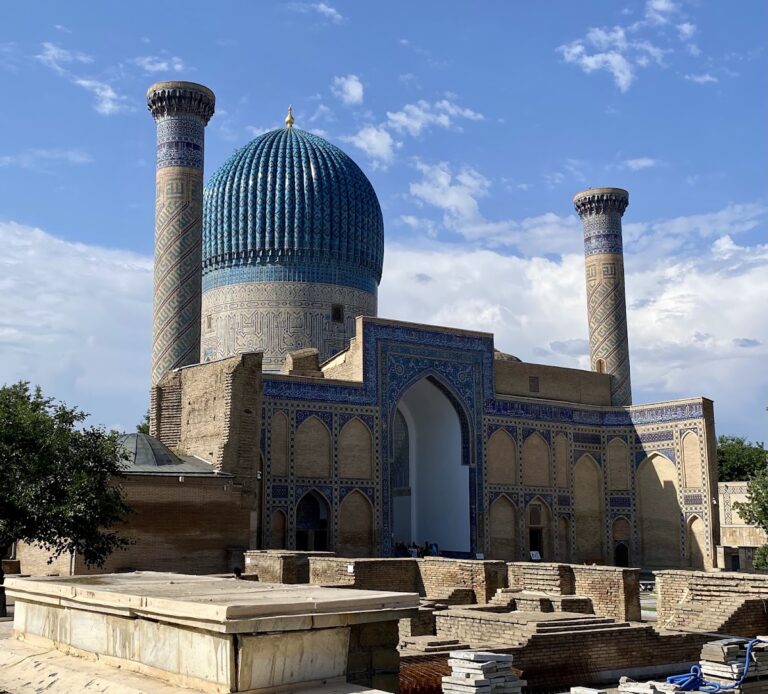
Aksaray Mausoleum is a fifteenth-century Timurid family tomb in Samarkand, Uzbekistan, built by the Timurids during the 1470s in the Timurid period. It stands a few hundred metres southwest of the Registan and about 30 metres southeast of Gur-e-Amir, the dynastic mausoleum that Timur established in Samarkand. The building’s exact construction date and original purpose remain uncertain, but it belongs to the final phase of Timurid monumental construction in the city.
Construction under Ahmad Mirza
The mausoleum was begun during the early years of Sultan Ahmad Mirza’s reign, which lasted from 1469 to 1494. The Timurid state, the dynasty founded by Timur whose empire had dominated much of Central Asia and Iran, was then weakened by civil wars among Timur’s descendants. Samarkand’s earlier wealth had declined, and limited funds brought most major building projects to a halt.
Burial needs may also have influenced the project. Gur-e-Amir no longer had room for further burials, while the earlier Ishrat Khana mausoleum still had space but was reserved for women of the Timurid family. One interpretation identifies Aksaray as a possible memorial to Abd al-Latif, the Timurid ruler who ordered the killing of his father, Ulugh Beg, a Timurid ruler known for astronomy and the patronage of learning. Another interpretation sees it as a family mausoleum for the male descendants of Sultan Abu Sa’id Mirza.
Timurid burial place and later decline
Ahmad Mirza financed the mausoleum, although he was buried in Herat. Several members of the Timurid family were interred at Aksaray, including Abd al-Latif. The building’s design and decoration closely relate it to Ishrat Khana, built about a decade earlier in southeastern Samarkand by Abu Sa’id Mirza. Ishrat Khana may have provided the model for Aksaray, and the two buildings may have shared architects and craftsmen. Together, they are regarded as the last Timurid monuments erected in Samarkand.
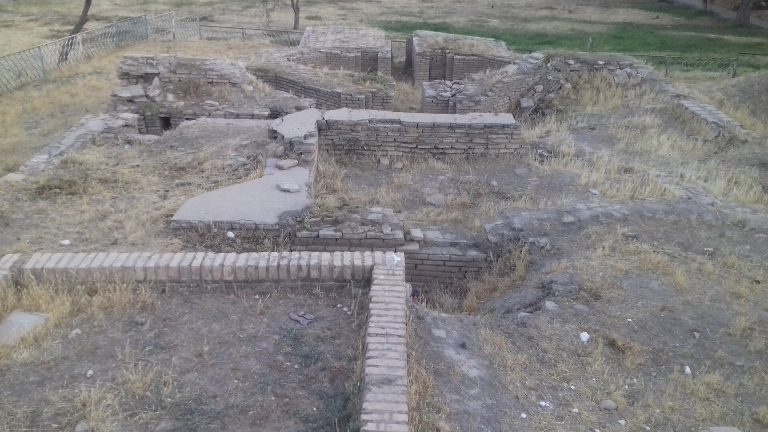
After the newly established Shaybanid dynasty conquered Samarkand, Timurid tombs were neglected and Aksaray fell into ruin. By the beginning of the twentieth century, earthquakes, weathering, and vandalism had caused severe damage, including the partial destruction of its side chambers. Conservation work in 1924 and 1925 prevented the building from being completely destroyed. It remained ruined until a privately financed restoration in 2007 restored the mausoleum. Its architectural solutions continued developments associated with Ishrat Khana and anticipated vaulting innovations used in Bukhara and other parts of Central Asia during the sixteenth century.
Remains
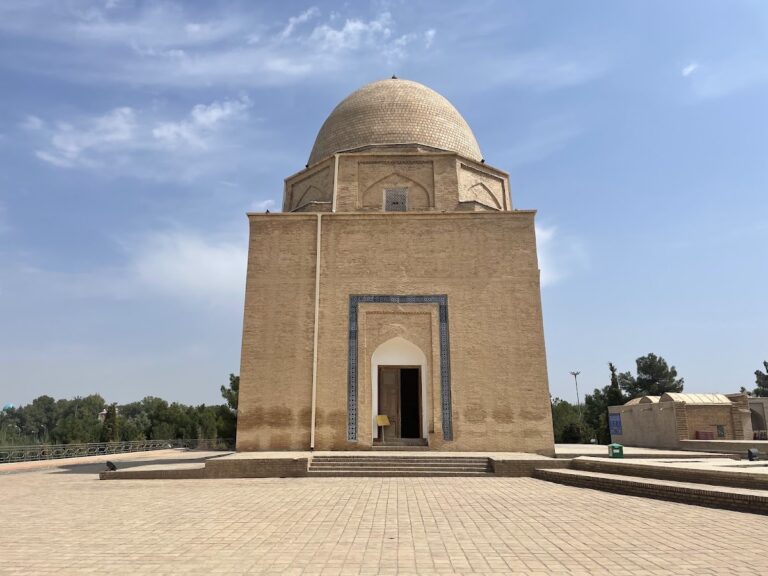
Aksaray is a rectangular, single-domed building organized around a central cross-shaped hall, with three further rooms forming the entrance group. Beneath the main hall, a narrow dromos, meaning a stair-like passage to an underground chamber, descends to an octagonal crypt lined with marble. The crypt contains unidentified burials, while the main hall occupies the space directly above it.
Main hall and interior decoration
The main hall has a dome raised on a high cylindrical drum. Intersecting arches and shield-shaped pendentives, curved surfaces that transform a square or polygonal space into a circular dome base, support the structure. The walls, pendentives, vaulting, and dome carry ornamental painting in the kundal technique, in which raised pigment is combined with gold leaf to create gilded relief decoration. The lower wall panels contain extremely small tesserae, or mosaic pieces, and the interior is richly gilded.
Ancillary rooms and unfinished exterior
The lavish interior contrasts with the plain exterior, which has no applied decorative treatment. A turquoise dome intended to rise above the gilded central hall was never completed, leaving the building with an unfinished appearance. Some supporting spaces were nevertheless completed. The southern row of rooms was probably used to prepare bodies for burial, while small corner rooms received elaborate star-shaped ceilings.
The corner rooms may have served as cells for Quran recitation. They are inaccessible to visitors, but their sophisticated vault designs are an important part of the mausoleum’s architectural character. The contrast between the completed interior work, the finished ancillary spaces, and the incomplete outer dome preserves evidence of the project’s interrupted construction.