Gur-e Amir: The Timurid Dynastic Mausoleum in Samarkand


Site at a Glance
- Rating
- 4.7
- Popularity
- Medium
- Country
- Uzbekistan
- Primary era
- Medieval
- Eras represented
- Medieval
- Civilizations
- Timurid
- Site type
- Religious
- Remains
- Tomb
On this page13 sections
History
Gur-e Amir is a Timurid mausoleum in Samarkand, Uzbekistan, begun in 1403 in the period of Timurid architecture. Its name is Persian for “Tomb of the Emir” or “Tomb of the King,” and it is also linked to the interpretation “Tomb of Mir,” referring to Mir Sayyid Baraka. The complex became the dynastic burial place of Timur, also known as Tamerlane, the Turco-Mongol ruler who founded the Timurid empire in Central Asia.
Foundation for Muhammad Sultan
The first part of the complex was commissioned by Muhammad Sultan, Timur’s heir and grandson, in the late fourteenth century. It stood in the southeastern part of medieval Samarkand and included a madrasa, an Islamic educational institution, and a khanqah, a religious lodge associated particularly with Sufi practice. After Muhammad Sultan died during a military journey in 1403, Timur ordered a mausoleum beside the existing complex. Construction began that year at Timur’s expense.
Timur returned to Samarkand in autumn 1404 and directed the building as Muhammad Sultan’s tomb. The mausoleum later assumed a wider dynastic function, and its work was completed during the reign of Timur’s grandson Ulugh Beg, a Timurid ruler of Samarkand and a major patron of architecture and astronomy.
Timur and the Timurid family crypt
Timur died at Otrar in early 1405 while campaigning toward China. He had intended to be buried in his native Shahrisabz, but his grandson Khalil Sultan arranged for his body to be taken to Samarkand. Timur was buried at Gur-e Amir, although the mausoleum was still unfinished. His body had been embalmed and placed in an ebony coffin covered with silver brocade. Khalil Sultan, who had taken the Samarkand throne despite Timur’s preference for his elder grandson Pir Muhammad, presided over the official mourning ceremonies on 18 March 1405.
During Ulugh Beg’s reign, Gur-e Amir became the family crypt of the Timurid dynasty. An entrance was created, the eastern approach and gallery were established, and the complex was adapted for further burials. The mausoleum contains the burials or commemorative tombstones of Timur’s sons Shah Rukh, Miran Shah, and Umar Shaykh; his grandsons Muhammad Sultan and Ulugh Beg; other Timurids including Abd Allah Mirza and Abd al-Rahman Mirza; and Mir Sayyid Baraka, Timur’s spiritual teacher and mentor.
Mir Sayyid Baraka was a descendant of the Prophet Muhammad and Timur’s principal spiritual adviser. Tradition associates him with presenting Timur with a drum and banner as symbols of authority when Timur came to power in 1370. He is also said to have accompanied Timur on major campaigns and blessed him before the battle with Tokhtamysh in 1391. Shah Rukh ordered that Mir Sayyid Baraka’s remains be brought to Gur-e Amir, with one account dating their transfer from Andkhoy to 1409. Timur was buried at his teacher’s feet.
The later burials reflected the political history of the Timurid house. Miran Shah died near Tabriz in 1408, Shah Rukh died in Herat in 1447, and Ulugh Beg was killed in 1449. Shah Rukh’s remains were brought from Herat to Samarkand in 1447, while Ulugh Beg was buried at Gur-e Amir in the early 1450s.
Later history and archaeological investigation
Nader Shah’s capture of Samarkand in 1740 was associated with an attempt to remove Timur’s jade tombstone. The stone broke during its removal and was returned to the mausoleum. The episode was interpreted at the time as a bad omen. Nader Shah was the ruler who founded Iran’s Afsharid dynasty and built a powerful empire across parts of the Middle East and Central Asia.
After the seventeenth century, Samarkand entered a prolonged period of decline. The city lost its capital status to Bukhara and was bypassed by the main Silk Road route, leaving its historic monuments neglected for an extended period. Russian forces captured Samarkand in 1868. By the beginning of the twentieth century, the surrounding Muhammad Sultan complex had been reduced largely to the madrasa and khanqah foundations, the entrance portal, and part of one of its four minarets.
Archaeological and architectural investigations from the mid-twentieth century identified buried walls, foundations, decorative fragments, and the former courtyard arrangement of the madrasa and khanqah. Reconstruction of the courtyard walls made the original sequence of the complex’s collapse easier to understand. In June 1941, a Soviet expedition led by anthropologist Mikhail Gerasimov opened the graves of Timur and other Timurids. The investigation sought to verify the burials, examine funerary practices, study the remains anthropologically, test historical and oral traditions, and reconstruct the physical features of the deceased. Gerasimov reconstructed Timur’s face and concluded that he had been about 172 centimetres tall and had walked with a pronounced limp.
Timur’s remains were reburied with Islamic rites on 20 December 1942. The excavation gave rise to the persistent “Spirit of Timur,” or “curse of Timur,” legend, which connected the opening of the tomb with the German invasion of the Soviet Union. That connection remains a legend rather than an established historical cause.
Repairs and restoration continued across the modern period. Early twentieth-century work renewed the marble floors and repaired the vault over the crypt. Large-scale restoration began in 1967 in preparation for Samarkand’s 2,500th anniversary. The dome, exterior glazed surfaces, portal, columns, and minarets were restored during campaigns in the 1950s, while the interior was restored in the 1970s. Major repair and restoration work followed in 1994–1996, and two minarets were reconstructed in 1996 using nineteenth-century photographs and measured drawings. Since 2009, the mausoleum has officially been designated the “Tomb of the Timurids.” It was included in the Commonwealth of Independent States’ “Pearls of the Commonwealth” attractions list in 2014 and is regarded as an important monument in Timurid and Islamic architectural history.
Remains
The surviving complex is centered on the mausoleum and a courtyard with its entrance portal. The mausoleum is an octagonal, single-domed building with a crypt and an overall height of about 30 metres. The former madrasa and khanqah survive principally through archaeological remains, including foundations, wall fragments, the entrance portal, and part of one of the original four minarets.
The mausoleum
Exterior form and dome
A small portal faces north, while the principal later access is from the east through a gallery and doorway. The lower structure is octagonal and supports a cylindrical drum, above which rises the great fluted dome. The dome and drum together account for more than half of the building’s total height. The dome measures about 15 metres across and about 12.5 metres high. Its 64 ribs and supporting arches transfer the load to the structural foundation, while a second outer dome was placed over the inner dome to give the building a more monumental appearance.
Glazed bricks and tiles face the exterior in dark blue, light blue, and white, set against terracotta brick. Their geometric and epigraphic patterns extend across the drum and dome. The predominantly blue dome has deep ribbing, rosettes, and lighter decorative markings. Glazed bricks cover the ribs and the stalactite transition, a three-dimensional cellular element used between the drum and dome. The drum carries ornamental motifs and inscriptions on a yellowish terracotta background.
Interior chamber
The interior forms a high central chamber with deep side niches. Greenish or bluish onyx panels cover the lower walls, with stone joints and decorative painting above them. Marble stalactite cornices mark the transition to the upper surfaces. Large wall areas are finished with painted plaster, while the arches and inner dome contain high-relief papier-mache cartouches painted and gilded.
Blue and gold paint, gilded relief ornament, marble panels, carved inscriptions, openwork window grilles, and coloured glass contribute to the interior decoration. Relief rosettes on the ceiling imitate a starry sky. Quranic and other Arabic inscriptions form a major part of the ornamental scheme. Circular inscriptions on the drum praise the eternity of God, while other texts include prayers and passages concerning divine power, salvation, justice, mortality, and the transience of worldly authority. A broad band around the interior carries text from the Quran’s Mulk chapter.
Burial enclosure and crypt
The upper chamber contains a square burial enclosure surrounded by a carved marble screen. Decorative tombstones mark the arrangement of the burials, but these stones are cenotaphs, commemorative markers that do not cover the actual graves. Timur’s marker is made of dark green jade or nephrite. Ulugh Beg brought two pieces of the stone from his 1425 campaign, had them joined, and placed them over Timur’s grave.
The jade monument carries carved inscriptions praising Timur, recording his genealogy, and expressing laments. Traditions connect the stone with earlier use in the palace of a Chinese emperor and as the throne of Duwa, a descendant of Chinggis Khan in the Chagatai Khanate. Marble markers for Miran Shah, Shah Rukh, Muhammad Sultan, and Ulugh Beg stand beside it. Mir Sayyid Baraka’s marker occupies the head of the enclosure, with Timur’s marker at his feet, while the other Timurid tombstones are arranged around them.
An eastern stairway descends to the crypt. This lower chamber is octagonal and undecorated, with a low twelve-sided domed ceiling. The actual graves are covered by marble slabs and follow the same arrangement as the commemorative stones in the chamber above.
The surrounding Muhammad Sultan complex
Portal and courtyard
The entrance portal of the Muhammad Sultan complex was richly decorated with carved brickwork, mosaics, interlaced geometric ornament, and inscriptions. The name of the architect, Muhammad ibn Mahmud al-Isfahani, survives within the portal decoration. One inscription includes the phrase “The religion of paradise belongs to the pure of heart.” The former complex was organized around a courtyard surrounded by two-storey arcades and chambers.
Four corner minarets narrowed upward and carried glazed-tile and stalactite ornament. The inscription panel once positioned above a side entrance described the building as the tomb of the “world-conquering sultan,” Timur Guragan. Thieves removed the panel in 1905. It was acquired in Constantinople in 1906 and eventually transferred to St Petersburg, where it is preserved in the Hermitage. A copy now appears above a carved door.
Madrasa and khanqah remains
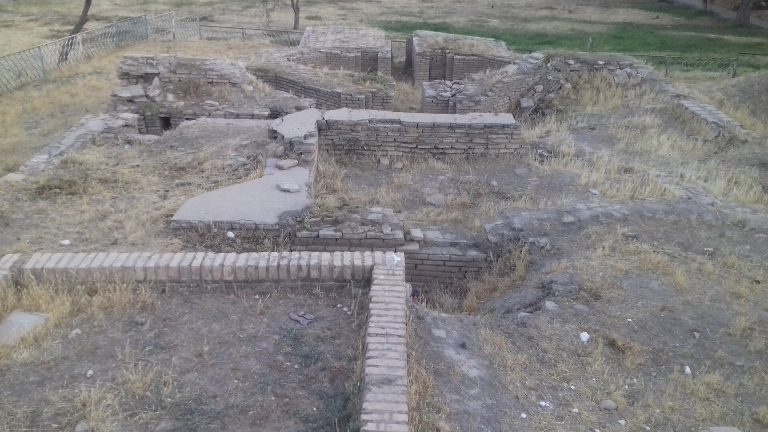
The madrasa survives through its entrance portal, wall and foundation fragments, and part of one of its four minarets. Excavations also revealed buried walls, decorative pieces, and the former courtyard layout. The courtyard walls were reconstructed after these investigations, clarifying the physical organization of the educational complex beside the mausoleum.
The khanqah contained a large domed central hall surrounded by two-storey rooms. Some rooms were residential, while others were used for storage. The eastern gallery leading to the mausoleum was built during Ulugh Beg’s period and belongs to the later eastern entrance arrangement. Large structures on the western and southern sides of the complex were begun but left unfinished, probably during the final years of Ulugh Beg’s reign.
Doors and the Blue Stone
Carved doors dating from the late fourteenth or early fifteenth century were removed from the mausoleum. Their decoration includes bone and mother-of-pearl inlay, vegetal designs, a vase, a bouquet of flowers, stars, half-crosses within square frames, and Arabic inscriptions. Surviving doors are held in collections outside the site, including the Hermitage, London, and Uzbekistan’s State Museum of Culture and History.
The former Kuk Tash, or “Blue Stone,” was a throne stone used for accession ceremonies by rulers in Samarkand from the Timurid period through the nineteenth century. After the former palace of the Bukharan emirs was demolished in the 1920s, the stone was moved several times. It was placed in the courtyard of Gur-e Amir in the 1960s.