Rukhabad Mausoleum: A Timurid Memorial in Samarkand, Uzbekistan


Site at a Glance
- Rating
- 4.4
- Popularity
- Low
- Country
- Uzbekistan
- Primary era
- Medieval
- Eras represented
- Medieval, Modern
- Civilizations
- Russian, Timurid
- Site type
- Religious
- Remains
- Tomb
On this page9 sections
History
Rukhabad Mausoleum is a fourteenth-century Timurid memorial and religious building in Samarkand, Uzbekistan, commissioned under Amir Timur, the Central Asian ruler who founded the Timurid imperial dynasty. Timur ordered its construction in 1380 over the grave associated with Sheikh Burhaneddin Klych Sagardzhi, an Islamic preacher, theologian, scholar, and mystic from Sagardzh.
Sagardzhi and the Mausoleum’s Foundation
Sagardzhi became known for spreading Islam among the nomads of Eastern Turkestan and held influence at the court of China’s Yuan dynasty, the Mongol dynasty that ruled China from the thirteenth to the fourteenth century. He reportedly married a Chinese princess, died in China, and instructed his son Abu Said to bury him in Samarkand. The date of his burial remains uncertain. The Qandia of Abu Hafsa Najmetdin Umar places it in the tenth century, while another tradition gives 1287. Many historians place it in the second half of the fourteenth century, partly because Ibn Battuta, a Moroccan traveler and chronicler, identified Sagardzhi in the 1340s as head of the Muslim mission in Beijing.
According to legend, Sagardzhi owned a copper box containing seven hairs from the beard of the Prophet Muhammad, and the box was sealed inside the mausoleum’s dome during construction. His wife, sons, and other relatives were later buried there. Soon after its completion, the building became one of Samarkand’s most revered religious monuments. Amir Timur was said to dismount whenever he passed it.
Timurid and Later Development
Timur later founded a religious center south of the mausoleum in honor of his grandson Muhammad-Sultan. The center contained a madrasa, an institution for Islamic religious and scholarly education, and a Sufi khanaka, a lodge associated with Sufi religious practice. The two sites were connected by the Shah-roh, or “Royal Avenue.” This religious center later became the Gur-e-Amir mausoleum.
The area around Rukhabad was repeatedly redeveloped. In the mid-nineteenth century, a one-story madrasa, a minaret, and a pool were built beside deteriorated earlier structures. A neighborhood mosque in a Chinese style followed in 1880–1882. Strengthening and restoration work took place in the 1950s and again in January 2016. The mausoleum is recognized as part of Uzbekistan’s tangible cultural heritage.
Remains
Central Mausoleum
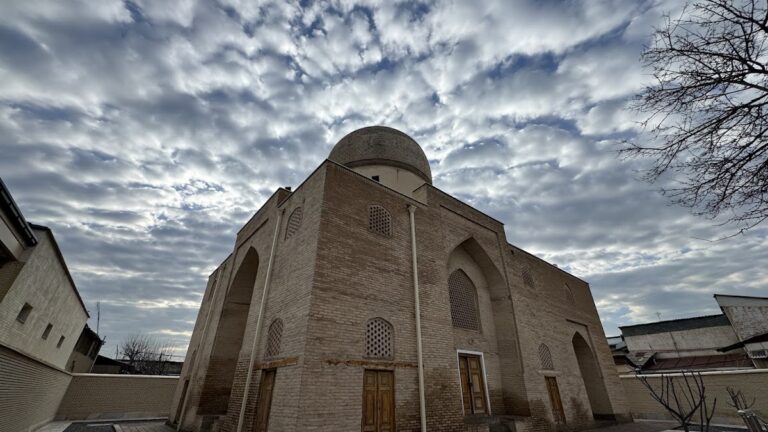
Rukhabad is a centralized, single-dome building measuring 14 by 12 meters and rising 24 meters high. Its cube-shaped lower body supports a transitional octagon formed by arched elements, above which stands a spherical-conical dome. Light windows occupy the principal axes, while three entrances open on the north, west, and south. Unlike many Timurid buildings, it has no dominant entrance portal, so all four facades have equivalent architectural status.
The exterior is deliberately austere, with fired brick providing the main surface texture. Glazed, carved terracotta tiles frame the arched entrances. Inside, a two-meter-high ceramic panel runs around the base of the walls. A narrow, interrupted strip of glazed tiles extends above it, while the remaining wall surfaces, the arched supports beneath the dome, and the dome itself are coated with alabaster.
Associated Religious Buildings
Adjacent Mosque and Minaret
The mosque beside the mausoleum was built in 1880–1882 and survives with its minaret. It formed part of the later religious complex that developed around the Timurid tomb.
Nineteenth-Century Madrasa
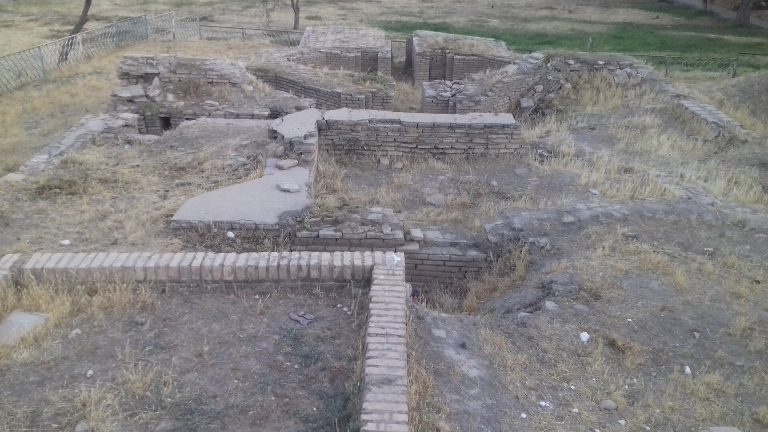
Surviving elements of the one-story madrasa include its portal entrance with a pointed arch, the small ornamental turret structures known as guldastas that flank the portal, and additional structures at the gate.
Pool
The surrounding complex also included a hauz, a constructed water basin or pool.