Aghaboe Priory: An Early Christian and Medieval Religious Centre in Ireland


Site at a Glance
- Rating
- 4.5
- Popularity
- Low
- Country
- Ireland
- Primary era
- Medieval
- External website
- Open
- Eras represented
- Medieval
- Civilizations
- Norman
- Site type
- Religious
- Remains
- Church
On this page9 sections
History
Aghaboe Priory is a historic religious site in Aghaboe, Ireland, whose origins are traditionally placed around 560 in the early Christian period, when Cainnech founded a monastery in the kingdom of Ossory. Cainnech, commonly known as Saint Canice, was its abbot when he died in 598. The name Aghaboe derives from Achadh Bó, interpreted as “little field of the cow.” The monastery later became a major centre of learning, commerce, and agriculture.
The early monastery
The importance of Aghaboe is reflected in annal entries naming its abbots from the seventh century into the early twelfth century. One such abbot, Scandlán, grandson of Tadc, died in 782. Another prominent churchman was Fergil, also called Feargal or Virgilius. An Irish scholar associated with geometry and astronomy, he later left Ireland and became bishop of Salzburg. He was canonized in 1233.
Viking attacks struck Aghaboe in 845 and 913. The monastery also suffered destruction by fire during the medieval period. Its religious foundation was rebuilt in 1234 as an Augustinian priory, whose canons followed the Rule of Saint Augustine and commonly served in churches and priories.
Ossory and the medieval transition
Aghaboe was closely connected with the ecclesiastical administration of Ossory, a medieval Irish kingdom and later bishopric covering parts of present-day Laois and Kilkenny. One traditional reconstruction places the bishop’s principal seat at Aghaboe from about 1052 to 1111 and again from 1152 to 1190, before Bishop Felix O’Dulany transferred it finally to Kilkenny. Another interpretation places the see at Kilkenny from the beginning and attributes the belief in an earlier move to Aghaboe to a later misreading of a thirteenth-century property transfer.
The Synod of Rathbreasail in 1111 included both Aghaboe and Kilkenny in the Diocese of Ossory, with Kilkenny as the episcopal seat. A daughter house of Aghaboe was later established at Kilkenny, where its abbey church became St Canice’s Cathedral.
After the Anglo-Norman invasion of Ireland began in 1169, Strongbow granted parts of Aghaboe’s lands as a fief to Adam de Hereford in return for five knights. Ossory subsequently came under the authority of the Marshals. The MacGillapatrick family withdrew to northern Ossory around Aghaboe and became their vassals. Under the Marshals, the house was rebuilt for Augustinian canons in 1234 and served as a parish church. English settlers helped Aghaboe develop into a small town.
Destruction and new religious foundations
On 5 May 1346, Dermot MacGillapatrick, supported by the Uí Céarbhail, attacked and burned Aghaboe, including its town, cemetery, and church. The shrine and relics of Saint Canice were destroyed in the assault. The attack took place during conflict with Norman fortifications built beside the abbey and was probably directed at that military context rather than at the abbey itself. MacGillapatrick control of the castle was complete by 1359.
A Dominican house was founded at Aghaboe in 1382 under MacGillapatrick patronage. The Dominicans were a mendicant order devoted to preaching and religious study. This foundation marked a change from religious houses established largely under English rule to one founded under Irish patronage. Its priors included many Irish members, among them people from ruling families of neighbouring territories and from Connacht and Munster. The community probably numbered about 12 to 15 friars.
Suppression and later preservation
The Dominican priory was suppressed in 1540 during the Reformation, the sixteenth-century religious and institutional upheaval that led to the dissolution of many religious houses in Ireland under English rule. In 1541 its buildings and lands were valued at 50 shillings and 10 pence. The former monastery and parish property passed to Florence Fitzpatrick in 1601.
The friars tried to continue their activities locally after the suppression, but Aghaboe was not included in the list of Irish Dominican houses compiled during the mastership of Seraphinus Cavalli. In 1635, Bishop David Rothe of Ossory described the priory as either ruined or in secular use.
By the twentieth century, bushes and ivy heavily covered the ruins. A community initiative cleared and repaired the site during the 1980s, and the work received an award in the nationwide Competition for Community Achievement in March 1989. Aghaboe retains a heritage and pilgrimage association for members of the Fitzpatrick–Mac Giolla Phádraig Clan Society. Both the civil parish and the Roman Catholic parish take their names from the priory, although their boundaries differ substantially.
Remains
The former monastery stands on gently undulating ground that falls northward. At the time of its foundation, the site lay beside the Slige Dála, a major early Irish route between Tara and Limerick, with connections toward Roscrea, Clonenagh, the monastery of Monaicha, and Clonfert Molua. The surviving medieval complex is centred on the church remains, with Norman fortifications visible beside the abbey.
Church remains
The medieval church survives principally in its nave and southern transept. Only the foundations of the nave’s north wall remain, while the former monastic residential buildings that stood north of the church have disappeared. Gothic-tracery windows remain along the southern side of the nave and in the eastern wall of the transept. The east wall also contains a finely carved three-light window, preserving an important part of the church’s medieval architectural character.
Windows and later alterations
Some of the Gothic windows were removed in 1773 for Frederick Trench’s private garden at Ballinakill, where they remain. The relationship between the surviving church and the Dominican foundation of 1382 is uncertain. The Dominican priory may have occupied the earlier monastery’s ground, or that location may have been occupied by the parish church, which was later replaced by an Anglican church built in 1818.
Fortifications and cleared ruins
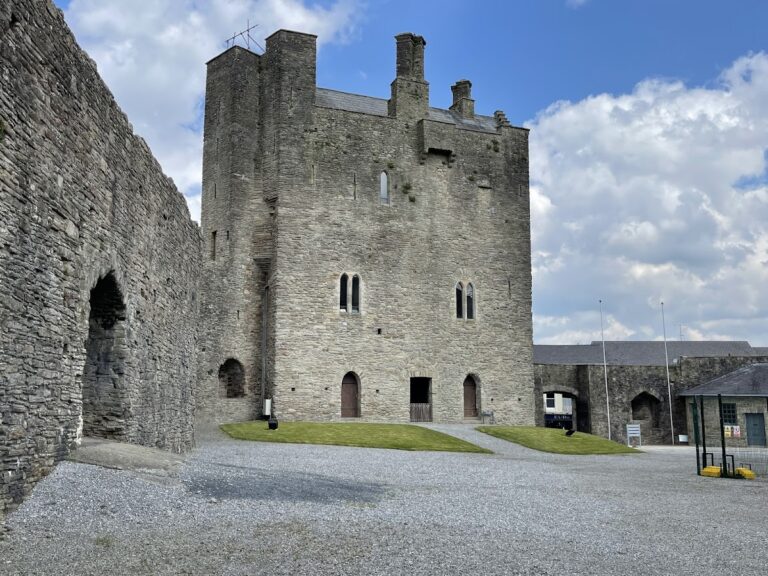
Norman fortifications constructed beside the abbey during the medieval conflicts remain visible. Their presence formed part of the setting for the fighting that culminated in the burning of Aghaboe in 1346. The ruins were formerly obscured by dense bushes and ivy, but the community-led clearance and repair campaign of the 1980s brought the surviving remains into clearer physical form.