St. Florian Monastery: An Augustinian Baroque Monastery in Austria


Site at a Glance
- Rating
- 4.8
- Popularity
- Medium
- Country
- Austria
- Primary era
- Early Modern
- External website
- Open
- Eras represented
- Medieval, Early Modern
- Civilizations
- Habsburg, Holy Roman Empire
- Site type
- Religious
- Remains
- Monastery
On this page20 sections
History
St. Florian Monastery is an Augustinian Canons’ monastery in Sankt Florian, Austria, whose present monumental Baroque form was created through rebuilding between 1686 and 1751. The first written evidence of a monastic complex dates to 819, during the Carolingian period, while the community has followed the Rule of Saint Augustine since 1071.
Origins and early veneration
The monastery is associated with Saint Florian, a Christian martyr traditionally connected with Upper Austria. Florian had served in the civil administration of the Roman Empire before being tortured and thrown into the Enns during the persecution under Emperor Diocletian. The ninth-century Passio Floriani states that he was buried at this place in 304. This supports the possibility of a Christian veneration tradition from the fourth century, although the origins of the monastery itself are not documented.
Before 1071, St. Florian was a house of secular canons. In that year, Bishop Altmann of Passau introduced the Rule of Saint Augustine. Augustinian Canons are priests who combine communal religious life with pastoral ministry. The community thereafter undertook both monastic and pastoral duties, and the monastery now serves 33 incorporated parishes.
The medieval monastery
The earliest recorded church building dates from the late eleventh century. A fire destroyed it in 1235, leading to reconstruction. A monastery chronicle records dedications of the Holy Spirit Chapel in 1235, the Michael Chapel in 1258, the Mary and Catherine Chapel in 1269, and the Saint John Chapel in the town in 1285. The rebuilt church was consecrated in 1291.
St. Florian also developed as a centre of learning and administration. Between 1140 and 1150, its scriptorium, a workshop for copying and illuminating manuscripts, produced the St. Florian Giant Bible, an important work of Romanesque illumination. The monastery acquired the Wachau mother parish of St. Michael and its branches in 1162, followed by additional properties and vineyards in 1258.
In the mid-thirteenth century, the provost, the head of the collegiate monastery, served as the Passau archdeacon of Lorch. St. Florian consequently became a centre of ecclesiastical administration in what is now Upper Austria and participated in the formation of the territory above the Enns under King Ottokar Přemysl. In 1256, Ottokar’s land recorder Witiko of Prčice and Blankenberg was murdered during a dispute in the monastery’s refectory.
Conflict and protection
During the conflicts of 1477 to 1487, valuables, grain, and wine belonging to the monastery were transferred to the city of Enns for safekeeping. The action took place amid pressure on Emperor Frederick III from Matthias Corvinus, the Hungarian king, and repeated plundering by the Liechtenstein family of Steyregg, who supported Corvinus. Enns repeatedly refused to return the stored goods.
Baroque rebuilding
Emperor Leopold I made a thanksgiving pilgrimage to Saint Florian’s memorial site in 1684 after the Second Siege of Vienna, a major Ottoman assault that ended with the relief of the city. The pilgrimage is regarded as the impetus for rebuilding the monastery church and, subsequently, the wider monastic complex.
Work began in 1686 on the plan of the earlier church, incorporating surviving medieval walls. Carlo Antonio Carlone directed the project until his death in 1708, completing the church and almost the entire west wing. Jakob Prandtauer then continued the rebuilding with modifications and additions. After Prandtauer’s death in 1726, the convent wing was completed according to his design under Jakob Steinhuber and his son Michael. The complex was completed in 1751.
Scholarship and music
During the nineteenth century, St. Florian became a centre of historical research in Upper Austria, associated especially with Franz Xaver Pritz and Jodocus Stülz. Anton Bruckner, the Austrian Romantic composer, organist, and church musician, served as monastery organist from 1848 to 1855. He was later buried beneath the basilica’s organ.
The St. Florian Boys Choir has roots extending to 1071 and traditionally provided music for worship at the monastery. Its activities later expanded to opera performances, international concert tours, and recordings. A men’s choir was established in 1989. The choir’s long connection with St. Florian also formed part of Bruckner’s early musical life, and the annual St. Florian Bruckner Days have continued this association since 1997.
War, recovery, and continuing use
In January 1941, the Gestapo, the secret state police of Nazi Germany, confiscated and expropriated the monastery. The canons and Provost Vinzenz Hartl were expelled, and the community was forced to continue its religious life at Pulgarn near Steyregg. From 1942, the Reich Radio Society, the broadcasting institution of the Third Reich, operated from the monastery under its director Heinrich Glasmeier. The canons returned after the Second World War.
The library, manuscripts, and historical collections have supported the monastery’s continuing scholarly importance. Works restored after the war by Eleonore Klee form part of this preservation history. Since 1984, part of the former Baroque monastery dairy has housed the Upper Austrian Fire Brigade Museum, also known as the Historical Fire Brigade Equipment Museum. The monastery and basilica are protected as historic monuments, and Pope John Paul II elevated the church to a basilica minor, a church with a special papal designation, in 1999. St. Florian belongs to the Austrian Congregation of Augustinian Canons; 23 canons belonged to the monastery in January 2025, and Klaus Sonnleitner has served as its 58th provost since 6 February 2025.
Remains
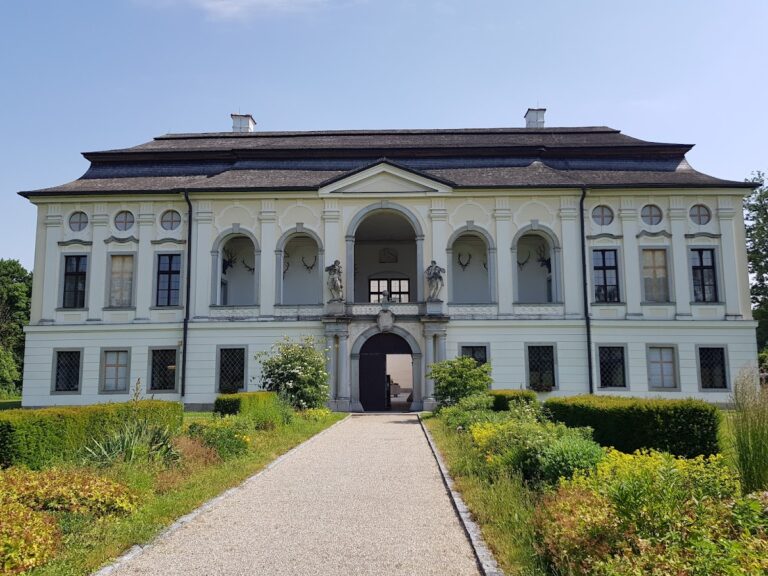
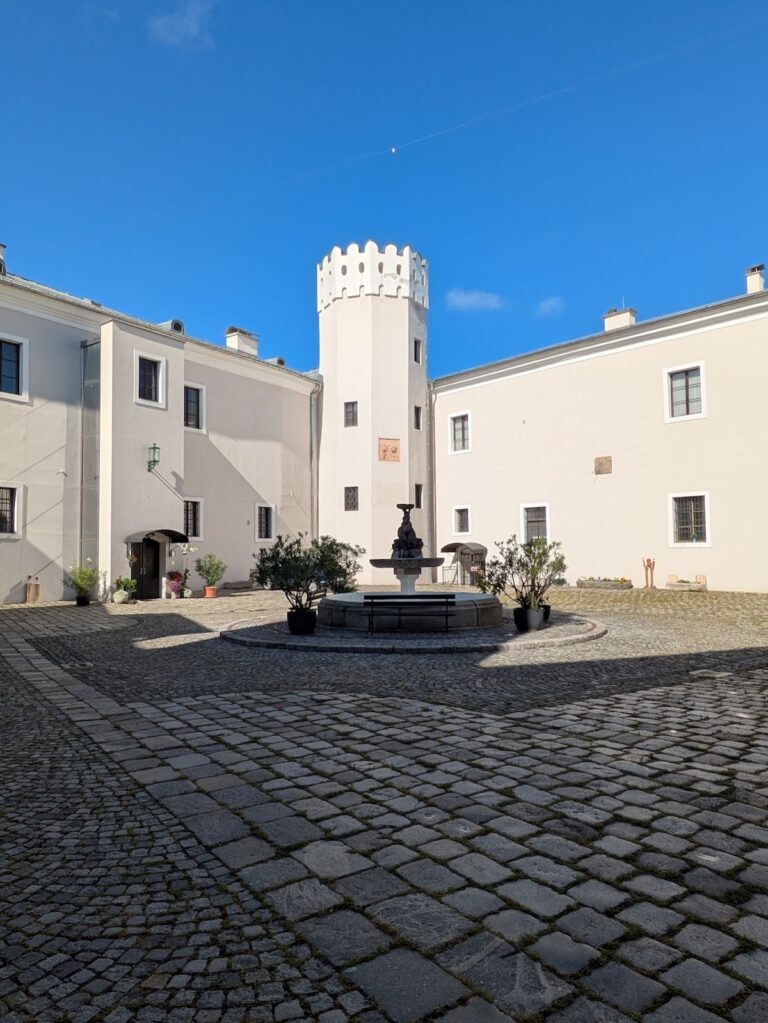
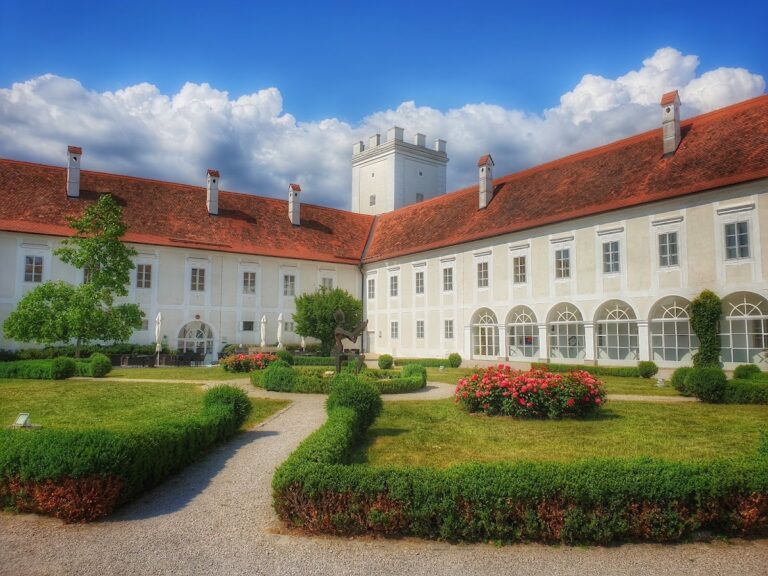
St. Florian survives as a monumental Baroque complex arranged around courtyards and incorporating medieval walls. Its compact main facade extends for about 214 metres. Two church towers rise above the church, while a third tower surmounts the monumental entrance. The former monastery dairy is arranged as a double four-sided courtyard, whose main courtyard contains a fountain dated 1757 and an ironwork well.
Monastery buildings and interiors
West wing
The west wing contains central work by Carlo Antonio Carlone and Jakob Prandtauer. Its principal features include a grand double-flight staircase and a portal extending through three storeys. These elements belong to the Baroque rebuilding that reshaped the earlier monastic complex while preserving its asymmetrical plan.
South and east wings
The south wing projects outward as a pavilion containing the Marble Hall. The east wing was built between 1744 and 1751 under Johann Gotthard Hayberger’s direction and contains the library. The Marble Hall measures 30 metres in length, 15 metres in width, and 15 metres in height, occupying the second and third storeys at the centre of the south wing. Prandtauer designed it in 1718, while Leonhard Sattler created the sculptural and ornamental decoration on the courtyard facade in 1723 and 1724.
Bartolomeo Altomonte’s ceiling painting in the Marble Hall celebrates Austrian and Hungarian victories over the Turks and the blessings of peace. Ippolito Sconzani painted the architectural illusionism in 1724, and Franz Josef Ignaz Holzinger carried out the stucco and imitation-marble work between 1724 and 1727.
Library
The principal library hall was built between 1744 and 1751. It is a late Baroque interior with bookshelves, a gallery, and doors made by regional craftsmen. Daniel Gran supplied the overall design, Antonio Tassi created the illusionistic architectural painting, and Bartolomeo Altomonte painted the ceiling figures for The Union of Virtue and Science in 1747.
The library contains approximately 150,000 volumes, including medieval manuscripts and early printed books. Its holdings include the St. Florian Giant Bible from about 1140 to 1150, a cartulary from 1276 to 1279 containing copies of charters and other legal documents, fifteenth-century copies of the Life of Wilbirg, and the Dedication Chronicle, probably compiled around 1300. The chronicle has 51 parchment leaves, approximately 100 consecration documents and indulgence letters dating from the late eleventh century to 1517, and copies of documents from 1250 to 1338. Its final section was probably joined to the rest around 1600.
The St. Florian Psalter, an illuminated manuscript containing the Psalms in Latin, German, and Polish, was found in the monastery in 1827 by librarian Josef Chmel. It remained in the monastery library until 1931 and is now held by the National Library of Poland.
Art collections and guest rooms
The art collections include two larger-than-life fourteenth-century statues of Saint Florian, stained glass, Baroque and contemporary paintings, works on paper, and works by artists associated with the Danube School. Albrecht Altdorfer’s Gothic Sebastian Altarpiece includes painted scenes of Christ’s Passion, the martyrdom of Saint Sebastian, and the recovery of his body.
Sixteen imperial and guest rooms retain eighteenth-century furnishings and furniture made by Upper Austrian artists and craftsmen. Among them are the Prince Eugene Room, the Faistenberger Room, and the Hunting Room. Their decoration includes door-top statues, candle holders, bedposts, wall paintings, landscapes, scenes of the Turkish wars, hunting imagery, stucco, and Brussels tapestries.
Basilica and furnishings
The church is dedicated to the Assumption of Mary and serves as both a parish church and a basilica minor. Its Baroque interior is organized by projecting half-columns, capitals, and strongly articulated horizontal members. Painted ceiling architecture continues the column motif and frames scenes from the life of Saint Florian in the nave and the Coronation of Mary in the choir. Johann Anton Gumpp and Melchior Steidl painted the frescoes between 1690 and 1695.
High altar and choir
The high altar is made of red Untersberg marble and was produced by Johann Baptist Colomba between 1683 and 1690. Giuseppe Ghezzi painted its altarpiece, The Assumption of Mary, in 1687, and Johann Jakob Sattler made the tabernacle in 1769. Adam Franz created the richly carved choir stalls in 1690 and 1691, with figures of the four Church Fathers by Jakob Auer. Two choir organs in elaborately carved cases are incorporated into the associated music galleries.
Side altars and nave furnishings
Four niches on each side of the church contain the Mary Magdalene, Barbara, Guardian Angel, Saint Anne, Augustinian, Florian, Cross, and Sacrament Altars. Their paintings and sculptures were produced by artists including Giovanni Antonio Daria, Andrea Celesti, Wenzel Halbax, Giovanni Battista Bianco, Michael Willmann, Leonhard Sattler, Johann Michael Rottmayr, Leopold Schulz, and Peter Strudel.
The pulpit has a black-marble body and a linden-wood sounding board, with sculptural decoration made by Josef Ressler in 1755. The church benches date from 1694 or later and were made by Stephan Jegg. Hans Meßner made the screen separating the vestibule from the nave in 1698. Behind it stands Herbert Friedl’s 1997 monument to the anchoress Wilbirg, together with a papal coat of arms by Klaus Wedenig commemorating the church’s elevation to a basilica minor.
Crypt, organs, and bells
Crypt
The crypt beneath the nave consists of an antechamber and a main chamber with groin vaults, ceilings formed by intersecting curved surfaces, supported by Tuscan columns. It contains gravestones and metal sarcophagi of provosts, the tomb of Queen Catherine of Poland, monuments to the Starhemberg, Volkenstorf, and Englhofer families, and the stone coffin of Wilbirg. The western end is an ossuary, a place for storing human bones. Beneath the organ stands Anton Bruckner’s sarcophagus, made by A. M. Beschorner and inscribed Non confundar in aeternum.
Bruckner Organ
Franz Xaver Krismann built the Bruckner Organ between 1770 and 1774. In its present form it has 103 stops and 7,386 pipes, with four manuals, electric action, reconstructed Krismann stops, and additional trumpet and regal divisions. Johann Christian Jegg made its late Baroque case. The instrument was altered repeatedly, including major changes by Matthäus Mauracher in 1873, electropneumatic conversion and expansion in 1932, partial restoration toward Krismann’s design by Wilhelm Zika in 1951, and restoration by the Upper Austrian Organ-Building Institution Kögler in 1996.
Choir organ and bells
The choir organ is divided between both sides of the presbytery. Its cases date from 1691 and contain a 1931 instrument by the Mauracher brothers with 43 stops.
Twelve bells are distributed between the two west towers, while the Great Bell is mounted separately in the northwest tower. The seven largest bells form the main peal. Several fourteenth-century bells, including the Twelve, Eleven, Six, and First Choir Bell, were cast in a St. Florian foundry and are dated 1318 and 1319. An eight-bell secondary peal in the oratory follows a C-major scale and bears the invocation and seven petitions of the Lord’s Prayer.