Maubuisson Abbey: A Cistercian Royal Nunnery in France


Site at a Glance
- Rating
- 4.4
- Popularity
- Low
- Country
- France
- Primary era
- Medieval
- External website
- Open
- Eras represented
- Medieval, Early Modern
- Civilizations
- French
- Site type
- Religious
- Remains
- Monastery
On this page17 sections
History
Maubuisson Abbey is a former Cistercian nunnery for women in France, founded by Blanche of Castile at Saint-Ouen-l’Aumône in the thirteenth century. Blanche began establishing it in 1234, and its foundation is also dated to 1236. Built in the Cistercian tradition, the abbey stood on the left bank of the Oise opposite Pontoise, between Saint-Ouen and Épluches, near Blanche’s castle and the confluence of the Oise and the Liesse stream.
Foundation and royal role
The abbey’s enclosure covered 32 hectares. Blanche appealed to the Cistercian general chapter, the order’s central governing assembly, in 1237, and construction was under way by 1241. In 1242 she installed nuns from Saint-Antoine near Paris, even though the buildings were still scarcely finished. Maubuisson became attached to the Cistercian Order in 1244.
Blanche formally named the institution Notre-Dame-la-Royale in honour of the Virgin Mary, regarded as the patron saint of the Kingdom of France. Maubuisson became the established name. An explanation connecting the name with a woodland associated with brigands, and translating it as “cursed bush,” remains unconfirmed.
Royal protection gave the abbey an important place in the surrounding economy. It provided a retreat for young women from noble families, accommodated members of the royal household, and served as a royal necropolis, a burial place associated with a ruling family. Its financial resources helped it endure the Hundred Years’ War, the long conflict between the English and French crowns and their allies.
Royal events and medieval burials
In September 1307, Philip IV used Maubuisson as the place from which the order to arrest the Knights Templar was issued on 14 September, the feast of the Exaltation of the Holy Cross. In April 1314, the mutilated bodies of Gauthier d’Aunay and his brother Philippe were dragged through the abbey’s meadow. Blanche of Burgundy, detained at Château-Gaillard for ten years after the Tour de Nesle affair, was permitted to retire to Maubuisson in 1324 and died there soon afterward.
The abbey church served as a royal and aristocratic burial place until the end of the fifteenth century, as well as a cemetery for abbesses. Those buried there included Blanche of Castile, who died in 1252; Robert II of Artois in 1302; Blanche of Burgundy in 1326; Mahaut of Artois in 1329; Bonne of Luxembourg in 1349; and Jeanne of France in 1390. Entrails of Alphonse of Poitiers, Charles IV of France, and Jeanne d’Évreux were also interred there. Gabrielle d’Estrées and her child were buried in the nuns’ choir in April 1599.
Maubuisson’s first abbess, Guillemette I, governed for nearly thirty years and was later called “Saint Guillemette.” Her parentage, including claims that she was related to Louis IX and Blanche of Castile, is uncertain. She was credited with conversions and miracles during and after her life.
Early modern reform and decline
Louis XI stayed at nearby Pontoise from 5 to 8 September 1463 and granted the abbey special royal protection by letters patent, renewing it in December 1474. At the beginning of the sixteenth century, Abbess Antoinette de Dinteville sponsored new building wings while the community numbered 120 nuns. Protestant troops pillaged the abbey and its dependencies in 1566 and 1588 during the French Wars of Religion, a series of conflicts between Catholics and Protestants in France.
Henri IV appointed Angélique d’Estrées, sister of Gabrielle d’Estrées, as mother abbess in 1597. Discipline had diverged from the Rule of Saint Benedict, the medieval code governing monastic prayer, work, obedience, and communal life. In 1618, the Cistercian vicar general ordered Angélique Arnauld to leave Port-Royal des Champs and reform Maubuisson. With the intervention of the Parlement of Paris, she was restored as abbess after opposing chaplains and supporters were removed. François de Sales visited her several times.
Angélique Arnauld was later replaced by Madame de Soissons, who died in 1627. Marie Suireau, known as Marie des Anges, led the abbey until 1648. From 1628 she opposed Molinism, a theological position concerning divine grace and human freedom, among some nuns. The expulsion of two suspected nuns was followed by an asserted return to Cistercian orthodoxy. Louise Hollandine of the Palatinate, daughter of Frederick V of the Palatinate and aunt of Elizabeth Charlotte of Bavaria, also served as abbess. On 27 April 1769, Archbishop Christophe de Beaumont, Duke of Saint-Cloud, visited to reconcile the abbess and the nuns.
The community declined during the eighteenth century, from 70 nuns in 1720 to 18 in 1780. Louis XVI ordered the abbey closed in 1786, and the French Revolution definitively ended its religious function. Before the Revolution, the abbess received approximately 5,000 livres in annual income.
Later uses and preservation
The former abbey became a military hospital in 1793. After buildings were demolished, the site was used as a stone quarry in the early nineteenth century. Usable surviving buildings later served as a textile mill and a farm.
The surviving buildings became property of the Val-d’Oise departmental council in 1979. Archaeological excavations continued for two years and ended in 1981, followed by major restoration work, including renewal of the tithe-barn tower roof between 1988 and 1990. Maubuisson was registered as a French historic monument in 1926 and 1945, then classified in 1947.
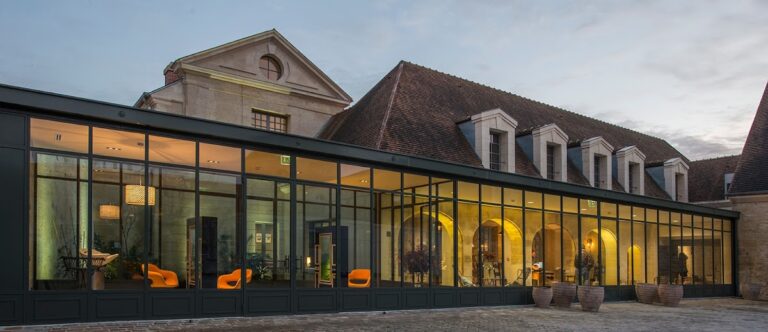
Since 2001, the former abbey has housed a contemporary art centre. It presents contemporary visual and plastic arts and develops research, production, and public programmes focused on architectural heritage, contemporary creation, and the natural environment. The centre also belongs to Tram, a network of contemporary-art institutions in Île-de-France. The site was used for filming sequences about Blanche of Castile in 2018.
Evidence of lead exposure
The bones of nuns buried at Maubuisson over approximately four centuries, from the fourteenth to the eighteenth century, contain unusually high levels of lead. Some measurements approached thresholds considered lethal today. Two major increases appear, one beginning in the late Middle Ages and reaching a maximum in the late fifteenth and early sixteenth centuries, and another beginning in the early eighteenth century. Eighteenth-century levels reached about fifteen times the French twelfth-century average.
Possible contributors included the abbey’s social composition, diet, water system, ceramics, cosmetics, and wine. An early fourteenth-century dump contained about 77 percent lead-glazed, highly decorated ceramics, probably reflecting the elevated social status of many nuns. The original water system included short sections of lead pipe, while the entire network was replaced with lead pipes in 1772. The plumbing alone could not explain contamination that was already present much earlier. Glazed floor tiles, roof tiles, and reused tile fragments have also been considered possible sources of lead exposure.
Remains
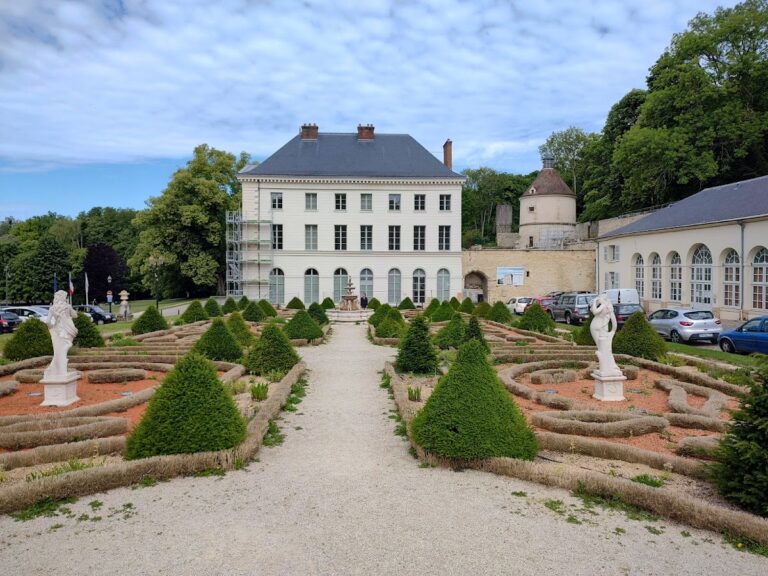
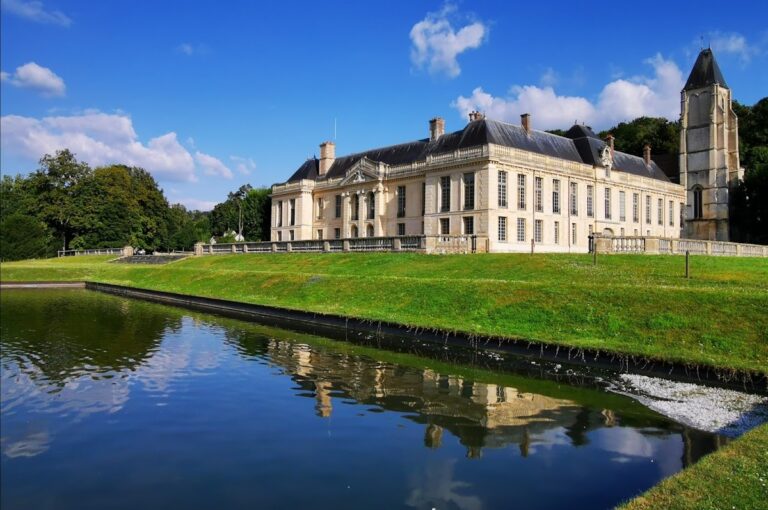
The surviving complex preserves parts of a Cistercian monastic layout, including the former chapter-house and refectory area, sacristy, parlour, nuns’ room, latrine building, and service structures. The cloister was arranged beside the abbey church, chapter house, dormitory, heated room, kitchen, and refectory. The surviving buildings and archaeological evidence together show the organization of a large enclosed religious community.
Church and burial areas
Abbey church
The abbey church, Notre-Dame-la-Royale, was described by Noël Taillepied in 1584 as exceptionally tall. It had two wings and a small bell tower that replaced a larger tower destroyed by a lightning-caused fire in 1540. Grilles and woodwork separated the nuns’ enclosure from the church. Jeanne d’Évreux donated a white-marble altarpiece for the high altar in 1340. The altarpiece was dismantled during the Revolution, while its central relief of the Last Supper is preserved at Saint-Joseph-des-Carmes church in Paris.
Burial spaces and sculpture
The church contained five principal burial areas. Royal and high-status burials occupied the main aristocratic area, while the nuns’ choir included the burials of Blanche of Burgundy, Charles IV, Mahaut of Artois, and Bonne of Luxembourg. A smaller winter choir held further burials, including that of the abbess Blanche de Brienne d’Eu. Another area served female officers of noble and bourgeois origin and contained Guillemette I’s modest tomb and epitaph. Lay sisters and boarders had their own burial area, while the nuns’ cemetery stood at the foot of the apse before its use gave way to the cloister gallery in the seventeenth century.
A small church southwest of the abbey church’s apse had a cemetery for benefactors, laypeople, priests, and other servants of the abbey and its nuns. The royal chaplain Abbé Grassis was buried there on 25 October 1766. The recumbent effigies, sculpted figures showing the deceased lying on a tomb, of Charles IV and Jeanne d’Évreux were made by Jean de Liège and are now preserved at the Louvre in Paris. Excavations in 1907 near Blanche of Castile’s burial place revealed numerous precious objects that later disappeared under unexplained circumstances.
Opening reliquary
Near the high altar stood a 140-centimetre-high Madonna and Child reliquary. This fourteenth-century walnut sculpture was painted and gilded. The seated Virgin holds the infant Jesus on one knee, and the figure opens to reveal a three-part hollow devotional scene. Its compartments, divided by small wooden columns, represented Paradise, Hell, Purgatory, and scenes from the Old and New Testaments. Figures of the Twelve Apostles around the Calvary were restored around 1840. The nuns entrusted the sculpture to their gardener in 1792, and it was transferred to Saint-Ouen church at Saint-Ouen-l’Aumône in 1839. Classified in 1897, it was stolen on 13 April 1973.
Conventual and service buildings
Chapter house and parlour
The chapter house was the daily meeting room of the professed nuns, who had formally taken religious vows. Under the abbess or her deputy, they heard a chapter of the Rule of Saint Benedict read aloud, received commentary, and handled communal business such as purchases, sales, and contracts. The parlour was the one room where conversation was permitted under the mother abbess’s direction, and discussion was limited to material and spiritual matters concerning the community.
Water system
Maubuisson’s medieval hydraulic system brought drinking water through an aqueduct from a source about 2 kilometres upstream of the Liesse stream. Dikes formed four ponds that maintained the level of a stone-walled canal. The canal remains visible in the park, where it powered a mill and carried away wastewater and drainage from the latrines.
Latrine building
The latrines stood above a drainage channel and contained 38 wooden seats arranged beside one another. Their openings are now glazed. The room was covered by 20 arches rising 14 metres high, making it one of the most distinctive surviving service structures in the complex.
Medieval monastic barn
The thirteenth-century monastic barn is traditionally, but inaccurately, called the tithe barn. It is the principal preserved building after the sacristy, chapter house, parlour, nuns’ room, and latrine building. The barn retains its original roof structure, and its tower roof was restored between 1988 and 1990.
Decorative materials
The abbey’s floors were laid with yellow and green lead-glazed tiles. During the thirteenth century, the lower thirds of the roof tiles were also covered with yellow or green glaze. Once assembled, these tiles produced a polychrome lattice pattern. The glazed surfaces and reused tile fragments form part of the material evidence considered in interpreting the unusually high lead levels found in the nuns’ bones.
Nearby sites