Pannonhalma Archabbey: Hungary’s First Benedictine Monastery


Site at a Glance
- Rating
- 4.7
- Popularity
- Medium
- Country
- Hungary
- Primary era
- Medieval
- External website
- Open
- Eras represented
- Medieval, Early Modern, Modern
- Civilizations
- Habsburg, Hungarian
- Site type
- Religious
- Remains
- Monastery
On this page23 sections
History
Pannonhalma Archabbey is a Benedictine monastery in Pannonhalma, Hungary, founded in 996 by Prince Géza as the first Hungarian Benedictine monastery and later centred on an early Gothic basilica. Established in honour of Saint Martin of Tours, a fourth-century Christian bishop and monastic patron, it became the mother house of the Hungarian Benedictine order. The first monks arrived from the Bohemian Abbey of Breunau, whose community had recently been settled from Niederaltaich.
Foundation and royal patronage
King Stephen I strengthened the monastery in 1001 and 1002 by granting it estates and privileges. He placed Pannonhalma directly under the authority of the Holy See in Rome and required the monks to pray for his salvation and for the stability of the kingdom. The abbey has retained this immediate status, and its monks continue the daily prayer pro stabilitate regni, meaning for the stability of the country.
The foundation was closely connected with the tradition that Saint Martin had been born near the hill. The nearby Roman settlement of Sabaria, which disappeared during the Migration Period, formed part of this tradition, although the identification of the saint’s birthplace remains disputed because modern Szombathely also bore the Roman name Savaria. The hill was formerly associated with Saint Martin, while the name Pannonhalma was introduced in 1823 by the language reformer Ferenc Kazinczy. He derived it from Mons Sacer Pannoniae, or “Holy Mountain of Pannonia,” the name used in the foundation charter.
Abbot Astrik, also known as Anastasius, is regarded as the community’s first abbot. Saint Maurus studied at Pannonhalma after 1010 and became abbot in 1034, before being appointed bishop of Pécs in 1036. The monastery also became a setting for royal and national affairs. In 1078 King Ladislaus I summoned the Hungarian nobility there, and the decisions reached at the meeting entered his Second Law Book. A charter from 1093 described the monastery’s considerable wealth and listed about two hundred books in its library. In 1097 King Coloman received Godfrey of Bouillon, leader of the First Crusade, at Mount Saint Martin while negotiating the army’s safe passage through Hungary.
Medieval rebuilding and the age of Uros
The first monastic buildings were destroyed and rebuilt in 1137. The early stone church from the foundation period had been consecrated in 1001, while a second church was consecrated in 1137 under Abbot Dávid. The surviving early Gothic basilica was built during the abbacy of Uros, who governed from 1207 to 1243, largely on the walls of the earlier church. It was probably consecrated in 1224.
Uros expanded the monastery’s estates and strengthened its legal position. He had eighty important charters copied into the Liber Ruber, travelled to Rome five times, accompanied King Andrew II on the Fifth Crusade, and successfully defended Pannonhalma during the Mongol invasion. His tenure established much of the institutional and architectural framework that continued to shape the abbey.
Pannonhalma became an archabbey in 1541. An archabbey is a principal Benedictine abbey whose abbot holds the rank of archabbot. It also became a Territorial Abbey, an autonomous ecclesiastical jurisdiction governed by an abbot rather than by a diocesan bishop. Pannonhalma remains the seat of the Hungarian Benedictine Congregation.
Gothic reconstruction and Ottoman warfare
King Matthias Corvinus claimed the abbey in 1472 and initiated the Gothic reconstruction of the cloister. The work was probably completed in 1486. During the Renaissance the monastery was sparsely populated, with no more than six or seven monks.
The Ottoman wars transformed Pannonhalma into a frontier fortress. Ottoman forces captured Mount Saint Martin in 1594 during their campaign against Győr, but an imperial army expelled them in 1598. The occupation caused repeated departures by the monks and extensive damage to the complex.
Ten monks resettled the devastated monastery in 1639 under Abbot Mátyás Pálffy, who had come from the Cistercian abbey of Heiligenkreuz. A renewed Ottoman advance in 1683 brought further destruction through siege, fire, and an earthquake. The church survived comparatively well, but reconstruction of the monastic buildings was delayed by financial difficulties, depopulation, and the abandonment of the abbey’s estates. The surrounding villages had to be resettled and the local economy restored before large-scale rebuilding could proceed.
Baroque rebuilding and suppression
Under Archabbot Egyed Karner, who served from 1699 to 1708, the community celebrated its seven-hundredth anniversary. Karner renovated the Porta Speciosa and redesigned the staircase leading to the lower church in forms resembling the Romanesque style. These historically imitative works are described as unique within Hungarian Baroque architecture.
Abbot Celesztin Göncz began building the Our Lady Chapel and its crypt in 1714. The Rákóczi uprising against Habsburg rule interrupted the work, and major Baroque reconstruction continued under Archabbot Benedek Sajghó, who served from 1722 to 1768. Göncz was the first monk buried in the chapel crypt, which remains the final burial place of the monks.
Emperor Joseph II dissolved Pannonhalma in 1786, along with Hungary’s other Benedictine monasteries. The order was restored in 1802 and was assigned an important educational role. Pannonhalma subsequently developed one of Hungary’s most prominent boarding schools.
Education, historicist renovation, and modern political change
The library and tower formed part of the complex’s largely Classical appearance by 1832. Between 1868 and 1886 Ferenc Storno carried out major historicist renovations in the church and cloister, replacing Baroque and Classical furnishings with Neo-Gothic elements. Many of Storno’s interventions were removed during renovation in the early 1960s.
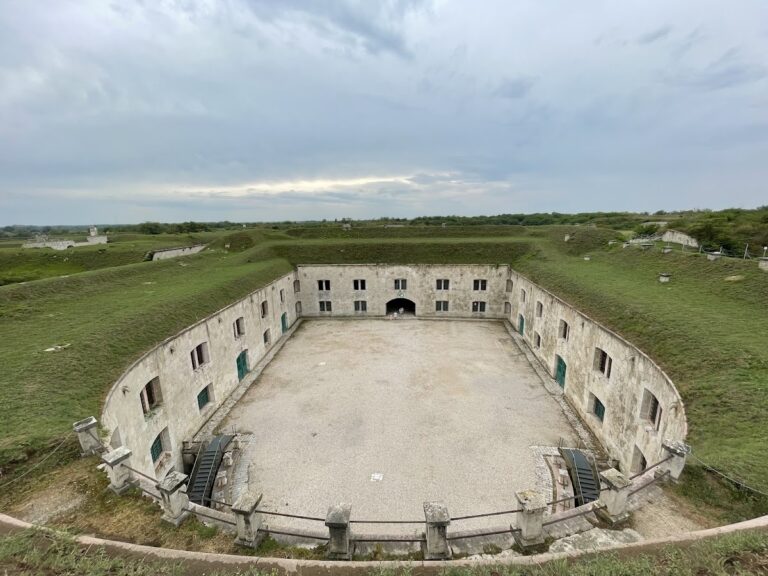
A Benedictine teacher-training institution operated at Pannonhalma from 1884 until the state nationalized the schools in 1948. During this period it could conduct examinations and issue appointment documents for trainee teachers. In 1938 the Hungarian government decided to establish an Italian-oriented secondary school with boarding facilities at Pannonhalma. The school opened in 1939, when construction also began on the school and boarding complex, including a new entrance and the Hóman Bastion.
After 1945 the Hungarian state nationalized the monasteries. In 1950 the Communist government confiscated the order’s properties and schools. The Benedictine community at Pannonhalma survived through an agreement concluded in August of that year, although monks were imprisoned in show trials and about thirty brothers fled abroad. Teaching continued under restrictions. After the political transition of 1989, the order resumed its traditional ecclesiastical and social work and again took responsibility for fifteen surrounding parishes.
The school introduced parallel four-year and six-year courses after 1989, and its school and boarding facilities underwent major renovation in 1995. The Benedictine secondary school and church-music vocational school now serve more than 300 students, most of whom live in the boarding school. The complex also contains the Saint Gerard College of Theology and institutions connected with the Territorial Abbey. The monastic community numbers approximately fifty monks.
Heritage, archives, and continuing traditions
The abbey and its natural environment were comprehensively reconstructed and renovated in 1995. In 1996 the complex was inscribed on the UNESCO World Heritage List under criteria (iv) and (vi), recognising its architectural development across roughly a millennium and its international cultural and religious importance.
Pannonhalma’s archives preserve important records from the first centuries of the Hungarian state, including Stephen I’s charter of 1001 and 1002 and the 1055 foundation charter of Tihany Abbey. The latter is the oldest surviving document containing Hungarian words and phrases. The archives also hold records relating to Pannonhalma and dependent Benedictine houses, the archabbot’s office, schools, finances, territorial parishes, and deposited or inherited family archives.
Benedictine wine production in the Pannonhalma-Sokoróalja region began with the monastery’s foundation in 996. The Communist state confiscated the vineyards and winery after the Second World War, interrupting the tradition. After the political transition, the abbey revived viticulture, repurchased vineyards in 2000, replanted them, and produced its first new harvest in 2003. The abbey also owns about 500 hectares of agricultural land and a private hunting estate at Deutsch Jahrndorf in Austria.
Pannonhalma remains a place of burial for members of the former Austro-Hungarian ruling family. Crown Princess-Dowager Stéphanie died at the abbey on 23 August 1945 and was buried in the church crypt. Her husband, Prince Elemér Lónyay, died in Budapest on 29 July 1946 and was also buried at Pannonhalma. The heart of Otto von Habsburg-Lorraine, the last Austro-Hungarian Crown Prince, was buried at the abbey on 17 July 2011.
In 2025 drugstore beetles were found in part of the library. The insects had burrowed into book spines and deposited dust on the shelves. The abbey began an oxygen-deprivation disinfection project for approximately 100,000 books, followed by vacuuming and inspection for damage.
Remains
Pannonhalma Archabbey stands on the summit of a 282-metre hill near Pannonhalma. Its buildings and landscape include the early Gothic Basilica of Saint Martin, the cloister, the Baroque refectory and Our Lady Chapel, the Classical library and tower, the school, gardens, archives, and agricultural buildings. Together they form a complex whose visible fabric spans Romanesque, Gothic, Baroque, Classical, historicist, and modern phases.
The basilica and medieval cloister
Early and Gothic churches
The first stone monastic church was a Romanesque building consecrated in 1001. Archaeological excavations in 1994 exposed its western sanctuary beneath the present bell tower. The evidence indicates that the early church was comparable in scale to the existing basilica.
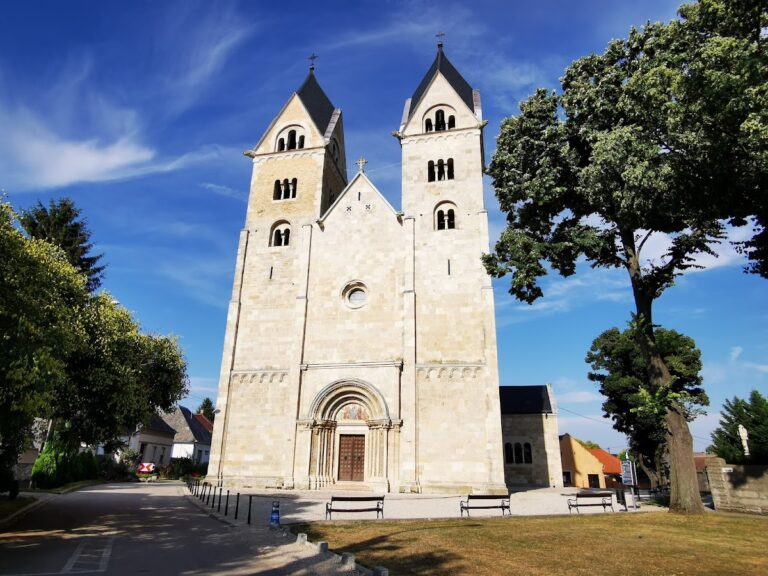
The present Basilica of Saint Martin is an approximately 50-metre-long, three-aisled early Gothic church with a crypt. It was built in the early thirteenth century, largely on the walls of the earlier church, and was probably consecrated in 1224. The oldest visible part is the southern aisle wall, which belongs to the second church consecrated in 1137. Two blocked gates in the sacristy probably relate to Dávid’s and Uros’s churches. A grave beneath the floor between the front altar and the sanctuary steps probably belongs to Abbot Uros.
Later church alterations
King Matthias enlarged the basilica. The present sanctuary ceiling, the eastern ends of the aisles, and the Saint Benedict Chapel belong to this phase. During the Ottoman occupation, the church furnishings were destroyed. Major post-Ottoman renovation began in the 1720s under Benedek Sajghó.
Ferenc Storno’s nineteenth-century renovation added the main altar, pulpit, ceiling frescoes, and an upper stained-glass window showing Saint Martin. It also introduced Neo-Gothic furnishings, historicising stained glass, frescoes, and sculptures. Many of these interventions were later removed during the renovation of the early 1960s.
Porta Speciosa
The Porta Speciosa is a thirteenth-century side portal leading from the cloister into the church. Five pairs of columns support arches richly decorated with foliage. It is described as the only surviving early Gothic side portal of its kind in Hungary. Its present door was designed by Ferenc Storno in the nineteenth century.
Gothic cloister and fresco
The present Gothic cloister was created under King Matthias beginning in 1472 and was probably completed in 1486, as indicated by an inscription on a cornerstone. Its construction was probably carried out by craftsmen associated with the Visegrád royal construction workshop. The cloister encloses a small inner garden known as the Paradisum, an earthly image of Biblical Paradise that was planted mainly with medicinal herbs during the Middle Ages.
A fourteenth- or fifteenth-century Volto Santo fresco in the Luccan tradition was found in 1994 on the cloister wall adjoining the church. A reinforcing wall erected beside the church in the late fifteenth century covered part of the painting, and the supporting structure prevents the fresco from being fully exposed.
Baroque buildings and the monastic burial chapel
Baroque refectory
The Baroque rebuilding included a two-storey rectangular refectory, probably constructed in the second half of the 1720s with a vaulted ceiling. Carmelite brother Atanáz Márton Witwer designed its Baroque elements, and Davide Antonio Fossati painted the wall decoration between 1728 and 1730 using secco, a technique applied to dry plaster.
The ceiling presents the apotheosis of King Saint Stephen. Six wall scenes connected with eating show the offering of vinegar to Christ on the Cross, Christ’s temptation in the desert, Daniel in the lions’ den, the feast of King Belshazzar, the decapitation of Saint John the Baptist, and an episode from the life of Saint Benedict.
Our Lady Chapel
Construction of the Our Lady Chapel began in 1714. The chapel contains three Baroque altars and a small eighteenth-century organ. Its main altarpiece depicts the Assumption of the Virgin Mary. Romantic wall and portal decoration was added during a renovation in 1865.
A crypt beneath the chapel served for centuries as the burial place of the monks. Göncz was the first monk buried there, and the crypt remains the community’s last burial place. A wooden lookout tower stands near the chapel.
Library and commemorative architecture
Classical library and tower
The Classical library was begun in 1825. Ferenc Engel designed and built its longitudinal section during the 1820s, while János Páckh designed the later oval hall. Joseph Klieber of Vienna provided the interior ornament. The ceiling of the oval hall contains allegories of the four medieval university faculties: Law, Theology, Medicine, and Arts.
The library holds approximately 400,000 volumes, including a thirteenth-century Bible, nineteen codices, hundreds of manuscripts produced before printing, tens of thousands of sixteenth-century books, manuscripts associated with the time of Saint Ladislaus, and about three hundred incunabula, or books printed before 1501. The bell tower, approximately 55 metres high, was built as part of the nineteenth-century Classical expansion.
Millennium Monument
The Millennium Monument was one of seven monuments erected in 1896 to commemorate the Magyar settlement of 896 and the seven Hungarian tribes. Dedicated in 1897, it originally carried a 26-metre-high double-shell dome surmounted by a large brass relief of the Hungarian royal crown. The outer shell was dismantled in 1937 and 1938 because of deterioration.
The monument now consists of a circular interior room covered by the surviving low inner dome and lit by two windows. An unfinished 1938 fresco by Vilmos Aba-Novák on the eastern wall presents an allegorical vision of the foundation of the Hungarian state.
Gardens, agriculture, and twentieth-century additions
Arboretum and surrounding features
The arboretum developed from plantings associated with the abbey’s foundation and its Benedictine apothecary and medical tradition. It contained eighty tree and shrub species in 1830. Fábián Szeder shaped it into an English garden in the 1840s, and later herb plantings increased the number of species and varieties to more than 1,200.
A Baroque Way of the Cross dating from 1724 lies near the monastery, while the Blessed Maurice Lookout Tower stands in the surrounding woodland.
Winery and vineyards
The winery complex stands at the southeastern foot of Saint Martin’s Hill. It includes a press house and cellar on a site of approximately 2,000 square metres, with a capacity of 3,000 hectolitres. The vineyards include Rhine Riesling, Sauvignon blanc, Gewürztraminer, Welschriesling, Ezerjó, Sárfehér, Chardonnay, Pinot blanc, Pinot noir, Merlot, and Cabernet Franc. Approximately 37 hectares were planted with new vines in the early twenty-first century.
School and boarding complex
The Benedictine school and boarding complex was begun in 1939. Lajos Hidasi and Tibor Kiss designed it in the spirit of contemporary Italian modernism. The complex includes a new gate entrance and the Hóman Bastion. Its school and boarding section underwent major renovation in 1995.
A visitor and conference complex containing the Viator restaurant and wine bar, together with an underground garage, opened on Kosaras Hill in 2010. Its architecture combines traditional and modern elements.
Nearby sites