Castle of Csesznek: A Medieval Fortress and Frontier Stronghold in Hungary

Site at a Glance
- Rating
- 4.7
- Popularity
- Medium
- Country
- Hungary
- Primary era
- Medieval
- External website
- Open
- Eras represented
- Medieval, Early Modern
- Civilizations
- Habsburg, Hungarian
- Site type
- Military
- Remains
- Castle
On this page10 sections
History
Castle of Csesznek is a medieval stone fortress in Csesznek, Hungary, built around 1263 during the great castle-building programme that followed the Mongol invasion of 1241–1242. The first castle was commissioned by Jakab Cseszneki of the Bána kindred, a royal sword-bearer, an official whose court duty involved carrying the ruler’s sword.
Foundation and medieval ownership
The castle appears in written records in 1281, when a document stated that Jakab’s sons could hold it jointly. The Csák kindred seized Csesznek in 1315. In 1323, Lampert, the judge royal, restored the property to Mihály Cseszneki and his son János. Later that year, they sold it to the Csák kindred in exchange for Pázmándfalu and 100 silver denars.
King Charles Robert incorporated the castle’s game-rich territory into the royal estates. In 1392, Sigismund of Luxembourg transferred Csesznek and its estate, together with 31 villages, to the Garai noble family in exchange for their properties in the southern regions. The Garais retained the castle until 1482, when the male line died out.
Fifteenth- and sixteenth-century transformation
In 1483, King Matthias Corvinus granted Csesznek to his treasurer, István Szapolyai. Ferdinand I captured the castle in 1527, bringing an end to its previous political control. Pál Bakics then received Csesznek and its estate, holding them until his death in 1537. The castle briefly belonged to Bálint Török, and in 1540 it was granted to István Csaby, captain of Eger. It later passed to the Csaby and Wathay families.
By the middle of the sixteenth century, Csesznek had become a frontier fortress, a fortified site positioned in a contested region for defence and military operations. Its role was tied to the Ottoman advance into Transdanubia. In 1573, the captain Lőrinc Wathay died at the castle when a cannon loaded with old gunpowder exploded as he tried to fire it. The artilleryman beside him was also killed.
Ottoman wars and the Rákóczi uprising
After the fall of Győr in 1594, Csesznek came under Ottoman control, but it was recaptured in 1598. At the turn of the sixteenth and seventeenth centuries, the castle belonged to the Cseszneky counts. It surrendered to the forces of István Bocskai in 1605, then was captured in 1619 by György Haller and Péter Fekete, commanders acting for Gábor Bethlen. Under the 1622 Peace of Nikolsburg, Csesznek became a royal possession again.
During the Rákóczi War of Independence, an early-eighteenth-century uprising led by Francis II Rákóczi against Habsburg rule in Hungary, the castle held ammunition and food supplies. It also served as a collection point for prisoners of war. Imperial troops failed to take it in a siege in 1708, but captured it the following year.
Residence, abandonment, and conservation
After the wars, the Esterházy counts altered the castle’s purpose. They converted the austere stone fortress into a more comfortable Baroque residence. The aristocratic family moved out in 1780, although servants continued to use parts of the building.
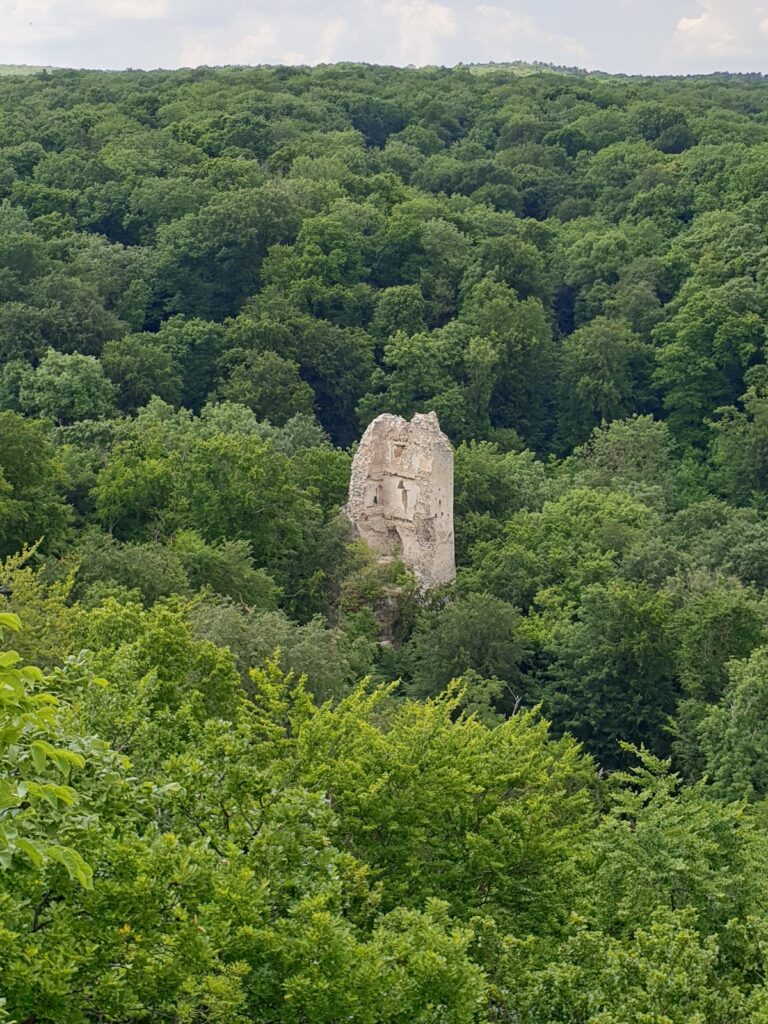
An earthquake followed by a fire made the remaining rooms uninhabitable around 1810–1820. The castle was then abandoned and gradually became a ruin. Excavations carried out between 1967 and 1969 clarified the form of the thirteenth-century castle. From 2017 onward, renovation has proceeded through Hungary’s National Castle Programme and National Fortress Programme.
Remains
Setting and castle layout
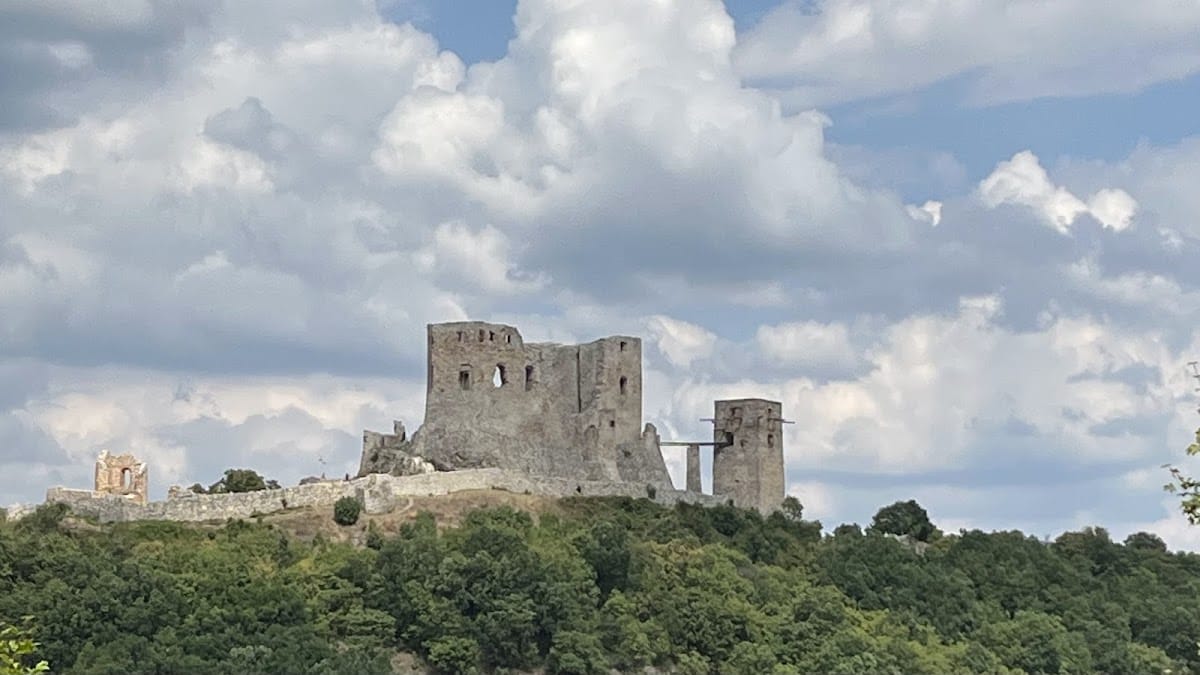
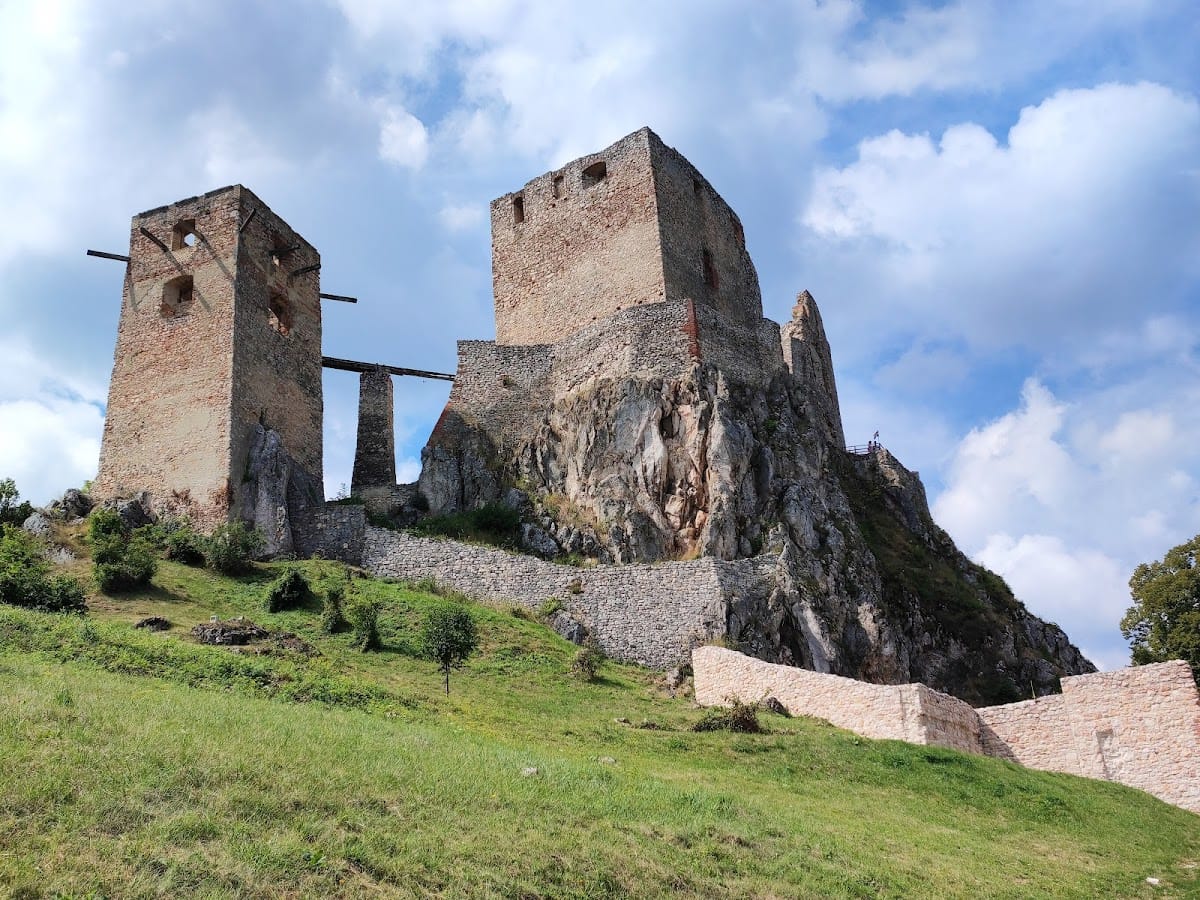
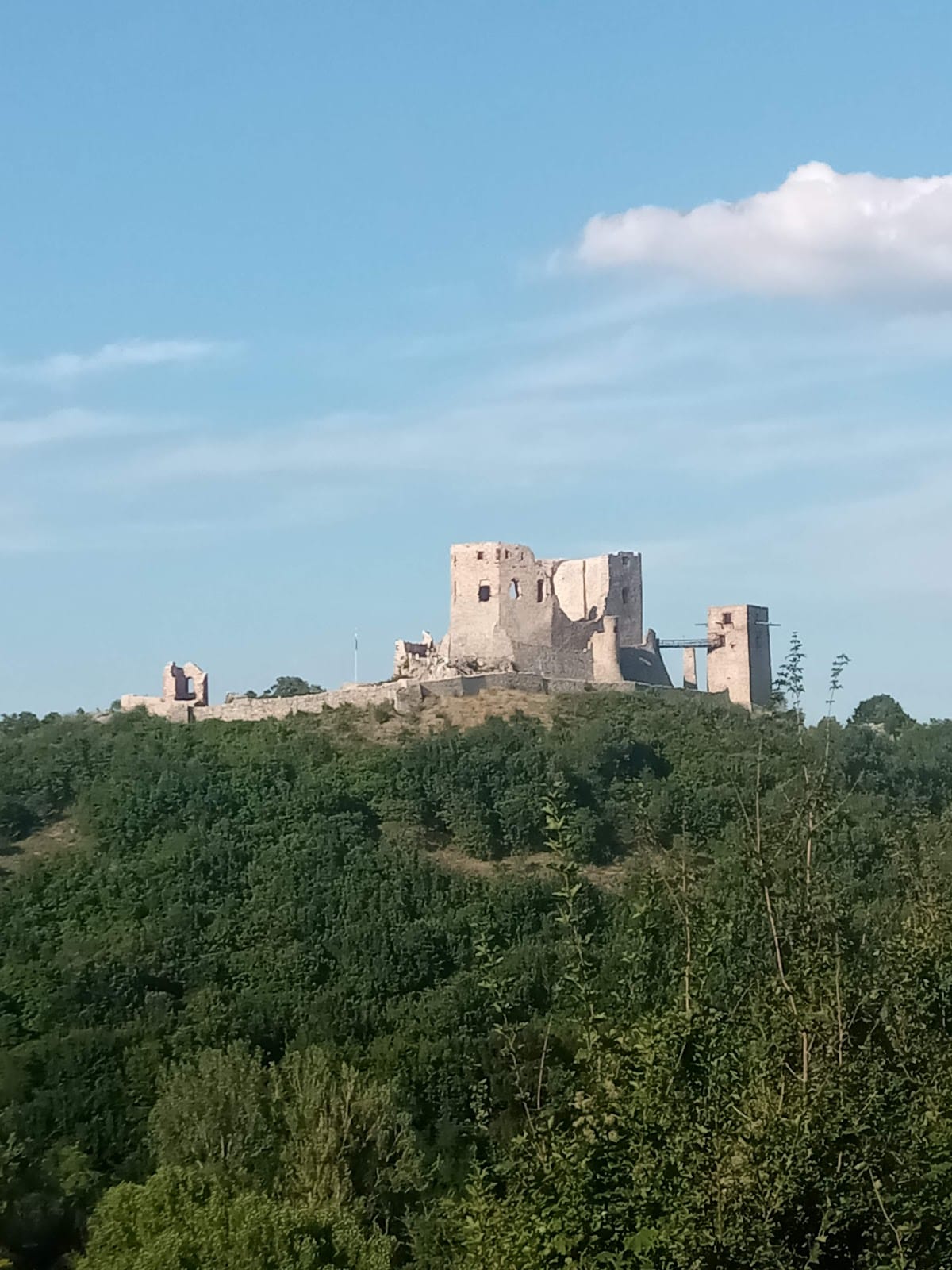
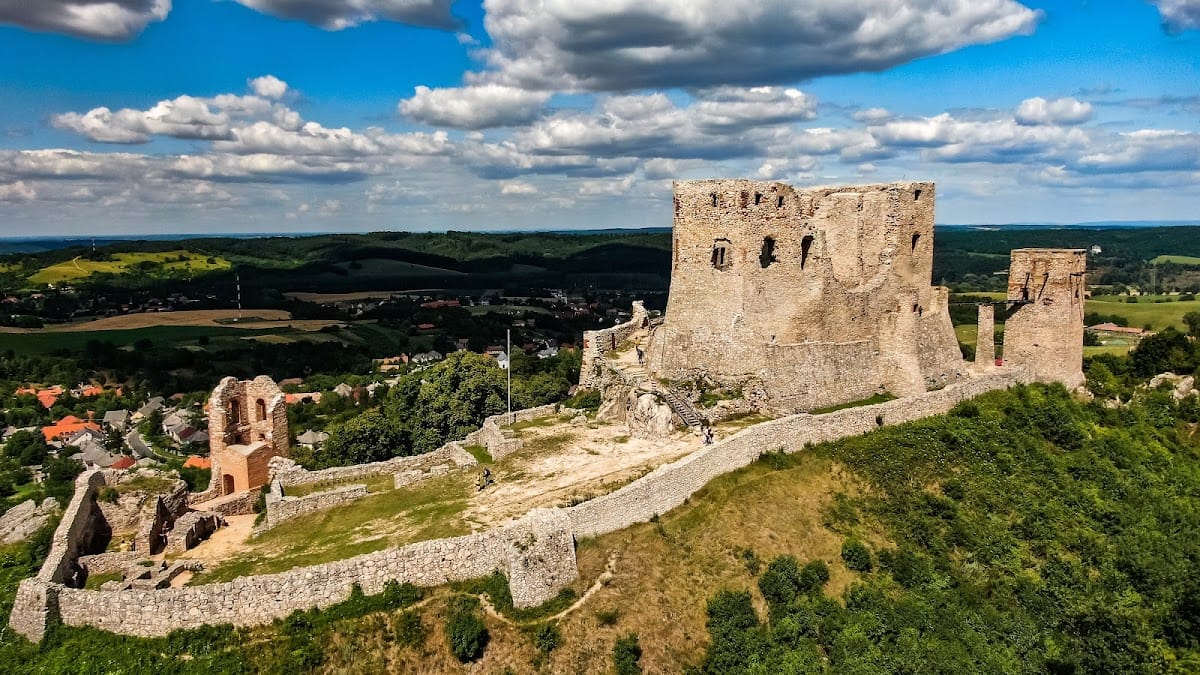
Castle of Csesznek occupies a rocky peak in the Bakony Mountains above the village of Csesznek, between Győr and Zirc, at an elevation of 330 metres. Built of stone on a site considered highly suitable for defence, the castle developed through several distinct building phases. Most of the visible ruins correspond approximately to the sixteenth-century fortress, while archaeological traces beneath the upper castle preserve the earlier layout.
Thirteenth-century enclosure
The original castle lay beneath the southwestern part of the upper castle. Its rectangular enclosure was substantially smaller than the later upper castle and was divided by transverse walls into smaller rooms. This first structure was completely demolished in the fourteenth century. Excavations in 1967–1969 recovered information about its form and established the presence of an earlier castle beneath the later remains.
Fifteenth-century upper castle
A new castle was built on fresh foundations at the beginning of the fifteenth century. Its plan combined a pentagon with a rectangle around a central courtyard. Lower service and economic buildings occupied the southern side, while residential buildings stood along the other sides. A small tower with a semicircular plan rose on the southern side of the complex.
Entrance and carved stonework
The northwestern entrance was probably protected by a drawbridge gate. Its surviving lintel bears the Garai–Cillei coat of arms, linking the entrance to the period when the Garai family developed the castle. Several finely carved stone fragments from the upper castle are preserved in the Hungarian National Museum. Their quality has led historians to infer that the castle’s former appearance reflected the wealth of the Garai palatine, one of the highest-ranking officials in the medieval Hungarian Kingdom.