Forte Someda: An Austro-Hungarian Border Fort in Italy


Site at a Glance
- Rating
- 3.7
- Popularity
- Very Low
- Country
- Italy
- Primary era
- Modern
- Eras represented
- Modern
- Civilizations
- Austria-Hungary, Habsburg
- Site type
- Military
- Remains
- Fort
On this page7 sections
History
Forte Someda, also known as Forte Moena, is an Austro-Hungarian military fort in Italy, near Moena in Trentino. Military engineers built it in 1898–1899 as part of the Moena sub-barrage, a smaller defensive sector within the Passo Rolle barrage, a coordinated group of fortifications intended to block a strategic valley or route. The fort formed part of the Austro-Hungarian defensive system along the Italian border and helped protect the San Pellegrino Valley against Italian forces advancing toward Val di Fassa.
Construction and defensive role
Forte Someda belonged to Subrayon IV of the Austrian fortification system. Telephone lines connected it with Moena and Forte Dossaccio, allowing the two forts to operate as a single defensive line. Its position near Someda therefore formed part of a wider network rather than an isolated military installation.
First World War and military decline
When the First World War began, the fort was considered inadequate against modern artillery. Its defensive positions were concentrated in one block, making them vulnerable to rapid destruction, while its masonry walls were highly exposed to artillery fire and offered limited resistance to large-calibre guns.
Because its strategic value was limited, the Austro-Hungarian military construction office used Forte Someda as a warehouse. This office, known as the k.u.k. Bauleitung, used the designation “imperial and royal” within the institutions of the Austro-Hungarian Dual Monarchy. It operated under the command of Richard Löwy, while the fort’s armament was transferred farther uphill, near Passo San Pellegrino.
Postwar ownership
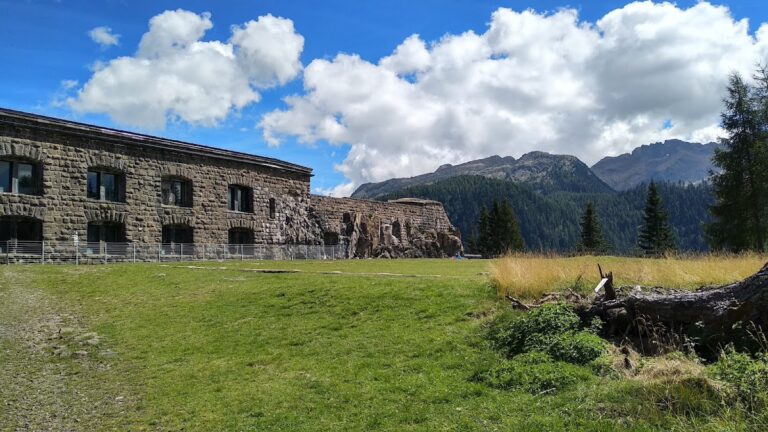
After the First World War, Forte Someda passed into military state ownership. It was sold to private owners in 1927 and remains privately owned. The building is now a ruin.
Remains
Fort structure and setting
The remains of Forte Someda stand at an elevation of 1,320 metres east of Someda, beside the road leading toward the Lusia facilities. The fort was built on a square plan over two levels. Its surviving fabric belongs to a compact masonry structure whose concentrated layout contributed to its vulnerability when artillery technology developed.
Planned armament
The fort’s planned armament consisted of two 120 mm M. 80 guns, two 150 mm M. 80 howitzers, and four M1893 machine guns. These weapons were intended to support the fort’s role in the defensive line protecting the valley, although the armament was later moved near Passo San Pellegrino after the fort was judged insufficient for modern warfare.