Forte Buso: An Austro-Hungarian Frontier Fortification in Italy
Site at a Glance
- Rating
- 3.8
- Popularity
- Very Low
- Country
- Italy
- Primary era
- Modern
- Eras represented
- Modern
- Civilizations
- Austria-Hungary, Habsburg
- Site type
- Military
- Remains
- Fort
On this page8 sections
History
Forte Buso, also known as Forte Albuso, is an Austro-Hungarian military fortification near Paneveggio in Predazzo, Italy. Built in the late nineteenth century and modernized in 1912, it formed part of the Paneveggio sub-barrier within Subrayon IV, a subdivision of the Austro-Hungarian fortified frontier system directed against Italy.
Construction and defensive role
The fort was designed to block the road over Rolle Pass and the route through the Travignolo valley. Its position also guarded the approach from San Martino through Rolle Pass toward the Fassa and Fiemme valleys. Forte Buso operated with the elevated long-range work at Forte Dossaccio, maintaining both telegraphic and optical communication with it.
In peacetime, approximately 57 or 60 military personnel were stationed at Forte Buso. Its wartime garrison comprised 134 soldiers and four officers. The armament included six 90 mm M4 casemate guns, enclosed weapons positions built into the fortification. In 1916, plans were made to place three to five additional small-calibre guns outside the fort.
Wartime and later history
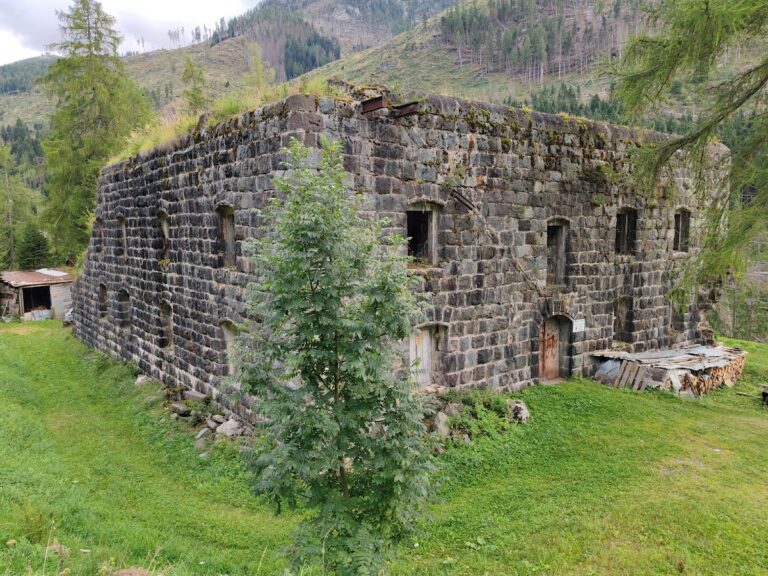
Forte Buso was not attacked by infantry during the conflict, and Italian artillery caused no major damage. The fort is in excellent structural condition. It is now owned, used, and maintained by Primiero Energia S.p.A.
A plaque inside the fort commemorates engineer Leo Moser, who died on 7 November 1950 in an accident during construction work on the dam. The fort lies within the territory of Predazzo, at the eastern edge of Paneveggio–Pale di San Martino Natural Park.
Remains
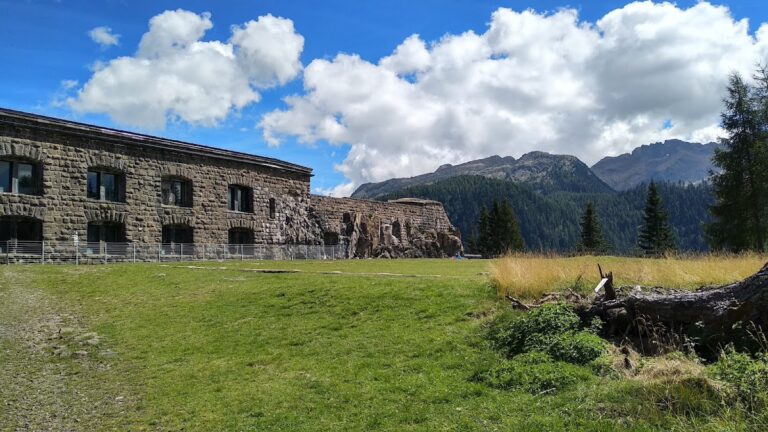
Forte Buso is a two-storey blockhouse surrounded by a broad ditch. A blockhouse is a strongly built military structure intended to provide protected accommodation and defensive fire. The fort was built in rubble-stone masonry and classified as shellproof and assault-proof, including after its modernization in 1912.
Fort and defensive connections
Blockhouse and ditch
The surviving blockhouse forms the core of the fortification, while the surrounding ditch strengthened its protection against assault. The six 90 mm M4 guns were housed in casemates, enclosed and protected gun positions within the fort.
Trenches and covered passages
Trenches and covered passages connected Forte Buso with the higher Forte Dossaccio and with other external positions. These links formed part of the wider defensive landscape of the Paneveggio area, joining the direct road barrier with longer-range artillery coverage.
Travignolo valley setting
The fort stands above the control facilities of the dam on the Travignolo stream, beside Lago di Forte Buso, a reservoir constructed after the Second World War. Its position was tied to the road and valley route through the Travignolo valley, which the fortification was built to control.
Nearby sites