Salegg Castle: A Medieval Hill Castle in South Tyrol, Italy


Site at a Glance
- Rating
- 4.3
- Popularity
- Very Low
- Country
- Italy
- Primary era
- Medieval
- Eras represented
- Medieval
- Civilizations
- Holy Roman Empire
- Site type
- Military
- Remains
- Castle
On this page7 sections
History
Salegg Castle is a medieval hill castle above Seis am Schlern in Kastelruth, Italy, built around 1200 in the period of feudal lordship. The castle was first documented in the twelfth century, like nearby Hauenstein Castle, and probably belonged to the Lords of Saleck.
The Lords of Saleck
The Lords of Saleck appear in records as ministerials of the Bishop of Brixen. A ministerial was a medieval official or vassal who served a higher lord in administrative, military, or estate-management duties. Heinricus de Salekke was named in 1178, followed by Conradus de Salec in 1184.
Feudal Ownership and Decline
Salegg functioned as a co-ownership castle, meaning that several noble holders divided its rights and property. In 1438, part of the estate belonging to Kaspar of Gufidaun passed to Konrad von Kraig. By 1473, the Zwingenstein family owned the entire castle. After a dispute involving the Wolkensteins and their relatives, ownership passed to the Wolkenstein family in the mid-sixteenth century.
At the beginning of the seventeenth century, Salegg was abandoned and began to decay. Some of its masonry was dismantled for use as building material. A local chronicle mentions a chapel at the castle, while tradition holds that its altar and bell were transferred during the decline of the site to the Maria Hilf Church in Seis. Jesse Perkhofer, Bishop of Brixen, consecrated that church on 6 September 1657. Its furnishings included the Maria Hilf altar and a side altar dedicated to Saint Catherine.
Later History and Conservation
A hotel built below the castle during the twentieth century adopted the name Hotel Salegg. The German philosopher Wilhelm Dilthey died there in 1911. In September 2000, the master builder Albrecht Ebensberger of Glurns prepared a conservation plan for the badly deteriorated ruins. Stabilization work began in summer 2001 and secured the masonry, followed in summer 2002 by the removal of undergrowth and trees from the site. Salegg is now owned by the Roman Catholic Diocese of Bolzano-Brixen.
A local legend describes an underground passage linking Salegg with Hauenstein. According to the story, the passage contained gold and silver treasures guarded by a maiden with long golden hair, seated on a chest of money.
Remains
Hilltop Setting and Defensive Walls
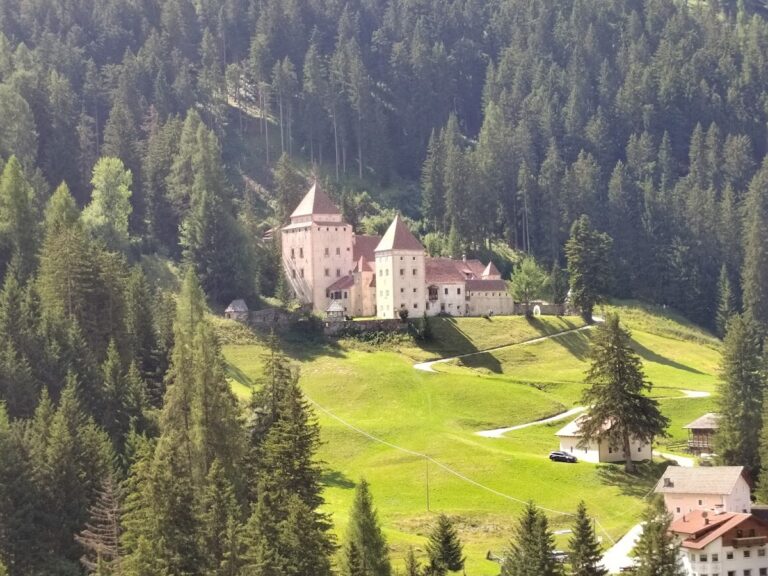
Salegg stands at approximately 1,219 metres above sea level at the foot of the Schlern and near the Santnerspitze. The ruin occupies black porphyry rock in the Hauenstein Forest and is surrounded by coniferous woodland. Porphyry is a hard volcanic rock that was commonly used for construction where it was locally available.
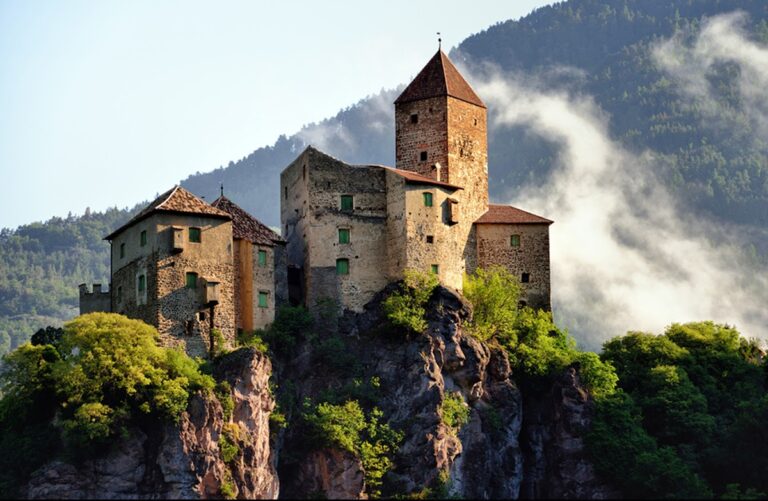
Only a small amount of the castle survives above ground. The remains include sections of the enceinte, or ring wall, which is about one metre thick. The castle’s position and surviving wall sections preserve part of its original hilltop defensive enclosure.
Residential Buildings and Nearby Ruins
Fragments of the palas wall also remain. A palas was the principal residential and representative building of a medieval castle, containing the lord’s main living and ceremonial rooms. Corner turrets were added to this wall during a later building phase.
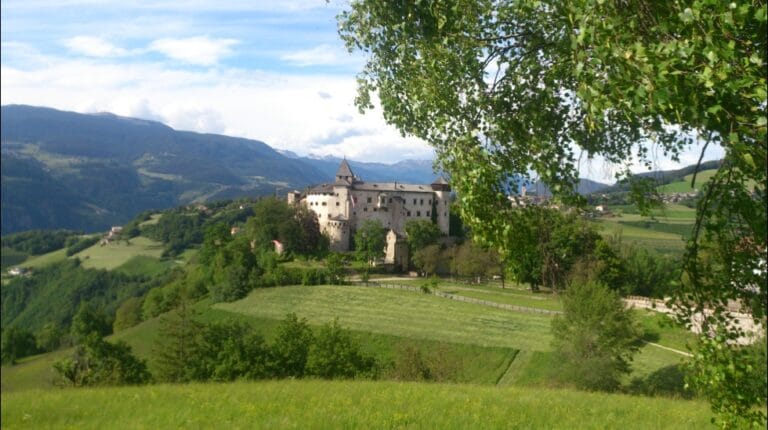
Hauenstein Castle lies approximately one kilometre east of Salegg at roughly the same elevation. Trees that once concealed the remains were later removed, making the ruins of Salegg clearly visible from Kastelruth. The surviving castle fabric remains heavily fragmentary, reflecting both long-term deterioration and the removal of masonry for reuse after abandonment.