Prösels Castle: A Medieval Fortress and Renaissance Castle in Italy


Site at a Glance
- Rating
- 4.5
- Popularity
- Medium
- Country
- Italy
- Primary era
- Early Modern
- External website
- Open
- Eras represented
- Medieval, Early Modern
- Civilizations
- Habsburg, Holy Roman Empire
- Site type
- Military
- Remains
- Castle
On this page19 sections
History
Prösels Castle is a medieval castle in Italy, standing in the village of Prösels within the municipality of Völs am Schlern, east of Bolzano in South Tyrol. Probably established around 1200 by the Lords of Völs, it developed from a medieval fortress into a Gothic castle with Renaissance elements, largely through rebuilding in the early sixteenth century. The castle was the ancestral seat of the Lords of Völs and occupied a position of authority in the territory around the Schlern upland.
Foundation and the Lords of Völs
The castle was first mentioned in 1279 as castrum Presil, while the nearby settlement appeared in written records in 1373 as Bresels. The Lords of Völs probably built the fortress around 1200. In their early history they served the Bishops of Brixen as feudatories. The Bishops of Brixen were the ecclesiastical rulers of the Diocese of Brixen and held substantial territorial power in the medieval region.
As the influence of the Bishops of Brixen and Trent declined, the Lords of Völs continued to hold Prösels as ministerial officials of the territorial rulers. A ministerial was a high-ranking official who held land or office in service to a territorial lord. The castle was initially named after a local chapel. Its later names, Prösels Castle and Völs Castle, reflected its association with the nearby settlement of Völs.
Leonhard of Völs and the sixteenth-century rebuilding
Prösels reached its greatest prosperity in the early sixteenth century under Leonhard the Elder of Völs, who was born in 1458 and died in 1530. He expanded the medieval fortress into a more lavish late Gothic complex, creating most of the castle that survives today. An inscription above the entrance portal associates the present form of the complex with 1517, and the rebuilt castle combines Gothic features with Renaissance elements.
Leonhard held important offices in Tyrol. He administered the salt mines of Hall, served as governor of the Adige, and was burgrave of Tyrol from 1498 until his death. A burgrave was an official responsible for administering a castle or territorial district. Leonhard also maintained a close relationship with Holy Roman Emperor Maximilian I, a Habsburg ruler who became emperor in 1508 and was also Archduke of Austria. He took part in the war against Venice from 1508 to 1516.
Conflict, trials, and local memory
During the Peasants’ War of 1525, dependent farmers briefly occupied Prösels. They burned the castle’s documents in an attempt to destroy evidence of debts and tithes. The uprising was eventually suppressed, and six of its leaders were executed.
Witchcraft trials were held at Prösels in 1506 and 1510. Approximately 30 people received death sentences by burning, including two men. Nine local women were tortured, forced to confess, and burned. The accusations included murdering their own children, submitting to the Devil, riding through the air on brooms, and taking part in diabolical dances. The exact location of the burnings is uncertain.
These trials gave rise to local traditions about the so-called Schlern witches. In 2006, the municipalities of Völs and Kastelruth placed a commemorative sculpture and plaque at the castle in memory of the first witch trial in South Tyrol. A monument at the entrance also commemorates the witch burnings associated with Völs am Schlern in 1506 and 1510.
Decline, restoration, and cultural use
The Lords of Völs retained the castle until Felix, Baron of Völs, died without children in 1810. Prösels then stood empty for about fifty years and nearly fell into ruin. Between 1860 and 1978 it changed owners fourteen times, passing through alternating periods of decay and attempted restoration before it was abandoned.
In 1978, the Kuratorium Schloss Prösels, a consortium involving private individuals and the municipalities of Kastelruth, Völs, and Tiers, acquired the castle. Restoration between 1981 and 1982 secured the complex and allowed its continued use. Since 1982, Prösels has hosted concerts, exhibitions, theatrical performances, and other cultural events, alongside guided visits.
Remains
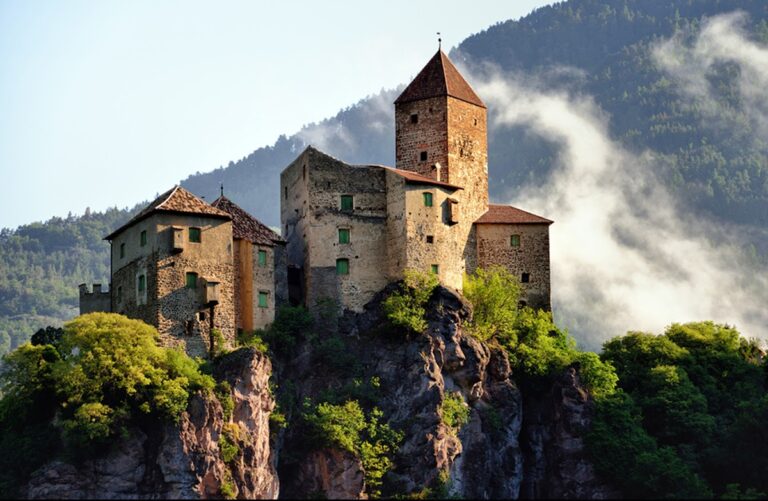
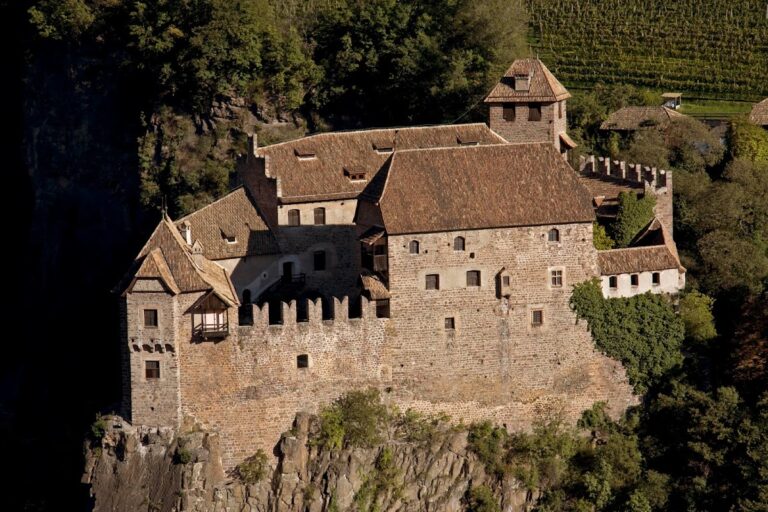
Prösels Castle rises on a prominent rocky outcrop beside the route from Blumau in the Eisack Valley toward the Schlern upland. It stands on the high plain below the Schlern mountain, between the larger municipal localities of Völs and Völser Aicha. The surviving complex combines elements of the first fortress, the late Gothic rebuilding under Leonhard of Völs, and Renaissance-influenced additions from the early sixteenth century.
Fortress and central castle
Early fortress
The central palace and a Romanesque archway belong to the first fortress, probably established around 1200. These elements preserve the medieval core of Prösels and form part of the fabric around which the later castle was built.
Gothic and Renaissance complex
The present complex was substantially rebuilt and enlarged in the early sixteenth century. Its entrance portal bears the date 1517, associated with the major transformation under Leonhard of Völs. The resulting castle is principally Gothic in character while incorporating Renaissance elements. A newly built arcade contains frescoes, including a representation of Emperor Maximilian I. Its loggia has pointed arches, and further frescoes cover the courtyard walls.
Chapel and residential interiors
Castle chapel
Leonhard built the castle chapel and dedicated it to Saint Anne. Its portal and net-rib vault identify it as a building from the third decade of the sixteenth century. A net-rib vault is a Gothic ceiling in which intersecting ribs create a net-like pattern. The chapel’s architectural details are noted for their high-quality craftsmanship.
Former residential wing
The former residential wing of the Lords of Völs contains 98 surviving works from the Batzenhäusl collection of Bolzano. These paintings were formerly associated with the Batzenhäusl restaurant and now form part of the castle’s interior holdings.
Collections and exhibition spaces
Weapons hall
The weapons hall contains the collection of Franz Anton von Kofler. After the restoration, the collection came to Prösels as a loan from the South Tyrolean provincial government. Most of the displayed objects date from the nineteenth century and include weapons from the battlefields of Solferino and Custoza during the Italian Wars of Independence. Some pieces date from Leonhard of Völs’s period, and the collection also includes the armor of a samurai warrior.
Modern art collection
A modern art collection developed partly from works left by painters and sculptors who exhibited at the castle. Works by the artist Lotte Copì are also displayed within Prösels.
Tischlerhaus
The building known as the Tischlerhaus serves as an exhibition gallery. Since 1982 it has hosted recurring summer exhibitions of painting and sculpture. Each participating artist left one work, creating a substantial collection connected with the gallery’s exhibition history.
Defensive tower and commemorative monument
Pulverturm
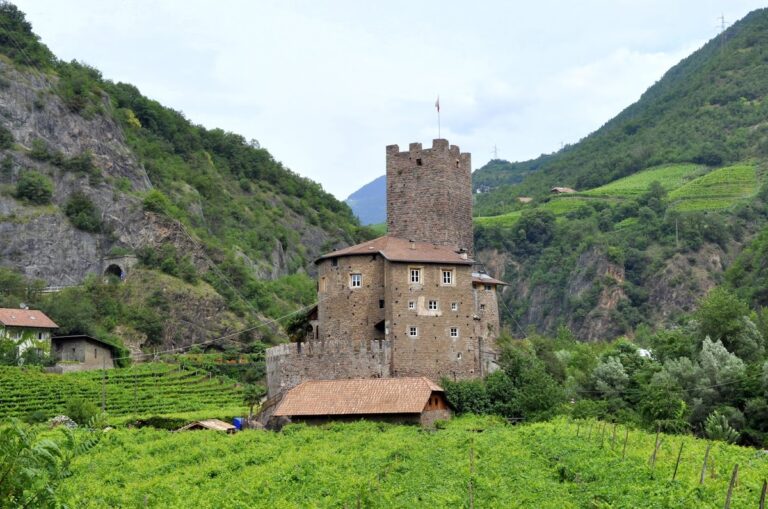
A medieval powder tower, known as the Pulverturm, stands somewhat above the castle and is historically closely connected with the complex. It has the form of a bergfried-like defensive tower. A bergfried was the principal defensive tower of a medieval German-speaking castle, intended mainly for defense and refuge rather than ordinary residential use.
Witch-trial monument
A monument at the castle entrance commemorates the witch burnings associated with the municipality of Völs am Schlern in 1506 and 1510. Together with the commemorative sculpture and plaque installed in 2006, it gives a physical presence to the memory of the trials in the castle complex.