Montmayeur Castle: Medieval Fortress in the Aosta Valley
Site at a Glance
- Rating
- 4.5
- Popularity
- Very Low
- Country
- Italy
- Primary era
- Medieval
- Eras represented
- Medieval
- Civilizations
- Holy Roman Empire
- Site type
- Military
- Remains
- Castle
On this page7 sections
History
Montmayeur Castle is a medieval fortress in Italy, located at Arvier above the entrance to the Valgrisenche valley. It was built by the counts of Montmayeur during the thirteenth century, although its precise construction date remains uncertain. The keep, and perhaps the entire castle, may date to 1271, when Anselme and Aymon d’Avise performed feudal homage, a formal acknowledgment of a superior lord’s authority, to Philip I of Savoy and received permission to build at the site. Another document gives 1312 as the construction date.
Montmayeur and Savoyard control
At the beginning of the fourteenth century, the fief of Montmayeur formed one-sixth of the lordship of Avise. A fief was land or jurisdiction held from a superior lord in return for obligations. In 1309 and 1310, the Count of Savoy purchased the fief from Aymonet and Faucon de Montmayeur. In 1323, he stationed armed men at the castle, reinforcing its role within the territories of the House of Savoy, the ruling dynasty whose lands included the historic Aosta Valley.
In 1337, Montmayeur Castle appeared among the revenues and expenditures presented at the Aosta Audiences, formal judicial and administrative sessions. The castle was assigned to the bailiff who also served as castellan of Châtel-Argent and Montmayeur. A bailiff was a senior territorial official, while a castellan was responsible for a castle and its garrison. The castle still belonged to the House of Savoy in 1351. In 1359, it was granted as a fief to Pietro de Montmayeur, and in 1430 it passed to the brothers d’Avise. It was still inhabited and garrisoned in that year.
Legend and abandonment
A later legend places a violent episode at the castle around 1450. After a count of Montmayeur was found guilty by the court of Chambéry in a dispute with a cousin, he allegedly invited the court president, Guy de Feissigny, to his residence and had him beheaded. According to the story, he sent Feissigny’s head to the judges as the “document missing from the trial,” then fled into the mountains and built the fortress as a refuge. The castle had acquired the nickname “Vulture’s Nest” by the nineteenth century, referring to its inaccessible position. It had already been uninhabited for centuries and survives today as a ruin.
Remains
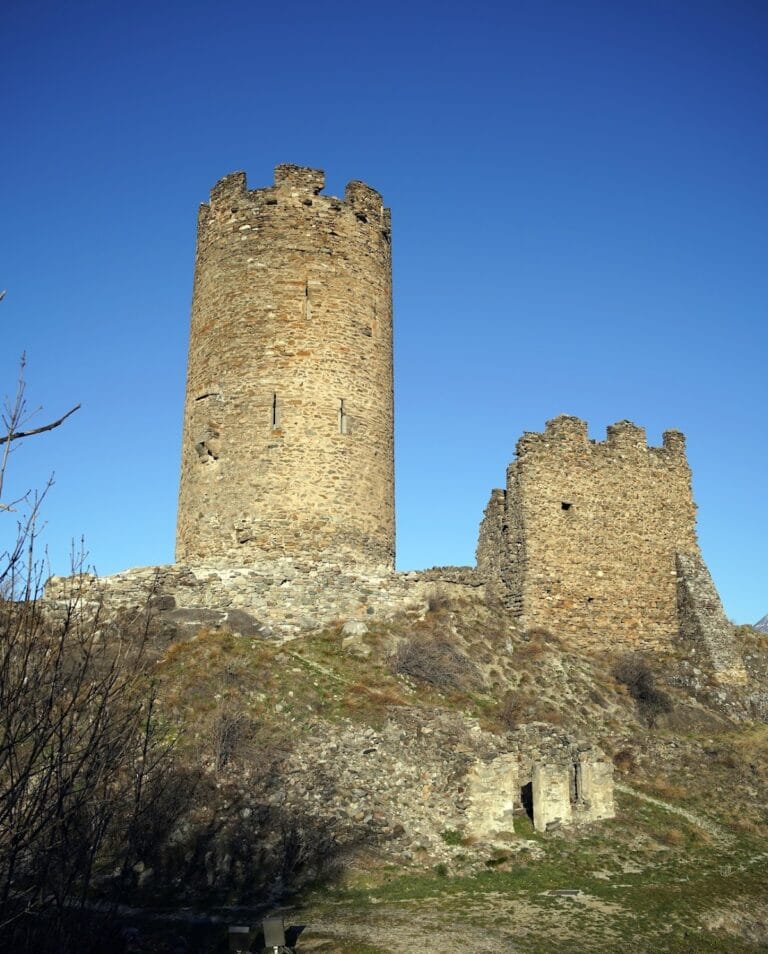
Montmayeur Castle stands at approximately 1,112 metres above sea level on the orographic right side of the Dora di Valgrisenche, at the entrance to the Valgrisenche valley. The surviving complex is largely ruined. Its principal elements are a circular keep, fragments of the surrounding curtain wall, and remains of the main castle complex. The fortress occupies grey albitic mica schist with a brownish patina, a foliated metamorphic rock containing chlorite and veins of quartz. The rock formed from debris deposits containing volcanic material and was later altered by Alpine metamorphism during the formation of the Alps.
Keep and defensive walls
Circular keep
The keep is a circular tower with an elevated entrance and swallowtail crenellations. These battlements have merlons with a forked, V-shaped profile. The tower forms the clearest surviving element of the fortress. Restoration work included sealing an opening at its base.
Curtain wall and castle complex
Remnants of the curtain wall surround portions of the site, while further ruins mark the main castle complex. Together, these remains show the relationship between the principal tower and the fortified enclosure. From the castle, the climbing wall at La Ravoire is visible.
Nearby sites