Maison de Mosse: A Medieval Fortified House and Cultural Centre in Italy


Site at a Glance
- Rating
- 4.1
- Popularity
- Very Low
- Country
- Italy
- Primary era
- Medieval
- External website
- Open
- Eras represented
- Medieval
- Civilizations
- Duchy of Savoy, Holy Roman Empire
- Site type
- Domestic
- Remains
- Elite Residence
On this page11 sections
History
Medieval origins and the d’Avise family
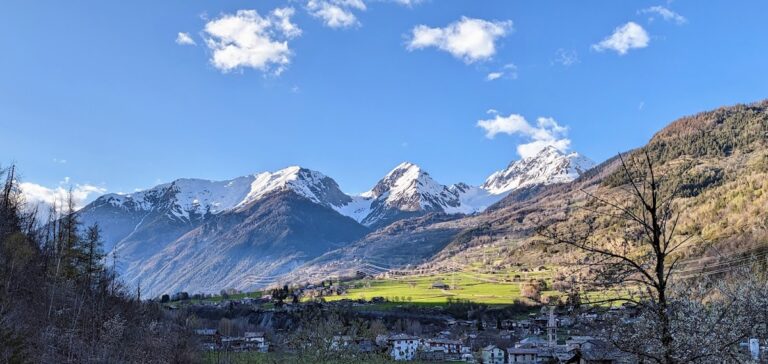
Maison de Mosse is a medieval fortified house in Runaz, Italy, a hamlet of Avise in the Aosta Valley. Built between the fourteenth and fifteenth centuries at the request of the noble d’Avise family, it stood along the ancient Roman Via Gallica, or “Road of the Gauls,” which crossed the Alpine region. Its position formed part of a wider system controlling traffic through the narrow Pierre-Taillée gorge, together with the main settlement of Avise.
During the Middle Ages, Runaz was already the most populous of Avise’s four villages. The d’Avise family was established in Avise by at least the twelfth century according to Jean-Baptiste de Tillier, an eighteenth-century historian of the Aosta Valley, although an earlier presence in the tenth century has also been reported. By controlling access to Valdigne, the upper Aosta Valley, the family became one of the valley’s most powerful noble houses. It was also among the few local noble families that did not seek an alliance with the House of Savoy, the ruling dynasty whose territories included Savoy and, at different times, the Aosta Valley.
The d’Avise family held the fief of Avise, a landed jurisdiction or estate governed through a feudal relationship, for a long period. It commissioned several fortified residences in the area, including Avise Castle, Blonay Castle, and Cré Castle. In the fifteenth century, the fief was divided among four brothers. Jean le Jeune became lord of Runaz, Jean l’Ancien lord of Valgrisenche, Boniface lord of Avise, and Rolet lord of Léverogne and Planaval.
Transformation into a seigneurial residence
Jean le Jeune probably commissioned major improvements to Maison de Mosse. The house was enlarged and given a more refined character as it became a seigneurial residence, the home of a lord exercising authority over his domain. This transformation reflected changing aristocratic requirements, while the building retained the combined domestic and defensive functions of a fortified house.
After the d’Avise family became extinct, Maison de Mosse passed through several owners. The last families to inhabit the house were the Milliéry, Lyabel, Martinod, and Vallet families. It was definitively abandoned in 1962.
Restoration and public use
The Autonomous Region of Aosta Valley acquired Maison de Mosse and began recovering it for public and sociocultural use in 1978. The building was converted into a library, and from 1995 it also became the seat of the Association Valdôtaine des Archives Sonores, or AVAS. The organization was established to preserve oral traditions and ethnographic testimony during a period of major social and cultural change in the mountain region.
The regional administration owns the restored building. It now functions as a multipurpose public centre containing the municipal library, a small auditorium, temporary exhibition spaces, and the permanent exhibition Au fil des ondes. AVAS is based there and manages the building. Its archive includes approximately 5,000 hours of recorded testimony, more than 200 radio broadcasts, video and photographic material, dozens of television programmes, several thousand photographs divided among about ten collections, objects and documents, 40 volumes, and the association’s publications.
Maison de Mosse has hosted temporary historical and ethnographic exhibitions on subjects including winegrowing, processions, local villages, marriage, wood sculpture, carnival traditions, theatre, emigration, schooling, Valdostan autonomy, the parish of Excenex, and chimney sweeps. The permanent exhibition Au fil des ondes was organized by AVAS for the anniversary of 150 years of telecommunications in the Aosta Valley. Its principal exhibit until April 2012 was The Flute Player, a mechanical automaton made in 1840 by the Aosta-born inventor Innocenzo Manzetti. The automaton is now displayed at the Centre Saint-Bénin in Aosta.
Legend of the 1691 fire
A local legend says that Maison de Mosse was the only building in Runaz spared when French troops set fire to the village in 1691. According to the tradition, a skull later found inside a wooden casket in the cellar protected the house. The owners traditionally take the skull to the Avise cemetery on the eve of All Saints’ Day, after which it is said to return to Maison de Mosse during the night.
Remains
The fortified residence
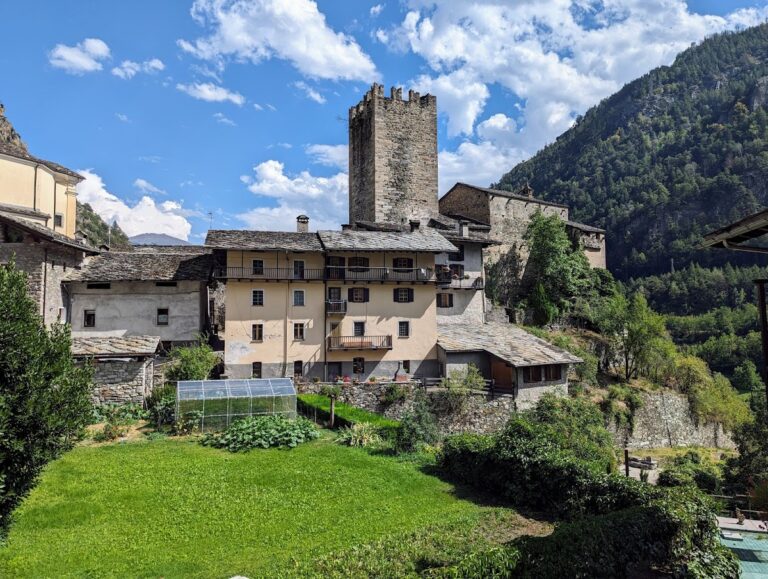
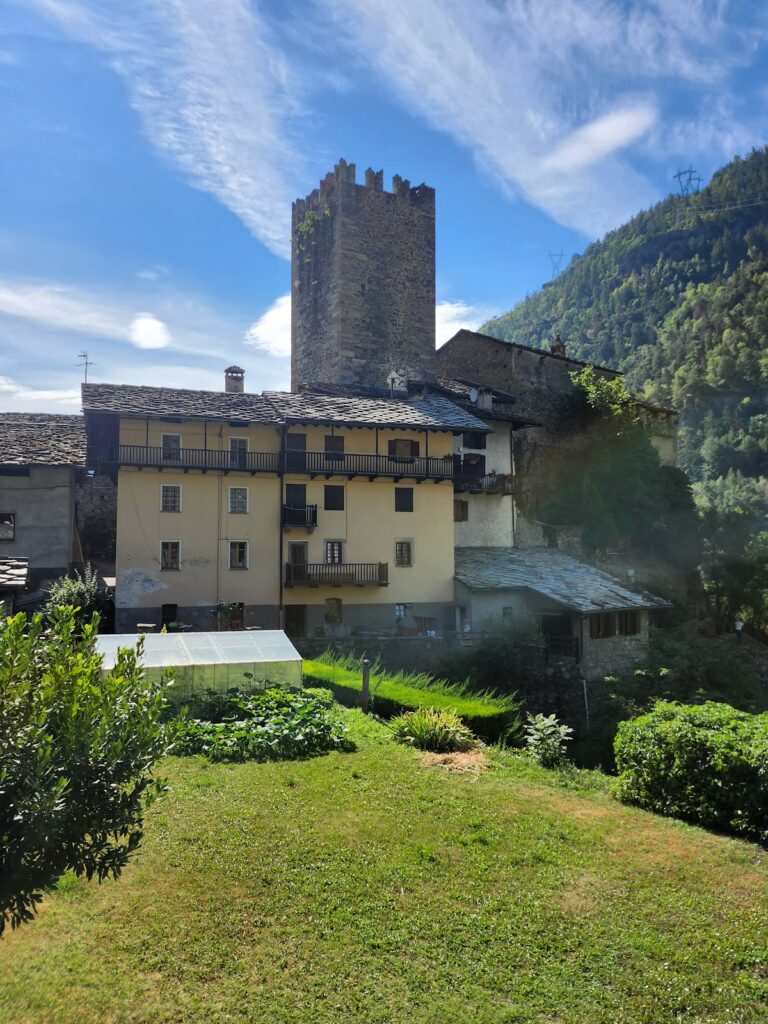
Maison de Mosse stands at about 822 metres above sea level, approximately 400 metres from the Pierre-Taillée architectural monument. The restored building is constructed from plastered rubble stone and preserves the character of a fortified residence, combining domestic accommodation with defensive features. Although its main fabric dates from the fourteenth or fifteenth century, the house includes later late-Gothic details.
Windows and entrance portal
Sixteenth-century cross-shaped windows are clad and framed in Villeneuve stone. The large entrance portal is crowned by a distinctive stone ornament shaped like an inverted keel. Together, these features express the more elaborate architectural treatment associated with the house’s transformation into a seigneurial residence.
Roof chimney
A complex chimney rises above the roof and is decorated with small turrets or spires. Its construction forms one of the building’s most recognizable external features and contributes to the house’s distinctive silhouette.
Basement traditions
A room in the basement retains a vault. An unconfirmed tradition interprets it as evidence of an earlier structure, possibly a convent. Another local tradition claims that a tunnel once connected a basement of Maison de Mosse with the village prison. Neither interpretation has been confirmed.
Interior functions and collections
The restored interior accommodates the municipal library, a small auditorium, exhibition areas, and the Au fil des ondes display. It also contains the AVAS archive and its associated recordings, photographs, documents, objects, and publications, giving the medieval house a continuing role as a centre for preserving the region’s oral and ethnographic heritage.