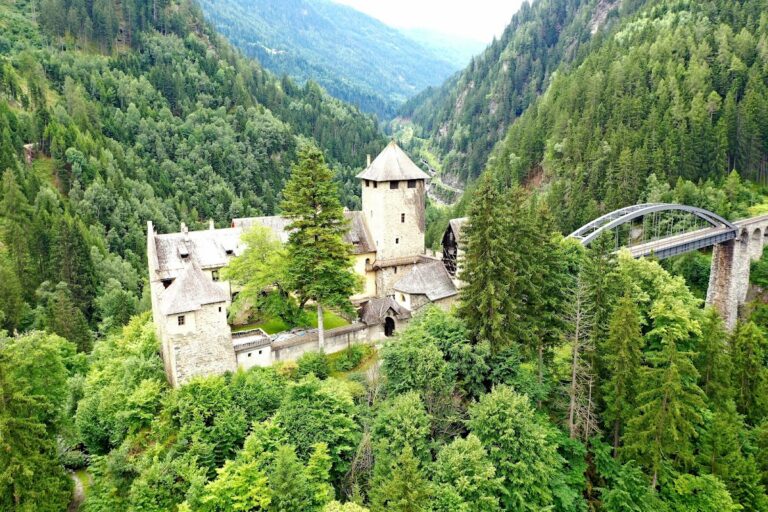
Burg Bideneck: A Medieval Castle in Austria


Site at a Glance
- Rating
- 4.8
- Popularity
- Very Low
- Country
- Austria
- Primary era
- Early Modern
- External website
- Open
- Eras represented
- Medieval, Early Modern
- Civilizations
- Habsburg, Holy Roman Empire
- Site type
- Military
- Remains
- Castle
On this page7 sections
History
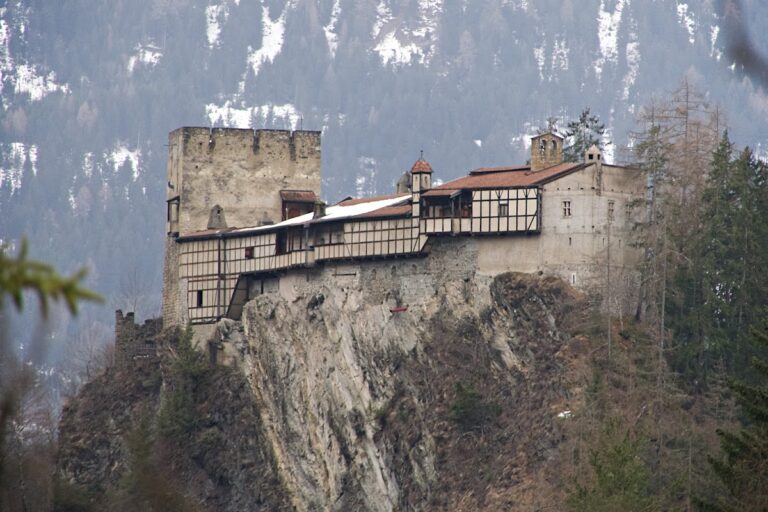
Burg Bideneck is a medieval castle in Austria, near Fließ in Tyrol. The complex was first documented on 6 May 1339, although its construction remains uncertain and it may already have existed in the twelfth century. One side of the hill was readily accessible, making the castle relatively weakly defended by the standards of its time.
Medieval ownership
In 1499, the estate and castle belonged to Bernhard Sigwein, the last male descendant of his family. Two years later, Emperor Maximilian I, whose rule as Holy Roman Emperor lasted from 1493 to 1519, transferred the estate to the brothers Rueland and Sigmund von Schrofenstein.
Rebuilding and later ownership
Hans Trautson acquired Burg Bideneck in 1546. The entire complex was rebuilt during the sixteenth century, after which it retained much of its appearance into the twenty-first century. In 1693, the castle and its lands passed by inheritance to Isaac Andre Benedikt von Pach. The von Pach family retained ownership until 1994, when the property passed to the Pöll family.
Hans Pöll began restoring the buildings, and the family planned to establish a local-history museum within the complex.
Remains
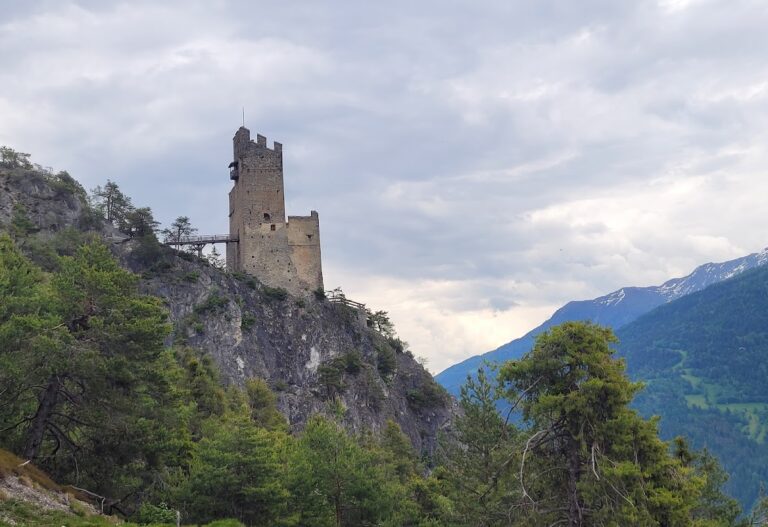
The castle complex is dominated by a nearly 30-metre-high keep, a castle’s principal fortified tower. The square tower measures 10 metres on each side and rises through four levels. Its rubble-stone walls are comparatively thin, measuring about 1.3 metres at the base. Later additions gave the keep a crown of twelve swallowtail-shaped merlons, each 1.5 metres high.
Keep and historic interiors
Keep
The four-level keep forms the principal surviving element of Burg Bideneck. Its square plan, rubble-stone construction, thin lower walls, and later battlements preserve the defensive character of the tower while also reflecting alterations made after the medieval period.
Entrance and Schrofensteinstube
A historic iron entrance door, added in the fifteenth century, survives within the complex. The upper floor contains the historic Schrofensteinstube, a Renaissance interior regarded as one of the finest of its kind in North Tyrol.
Nearby sites