Wiesberg Castle: A Medieval Fortress in Austria

Site at a Glance
- Rating
- 4
- Popularity
- Very Low
- Country
- Austria
- Primary era
- Medieval
- Eras represented
- Medieval, Early Modern, Modern
- Civilizations
- Habsburg, Holy Roman Empire
- Site type
- Military
- Remains
- Castle
On this page13 sections
History
Wiesberg Castle is a medieval fortress in Tobadill, Austria, probably built by the Bishopric of Chur during the 13th century. The Bishopric of Chur was an ecclesiastical principality that also held secular territories and feudal rights in the Alpine region. The castle occupied a strategic position where the Paznaun Valley opens into the Stanzer Valley, and it later became a sovereign fief of the Counts of Tyrol.
Origins and the Lords of Ramüss
Hugo of Wiesberg appears in a document from 1271, while references from 1292 mention the Wiesberg family or estate. The property may have passed by inheritance from Agnes of Montfort or Agnes of Wiesberg to the Ramüss family. The Lords of Ramüss were ministeriales of Chur, dependent service nobles who performed administrative and military duties for an ecclesiastical lord.
Nanno of Ramüss, who died in 1350, is recorded as the castle’s owner. Hans of Ramüss-Wiesberg sealed documents in 1330 and 1331. In 1331, Degn of Villanders and Heinrich vor Musetz were required to compensate for damage caused during the siege of Wiesberg.
Tyrolean rule and changing custodians
In 1350, Voltger of Flachsberg promised Margrave Ludwig of Brandenburg that he would keep Wiesberg open. By the end of the 14th century, the castle belonged to the Counts of Tyrol and was held as a fief by the Rottenburg family. During the conflict between Heinrich VI of Rottenburg and Duke Friedrich, Heinrich surrendered Rottenburg, but Wiesberg remained in his possession.
After Heinrich’s death, the Bishop of Chur renewed his claim to Wiesberg, but the claim was rejected. The castle was entered in the Tyrolean main land register as a sovereign fief, meaning land held directly from the territorial ruler. It was administered by custodians, or Pfleger, who were responsible for the castle and its associated territorial office. Steffan Eggsteiner held the position in 1411, followed by Moritz Hergasser in 1414 and Ulrich Fulhin in 1425.
Wiesberg was later pledged to Hans von Stuben and his wife, Elisabeth von Westernach. Duke Friedrich redeemed the pledge in 1431, after which custodians again administered the castle. They included Hermann Gessler and Christian von Liechtenberg in 1434, Erasm Gelter in 1452, Balthasar Villinger in 1465, and Paul Renntlein in 1476.
The late medieval wars and early modern owners
In 1486, Anton Schenk von Schenkenstein and his wife Helene, the daughter of Jörg von Annenberg, redeemed Wiesberg from the heirs of Hans Wiser, the last pledge-holder. They were followed by Hans Schenk von Schenkenstein and his wife Felicitas, daughter of Wolfgang von Breysach.
Wiesberg had strategic importance during the Swabian War of 1499, a conflict between the Three Leagues and the Swiss Confederation on one side and the imperial forces of Maximilian I on the other. Peace agreements concluded in 1500 and 1502 established an inheritance settlement that remained valid until the Treaty of Feldkirch in 1641 and also defined the borders with the Three Leagues, an alliance of Alpine political communities in what is now southeastern Switzerland.
After the Battle of Calven in 1520, Bishop Paul of Chur transferred Wiesberg and conquered fiefs in the Vinschgau to the military commander Hertli von Capol. Further ownership changes followed as part of the imperial settlement. The Schenk von Schenkenstein family retained the castle until 1575. Georg von Freysing then held it, followed from 1588 by Cyriak von Haidenreich, whose custodians included Michael Weinzirl and later his son Andre.
After Cyriak von Haidenreich died, Wiesberg passed to Carl von Stredele, a privy councillor and lord of Ober- and Niedermontan. Christoff von Welsberg and then Lelio Pecchio followed him. After a period in sovereign possession, the castle passed in 1679 to Johann Marx Georg von Clary and Aldringen, while the Fischer family of Landeck administered it.
Private ownership, railway works, and restoration
Karl von Clary-Aldringen sold Wiesberg in 1777 to his brother-in-law, Theodor Peregrin von Wolkenstein-Rodenegg. Therese von Wolkenstein later owned the property and planned to sell it to the Bavarian government in 1813, but the purchase did not take place. She leased Wiesberg to Johann Josef Pfisterer of Grins in 1815. After his death in 1822, bankruptcy proceedings were opened against his estate.
From 1835 to 1837, Therese von Wolkenstein and the provincial government disputed responsibility for repairs to the agricultural buildings. She sold the property in 1837 to Michael Fink, a shipmaster from Braunau, who immediately transferred it to his wife, Eleonore. Wiesberg became state property in 1852. Martin Siegele acquired it in 1859, and his family had farmed the castle’s agricultural land since 1770.
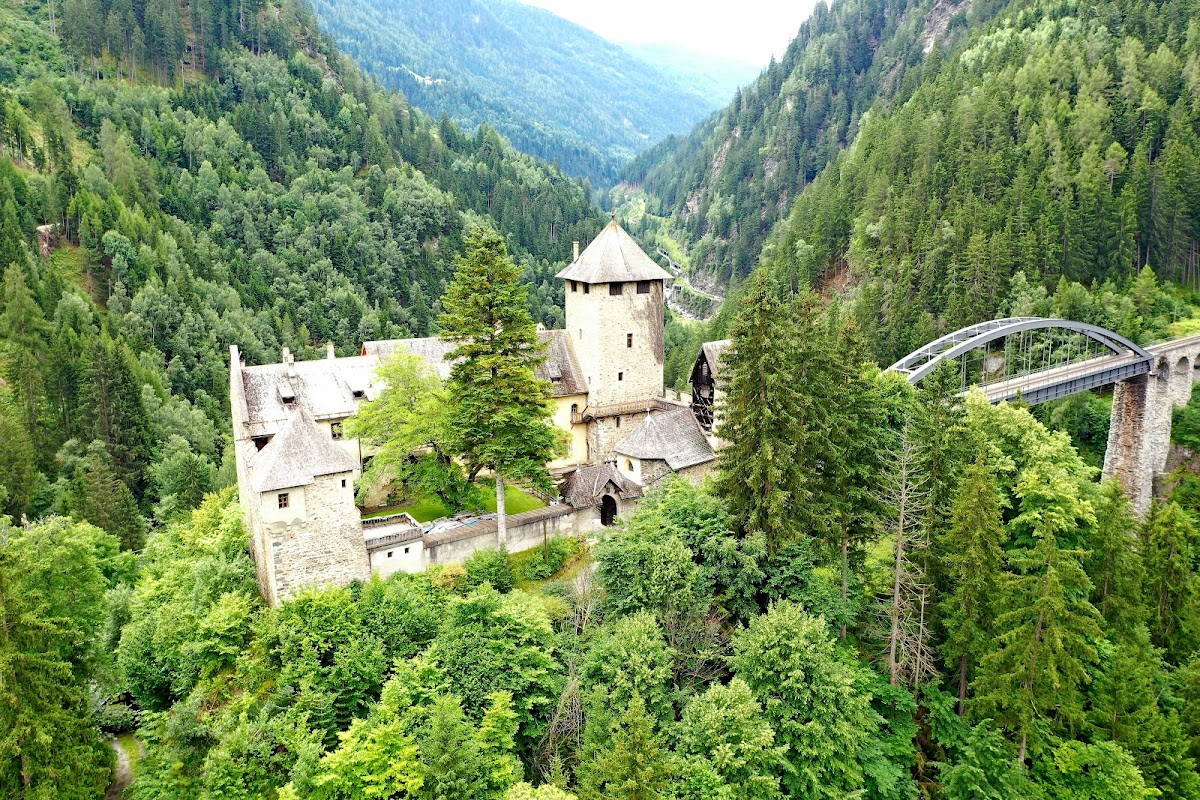
The Austrian state railways later purchased the already dilapidated property to allow construction of the Trisanna Bridge to proceed. The castle chapel was deconsecrated and demolished during these works. Georg Auer, a brewer from Saalfelden, acquired Wiesberg in 1887 and began renovations, but bankruptcy brought the project to an end. Hermann Landfried of Heidelberg bought the castle at the bankruptcy auction in 1889, and he and his brother Fritz began a comprehensive restoration. Wiesberg remains in the possession of the Landfried family.
Wiesberg in 1945
In May 1945, Army High Command 24 of the German Wehrmacht took up quarters at Wiesberg Castle and conducted armistice negotiations with the Americans from the site. Emma Schmitthenner, the wife of Paul Schmitthenner, looked after the property until 1950, first for the American and later for the French occupying authorities. Wiesberg is privately owned and protected as a listed monument in Austria.
Remains
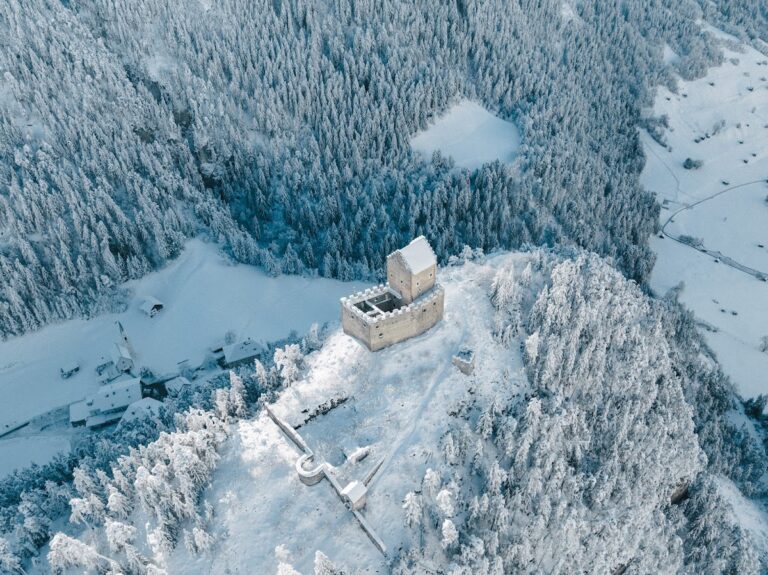
Wiesberg Castle stands on a rock above the Trisanna River, where the Paznaun Valley opens into the Stanzer Valley. Its medieval enclosing wall dates from the second third of the 13th century and forms a trapezoidal plan. Built of strong rubble stone, the curtain wall reaches up to 2.7 metres in thickness and survives almost completely. The western front includes herringbone masonry, in which the stones are arranged in a distinctive angled pattern.
Fortified enclosure
Keep and entrance
The keep flanks the entrance gate and has an almost square plan measuring approximately 7.8 to 8.4 metres. Its corners are built from smoothly dressed granite. The lower third belongs to the earlier structure, while the remainder was added during alterations in 1908. The keep was heightened in the same year and received its present pyramidal roof.
Outer defensive enclosure
An outer defensive enclosure, comparable to a protected space between the main fortification and an exterior wall, dates from around 1500. It includes a roundel and loopholes, narrow openings for defensive weapons. When the enclosing wall was raised to its present height during rebuilding, the older castle gate was buried. It remains visible from the outside.
Residential and religious buildings
Residential connection
A 15th-century building connects the keep with a small residential palas, the principal living building of a medieval castle. This structure forms part of the surviving relationship between the castle’s defensive and residential areas.
Castle chapel
A chapel built in 1420 occupied the northwestern corner of the curtain wall, whose walls are up to 2.7 metres thick. It was remodelled in 1595 and consecrated in 1602 by Simon Feuerstein, Bishop of Brixen, in honour of the Virgin Mary. The chapel was later deconsecrated and demolished during the railway-related works.