Schloss Aschach: A Medieval Castle and Museum Complex in Germany


Site at a Glance
- Rating
- 4.6
- Popularity
- Low
- Country
- Germany
- Primary era
- Early Modern
- External website
- Open
- Eras represented
- Early Modern
- Civilizations
- Holy Roman Empire
- Site type
- Domestic
- Remains
- Castle
On this page12 sections
History
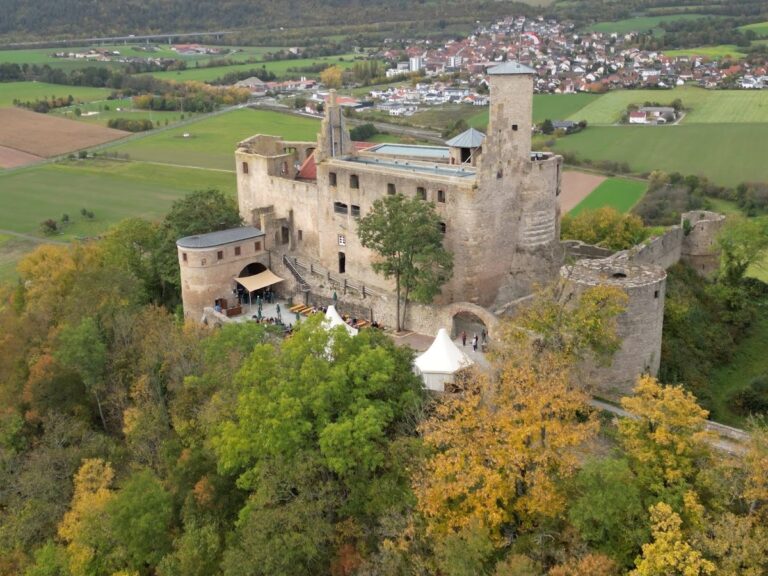
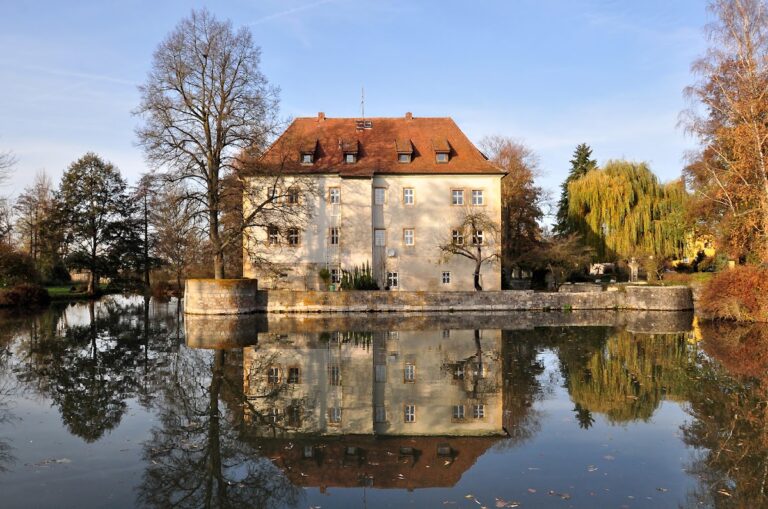
Schloss Aschach is a medieval castle in Germany, in Aschach, now part of Bad Bocklet, whose construction began in 1165 under the Henneberg count Poppo VI. It later became a possession of the Würzburg prince-bishops, survived repeated destruction and changes of ownership, and now houses three museums.
Henneberg Foundation and Succession
Poppo VI began building the castle in 1165, and his son Poppo VII continued the work after his father’s death. When Poppo VII died in 1245, the estate passed to his nephew Heinrich. Heinrich’s death in 1274 led to a division among his three sons, who established the Aschach, Hartenburg, and Schleusingen lines of the Henneberg dynasty. The Hennebergs were a noble family whose territories extended through parts of central Germany and Franconia.
Financial problems later forced the Hennebergs to pledge Schloss Aschach for 20,000 gulden. When they could not redeem it, Dietrich von Bibra acquired the castle in 1391. The Würzburg prince-bishop Johann I von Egloffstein bought it in 1401 and pledged it to Hildebrandt von Thüngen for three years from 1409. Under Johann’s successor, the castle passed to Count Georg von Henneberg for 24,000 gulden. Prince-Bishop Rudolf II von Scherenberg then exercised a right of repurchase, returning Schloss Aschach to the Würzburg prince-bishopric, which retained it for the next three centuries. A prince-bishop combined the spiritual leadership of a diocese with territorial rule, so the castle belonged both to an ecclesiastical institution and to Würzburg’s government.
Destruction and Rebuilding
During the Peasants’ War of 1525, insurgent peasants occupied and burned the castle. Eiring von Rotenhan, the local official responsible for Aschach, was taken to Schweinfurt. After the revolt was defeated, Prince-Bishop Konrad II von Thüngen imposed a punitive court throughout the Würzburg territory. More than 400 people from the Aschach district were fined, while the peasants of Trimberg had to rebuild the castles of Aschach, Botenlaube, and Trimberg. Reconstruction at Schloss Aschach was completed in 1527.
Würzburg’s prince-bishops regularly used the castle during their journeys. From 1542 to 1544, it was the official residence of Prince-Bishop Konrad III von Bibra, who had left Würzburg because of mass deaths. Arson in November 1553, during the conflict begun by Albrecht II Alcibiades, destroyed the castle again. A new building was completed after about twenty years under Prince-Bishop Friedrich von Wirsberg, giving Schloss Aschach its present overall form.
Prince-Bishop Julius Echter von Mespelbrunn visited Schloss Aschach regularly and stayed there for medical cures. In 1575, a delegation from Schweinfurt gave him a 180-pound sturgeon caught in the Main. He commissioned a portrait of the fish, which was placed above the door to the court kitchen. Julius Echter also frequently met his brother Valentin Echter von Mespelbrunn, who administered the Aschach and Kissingen districts for 45 years.
War and the End of the Prince-Bishop’s Residence
In October 1631, during the Thirty Years’ War, the Swedish king Gustav II Adolf conquered the Würzburg territory and granted Schloss Aschach and its district to Colonel Count Brandenstein. The Thirty Years’ War, fought from 1618 to 1648, was a European conflict shaped by religious, dynastic, and territorial struggles. After the Swedes lost the territory in 1633, imperial troops recovered the castle.
After the war, the prince-bishops held social events at Schloss Aschach and made small alterations. Among them was the replacement of the narrow spiral staircase at the portal with a wider external staircase. The castle gradually ceased to function as a prince-bishop’s residence after Prince-Bishop Friedrich Karl von Schönborn-Buchheim commissioned Balthasar Neumann’s summer palace at Werneck. The upheavals connected with the French Revolution further weakened its earlier political role.
Secular Ownership and the Luxburg Period
The secularization of 1803 transferred many Bavarian church properties into secular ownership or administration. Schloss Aschach was sold in 1829 for 5,000 gulden to the Schweinfurt industrialist Wilhelm Sattler. With support from the Bavarian Ministry of Finance, he planned to establish a factory for tin-glazed earthenware or English porcelain at the castle as part of efforts to promote industry in the Rhön. King Ludwig I approved the sale on the condition that the exterior remain unchanged.
Wilhelm Sattler’s wife, Katharina Sattler, born Geiger, helped manage the porcelain factory by keeping its accounts and artistically designing its products. She also created many views of Aschach and the surrounding area. Competition from less expensive mass-produced English goods reduced turnover, and the factory closed in 1860, one year after Wilhelm Sattler’s death. Its inventory was then auctioned.
Fichtel of Schweinfurt, one of Sattler’s sons-in-law and heirs, initially considered converting the castle into a spinning factory but gave the opportunity to his brother-in-law Anton Sattler. Anton restored Schloss Aschach in an “original style” and assembled a large art collection. He auctioned the collection and the castle’s contents in 1868, then sold the castle three years later to his brother Ernst Sattler of Coburg for 32,000 gulden.
In spring 1873, Friedrich von Luxburg, royal Bavarian government president of Lower Franconia and Aschaffenburg, bought Schloss Aschach for 72,000 gold marks. He spent another 56,000 gold marks on alterations, restoration, and furnishings. With the support of Jens Sattler, a son of Walter Sattler, and the Würzburg city architect Josef Scherpf, he directed an artistic renewal of the castle. Count Friedrich von Luxburg also built up an extensive art collection with assistance from the Kissingen collector Karl Streit.
Reich Chancellor Prince Otto von Bismarck visited Schloss Aschach almost every year between 1876 and 1893 while staying at the Upper Saline in Hausen for medical treatment. He used the castle for midday rests and maintained a close conversational relationship with Friedrich von Luxburg. Their relationship briefly became strained after Luxburg, as a member of the Reichstag, voted against one of Bismarck’s legislative proposals. After Bismarck’s dismissal, Luxburg ignored instructions from Berlin to distance himself from the former chancellor and continued to receive him.
War, Donation, and Museums
After Friedrich von Luxburg died in 1905, his second son Karl von Luxburg and Karl’s wife Carola cared for the castle and its collections. During the Second World War, several hundred US soldiers were housed there. In the final days of the war in 1945, Schloss Aschach temporarily served as the headquarters of Field Marshal Ewald von Kleist. The buildings survived the war without major damage. Karl and Carola von Luxburg, who had been in South America since the war began in 1939, returned only in 1949.
In 1955, the 84-year-old Karl von Luxburg, who had no direct descendants, donated Schloss Aschach, its entire inventory, and its associated land to the District of Lower Franconia. The transfer was completed on 14 November 1955. The district undertook to preserve the castle and its art collection for future generations and to make them accessible for cultural and representative purposes.
After Karl von Luxburg’s death in 1956, the Great Castle was carefully converted into a museum under Max Hermann von Freeden, then director of the Main-Franconian Museum. It opened on 21 June 1957. The former forester’s house became a school museum in 1982, and a folk-life museum opened in the Baroque tithe barn in 1984. A tithe barn was used to store agricultural dues traditionally paid in grain or other produce.
The three museums now form the Schloss Aschach cultural complex together with the castle’s small park and restaurant. The Graf-Luxburg Museum closed in 2017 for building work and a redesigned permanent exhibition, reopening in July 2020. Annette Späth directed the museums from 2001 until early 2018, and Josefine Glöckner became director in June 2018.
Remains
The surviving complex combines the castle rebuilt under Friedrich von Wirsberg with later museum buildings and collections. The Great Castle retains domestic interiors, while the former forester’s house and the Baroque tithe barn preserve material relating to schooling and rural life. A coat of arms dated 1530 is mounted on the courtyard facade, and the former portal is approached by the broad external staircase added after the Thirty Years’ War.
The Great Castle
Luxburg Rooms and Collections
The Graf-Luxburg Museum occupies the Great Castle. Of the 36 rooms used by the Counts of Luxburg, 29 have been arranged for museum presentation while retaining their domestic character. The collection includes paintings such as Judith with the Head of Holofernes by Lucas Cranach the Elder and The Baptism of Christ by Michael Wohlgemut. Other displays include sculpture, Augsburg silver, porcelain, furniture, and an important group of East Asian art. Together, the rooms and contents reflect the successive transformation of the castle’s interiors, especially during the Luxburg period.
School and Folk-Life Museums
Former Forester’s House
The former forester’s house contains the School Museum. Its principal feature is a classroom furnished in the style of the period from 1850 to 1900. Old wall charts and maps accompany equipment used for reading, writing, and arithmetic instruction. The museum’s material began to be assembled in 1972, principally by Rudolf Erben, a former one-class teacher who later became a headmaster.
Baroque Tithe Barn
The Folk-Life Museum occupies a Baroque tithe barn dated 1692. The entrance area contains furniture and merchandise from an old village shop. Agricultural tools used throughout the year on farms are displayed on the ground floor, while the upper floor presents rural life among the Rhön population from 1850 to 1950. The barn also provides space for temporary exhibitions.
Nearby sites