Burgruine (Botenlauben): A Medieval Hilltop Castle in Germany


Site at a Glance
- Rating
- 4.6
- Popularity
- Medium
- Country
- Germany
- Primary era
- Medieval
- Eras represented
- Medieval
- Civilizations
- Holy Roman Empire
- Site type
- Military
- Remains
- Castle
On this page10 sections
History
Burgruine, also known as Botenlauben or Bodenlaube, is a ruined medieval hilltop castle in Germany, located in Reiterswiesen, now a district of Bad Kissingen in Bavaria. Its foundation date is unknown, but construction is generally placed around 1180, while its two principal towers were probably built between 1200 and 1220. The castle first appears in a document from 1206, when Otto von Botenlauben was named as “Otto de Bodenlouben.”
Origins and the Henneberg residence
The name Botenlauben may combine the personal name Boto with Laube, understood here as a residence. One interpretation associates Boto with Count Boto of Carinthia, who may have been linked to the transfer of power from the Imperial Abbey of Fulda to the Margraves of Schweinfurt and later the Henneberg dynasty. Another theory connects the name with an older estate below the castle, supposedly occupied by a landowner named Boto who donated it to Fulda Abbey in 797. This identification remains uncertain. Medieval records used many forms of the name, including Bodenlouben, Bodenlovben, Botenlovbe, Bothinloibin, Botenloben, Botenlouben, and Botenlauben.
From 1220 to 1242, Botenlauben was the residence of the Henneberg nobleman Otto von Botenlauben and his wife, Beatrix of Courtenay. Otto had taken part in Henry VI’s Crusade and remained in the Orient for a period, where he met Beatrix. The couple eventually settled at Botenlauben in 1220. Otto was a German minnesinger, a medieval poet associated with courtly song, and his court was connected with this literary tradition. Visitors reportedly included members of the Hildenburg and Trimberg families, Henneberg relatives, merchants, entertainers, and other minnesingers.
Tradition relates that Beatrix lost her veil while walking near the castle and vowed to establish a monastery at the place where it was found. Otto and Beatrix consequently founded Frauenroth Monastery. They retained the right to live at Botenlauben until 1242, when they withdrew to Würzburg. Their son Otto II and his wife Adelheid entered the Teutonic Order, a medieval religious-military order, in 1230 or 1231. This event appears to have formed part of the circumstances that led Otto and Beatrix to sell the castle.
Transfer to the Bishopric of Würzburg
In 1234, under Bishop Hermann I of Lobdeburg, Botenlauben passed to the Bishopric of Würzburg. The bishopric was both an important ecclesiastical institution and a territorial principality whose bishops exercised secular authority over their lands. The sale also provided financial support for Frauenroth Monastery. In 1244, Hermann I established the Amt Botenlauben, an administrative district intended to restrict Henneberg power. It became one of roughly 40 such districts within the Bishopric of Würzburg.
The first recorded episcopal administrator was Lambert Marschall of Botenlauben, who held office until 1259. Later officials included Konrad of Schwanfeld, Konrad Hurnig, and Eberhard of Erthal. The castle itself was granted as a fief to successive nobles, while ultimate authority remained with Würzburg. Among the recorded holders were members of the Schwanfeld, Hurnig, Erthal, Heustreu, Eltingshausen, Maßbach, Bibra, Schlitz, Arnstein, Schletten, Witzleben, Henneberg, Brunn, Herbilstadt, Milz, Fullbach, Stein, Wiesenthau, Thüngen, Münster, and Heußlein families. These enfeoffments continued into the nineteenth century.
Pledges, conflict, and administrative change
Botenlauben was repeatedly pledged to nobles who advanced money and then received control of the office. In 1356, Bishop Albert II of Hohenlohe pledged the castle to Knight Lutz of Thüngen for 2,550 pounds of Heller, a historical monetary unit whose value varied by time and place. During the grape harvest of 1395, Count Frederick of Henneberg-Hartenberg attacked the castle while Anton of Bibra and his brother-in-law from the Schwanfeld family served as castellans. Anton later faced a case before the Nuremberg Regional Court, but its outcome is unknown.
Around 1400, the brothers Frohwein, Hartmund, Heinrich, and Ludwig of Hutten controlled Botenlauben and divided its administrative powers among themselves. Their treatment of local subjects led the Bishop of Würzburg to remove the office from them in early 1402. On 29 May that year, it passed to Count Frederick I of Henneberg, although the bishop retained the right to appoint the administrator. The Hutten brothers responded with raids in the Botenlauben district. Their castle at Werberg was besieged until 13 November 1403 on the orders of King Rupert, Bishop Johann I of Würzburg, Abbot Johann of Fulda, and Counts Heinrich and Frederick I of Henneberg. A settlement required the brothers to appear before the Landfriedensgericht, a court concerned with maintaining the public peace, and to pay compensation.
For several decades, Botenlauben remained subject to a pledge relationship between Würzburg and the Henneberg family. Frederick I of Henneberg, his son George I, and George’s son Otto IV each failed to secure complete possession. In 1474, Bishop Rudolf II of Scherenberg redeemed the castle and office for Würzburg. Heinrich of Steinau had lent the 3,000 gulden needed for the redemption and served as administrator until 1500, followed by his son Reinhard. In 1521, Prince-Bishop Konrad II of Thüngen redeemed the office, which was thereafter managed by an official treasurer.
The estate below the castle
The agricultural estate below Botenlauben developed into the hamlet of Unterbotenlauben. It may have existed before the castle, although its proposed connection with the landowner Boto is uncertain. Under the Hennebergs, the estate supplied the castle’s economic needs. From 1234, documents described it in various ways, including as a suburb, forecourt, outer bailey, farm below the castle, farmyard, and Unterbotenlauben.
From 1244, records distinguished Hofgut Botenlauben from the castle estate, or Schlossgut. The latter extended around the castle and included the Breitenloh woodland, which measured 380 acres. Hofgut Botenlauben consisted of two free farms. One was connected with a castle fief and passed through several holders, while the other was administered by Würzburg and was partly shared with the Hennebergs until their line died out in 1559.
Destruction and later preservation
The Peasants’ War of 1525, a widespread uprising against social and economic burdens in the German lands, severely damaged Botenlauben. Peasants from Aura an der Saale captured or attacked the castle, and the suppressed peasants were then compelled to rebuild the nearly destroyed fortress. Their collective payment toward the stated damages of 269,659 gulden amounted to 647 gulden. The administrative seat moved to Ebenhausen, whose official, Engelhard the Younger of Münster, directed the Botenlauben district until his death in 1528.
The castle was finally destroyed in 1553 during the Second Margrave War. The combined district of Ebenhausen-Botenlauben was then pledged by the prince-bishop for 13,900 gulden to Lorenz of Münster, Engelhard’s son and successor. From the seventeenth century, residents of Reiterswiesen used the ruins as a quarry. During the Thirty Years’ War, the district had to pay the Swedes an annual contribution of 472 gulden from 1631. On 2 March 1632, Swedish forces transferred the Botenlauben villages of Kronungen and Oberwerrn to the Imperial City of Schweinfurt. By 1635, the population of the Bodenlauben-Ebenhausen districts had fallen to 634 men, and in 1637 the Kissingen pastor Pistorius described a severe famine. The two villages returned to the district in 1641, and the last Swedish march through the region took place in 1647.
The Amt Botenlauben was dissolved in 1670, when its villages were incorporated into the Amt Ebenhausen. Feudal enfeoffment continued into the nineteenth century. In 1796, the last Prince-Bishop of Würzburg enfeoffed Botenlauben to the families of Bibra and Erthal. After the Erthal line died out in 1805, the property passed into government hands. King Ludwig I granted it again to Ernst Freiherr of Bibra on 15 April 1830, but the arrangement ended when the Allodification Act converted Botenlauben from feudal tenure into state property on 13 June 1848.
King Ludwig I also took measures to preserve the ruins. Stone robbing ended around 1830 as interest in the Middle Ages and Romanticism increased. In 1881, the Bad Kissingen spa physician Ignaz Ising founded the Botenlauben Association, initially with the aim of making the ruins a tourist attraction. From the beginning of the twentieth century, its emphasis shifted toward historical interest. Restoration work took place during the second half of the twentieth century. Since 1984, the Reiterswiesen local-history association has held the Burgfest, a historically themed festival recalling medieval life at the castle. Burgruine is listed as a monument of Bad Kissingen under number D-6-72-114-119 and stands at approximately 340 metres above sea level.
Remains
Hilltop castle and towers
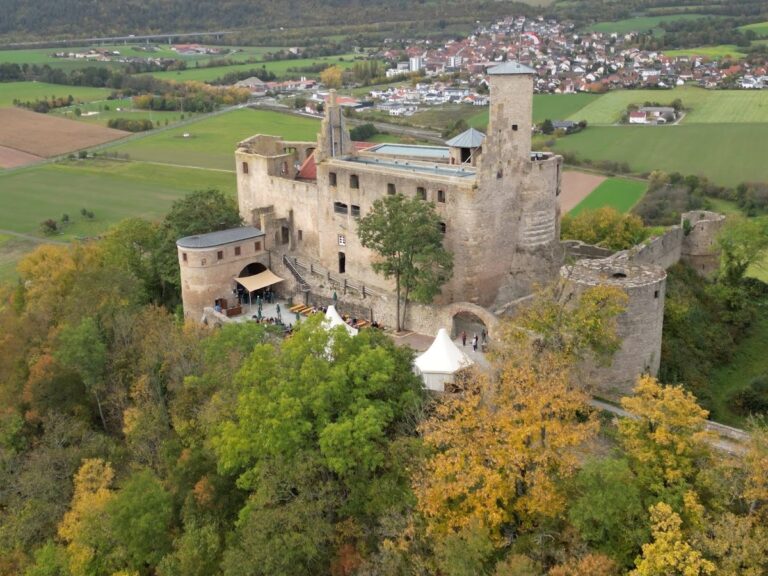
Burgruine survives as a hilltop castle ruin whose two principal round defensive towers remain only as stumps. They were built from highly regular bossed ashlar, or dressed stone blocks with projecting cushion-like outer faces. The masonry has no clamp holes, openings associated with lifting or construction equipment. These features support a date around 1200 to 1220. The arrangement of the towers has been compared with Münzenberg Castle in the Wetterau and with castles at Saaleck, Hoh-Andlau, Kohren, and Thurant.
Residential buildings and chapel
The residential buildings date from the first half of the thirteenth century. Their foundation walls, including those of a palas, the principal residential and representational building of a medieval castle, were exposed or made visible again through archaeological excavations. A house chapel occupied the north tower. Its services probably served the castle household as well as the inhabitants of the associated estate below the hill. Otto’s scribe Berthold is the only chaplain known from this period. A later legend says that the chapel bell was transferred to the chapel at Terzenbrunn in Arnshausen.
Unterbotenlauben and the former estate
Hofgut Botenlauben lay on the northern slope below the castle and functioned as its agricultural or economic estate during the Henneberg period. The later hamlet of Unterbotenlauben developed from it. In 1741, four houses stood around an old lime tree at the present intersection of Kissinger Strasse and Carl-Diem-Strasse. The tree stood beside a well associated with the hamlet, and both became a popular excursion destination during the nineteenth century. When the lime tree was considered threatened by decay, a preservation fund was established in 1825 and its strong branches were supported with iron rods.
A restaurant established in 1832 burned during the winter of 1843 to 1844 but continued later as Café Botenlauben. Unterbotenlauben contained ten properties in 1903 and gradually merged with Reiterswiesen. Reiterswiesen became a district of Bad Kissingen during the municipal reform of 1972. A donor plaque installed on the north tower in 2012 commemorates donations that financed replacement flags after a year without one because of wear and vandalism. The plaque and flags are modern additions to the surviving ruin.
Nearby sites