Homberg Castle: A Strategic Hilltop Fortress in Germany


Site at a Glance
- Rating
- 4.7
- Popularity
- Low
- Country
- Germany
- Primary era
- Medieval
- External website
- Open
- Eras represented
- Medieval, Early Modern, Modern
- Civilizations
- Holy Roman Empire
- Site type
- Military
- Remains
- Castle
On this page17 sections
History
Homberg Castle is a hilltop fortress ruin in Homberg an der Efze, Germany, whose construction date and builder are unknown, although it was already in existence before 1190. Also known as Hohenburg or Homberg, it stood above important roads and developed with the town as a single political and defensive unit.
Medieval lordship and administration
A Rentwich of Hohenburg was named in 1162, while the Hohenburg family continued until 1427, when it died out with Simon vom Hohen Berg. From about 1190, the castle belonged to the Landgraviate of Thuringia, a territory ruled by a high-ranking prince. It was first explicitly described as a castle in 1246.
During the thirteenth century, Hohenburg passed under Landgrave Henry I into the newly established Landgraviate of Hesse. The castle then became the administrative center of the Homburg office. Its position on the historic road between Frankfurt and Leipzig, near the junction of routes linking Fritzlar with Hersfeld and Frankfurt with Eisenach, gave it considerable strategic value.
Rebuilding and strengthening
In 1508, Hermann IV, Archbishop of Cologne, owned the castle and carried out extensive rebuilding. An archbishop was a bishop with authority over an ecclesiastical province. Hermann was also an elector, a prince entitled to help choose the Holy Roman Emperor, and Imperial Archchancellor through Italy.
Landgrave Maurice ordered the construction of the castle well and further strengthening of the fortifications between 1605 and 1613. The work cost 25,000 thalers.
Sieges and destruction in the Thirty Years’ War
The Thirty Years’ War, a European conflict fought from 1618 to 1648 over religious, dynastic, and territorial disputes, brought the castle into direct military action. Imperial troops occupied Homberg on 16 July 1636. General Johann von Gotzen then led an army of 13,000 men against the castle, but the siege failed. The water supply became unusable after a woman fell into the well shaft, while about 3,000 refugees sheltered inside the fortress.
Gotzen’s forces began another siege on 3 August 1636. The garrison capitulated because it lacked water, and an Irish regiment commanded by Colonel Hugh Tirell occupied the partly destroyed castle for four months. When the regiment withdrew, imperial troops burned both the castle and the town.
General Peter Melander of Holzappel occupied the ruined complex in 1647 and ordered repairs. Major General Carl Rabenhaupt besieged it from 28 to 30 January 1648 and recaptured it for the Landgraviate of Hesse-Kassel. The garrison capitulated again on 9 February. The war ended soon afterward with the Peace of Westphalia, the treaties that concluded the conflict in 1648.
Decline and preservation
The heavily damaged castle was not rebuilt. It deteriorated and was partly quarried for stone during the reconstruction of Homberg, which had also suffered destruction. Former castle components were reused in the town, and the castle well was filled in during 1657.
The ruins passed to the town of Homberg in 1822. From 1881, the Homberg Beautification Association developed the Schlossberg as a park-like landscape. A castle association began exposing, restoring, and maintaining the ruins in 1936. Its plans for a new tower and a memorial hall for soldiers killed in the First World War were halted by the outbreak of the Second World War.
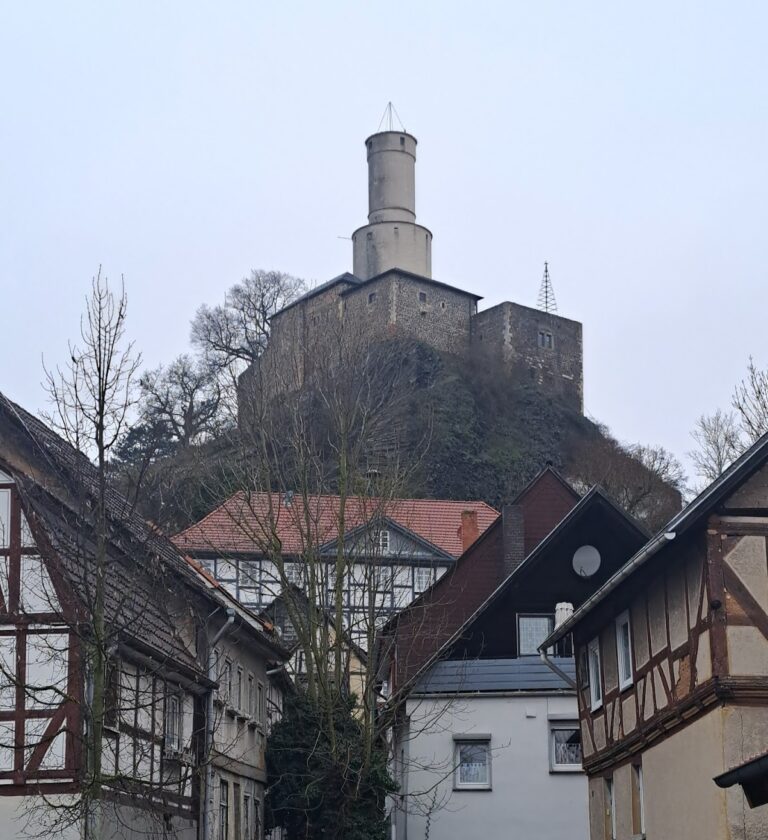
A new tower was erected on old foundations between 1952 and 1958. It was designed in the form of a historically inspired keep but is an observation tower rather than part of the medieval castle fabric. The castle is maintained as a ruin, and a restaurant occupies the site of the former outer ward.
Remains
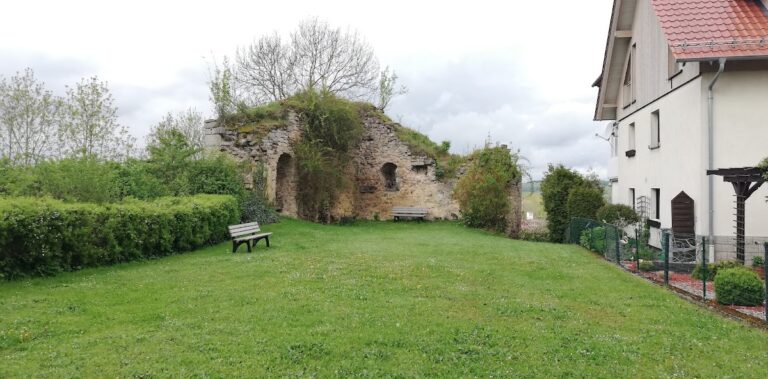
The ruins occupy the wooded Schlossberg, a steep basalt cone rising to 376.5 metres above sea level from the Efze floodplain. Built-up parts of Homberg surround the hill on its western, southern, and eastern sides. The former fortress was an extensive complex with an outer defensive enclosure, a main castle, a ring wall, and a ditch.
Outer defenses and entrance
Outer ward
The outer ward, or zwinger, was a defensive enclosure between the main fortification and the outer wall or gate. It included an outer gate, a drawbridge crossing the castle ditch, and outer bastions, which were projecting fortified platforms. The area now contains a restaurant, while surviving or recorded elements include the outer gate and the former gate tower.
Main entrance
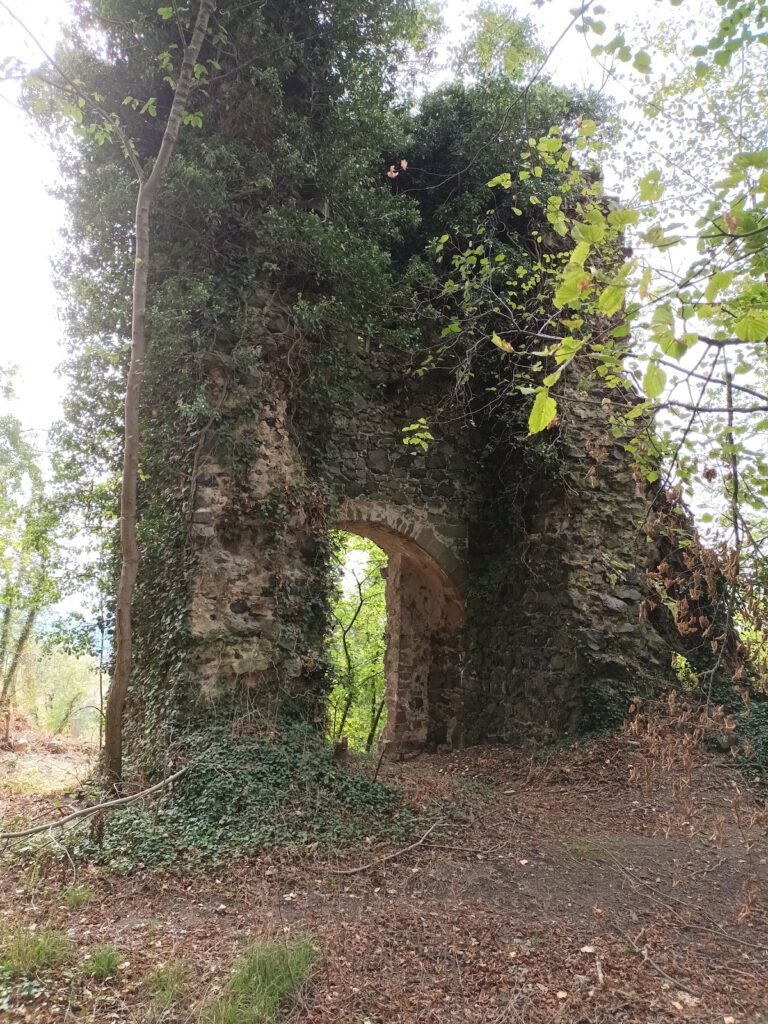
A gate tower connected the outer defenses with the main castle. From this area, a defensive passage led along the battlement to the entrance of the castle chapel. The castle gate, a heraldic stone in the gate passage, and parts of the former gate tower remain among the identifiable entrance features.
Main castle structures
Residential and military buildings
The main castle contained a palas, the principal residential and representative building of a medieval castle, with a knights’ hall used for major communal and ceremonial activities. Other structures included a stable, military accommodation, a commandant’s house, an arsenal, and a gun house.
Walls and defensive features
The ring wall was 1.5 metres thick and enclosed the main complex. A projecting shooting gallery formed part of the defensive arrangements, while a stair tower and the castle ditch supported movement and protection within the fortress.
Well house and surviving tower
Castle well
The well house contained a 150-metre-deep castle well, described as the fourth-deepest castle well in Germany, together with a cistern. The well was filled in after the Thirty Years’ War and excavated again between 1997 and 2001. Its depth and water-related role help explain the outcome of the 1636 sieges.
Observation tower
The present tower has a diameter of 11 metres and stands 14 metres high. Built between 1952 and 1958 on historic foundations, it takes the form of an old keep, or main defensive tower, but does not belong to the medieval castle fabric. It functions as an observation tower overlooking Homberg and its surrounding area.
Archaeological evidence
Bronze plaque
A bronze plaque found during excavation bears an inscription naming Hermann, Archbishop of Cologne, Imperial Archchancellor through Italy, elector, and Duke of Westphalia and Engern. It dates to 1508 and carries the archiepiscopal and landgravial coats of arms with chased decoration. The plaque is preserved in Homberg’s local history museum.