Schloss Mauer, Radstadt: A Historic Estate and Former Defensive Residence


Site at a Glance
- Rating
- 4
- Popularity
- Very Low
- Country
- Austria
- Primary era
- Early Modern
- Eras represented
- Early Modern
- Civilizations
- Holy Roman Empire
- Site type
- Domestic
- Remains
- Castle
On this page12 sections
History
Schloss Mauer, also known as Oberbräuschlössl, is a historic residence in Radstadt, Austria. The estate was first recorded in 1350 in the possession of Jakob von Mauer, and a defensive residential tower typical of the Pongau is considered likely to have stood on the site earlier. Jakob’s possible connection with the Lungau family von der Mauer remains uncertain.
The Graf and Schernberg families
The property later came into the hands of the Graf family, whose influence in the region expanded through administrative office and acquisition. Konrad Graf exchanged his position as Urbarprobst of Werfen, an official responsible for estate administration and land dues, for the judgeship of Radstadt in 1344. His son Heinrich acquired Schloss Schernberg in 1370 and adopted the noble designation of the extinct Schernberger family.
Konrad II became Pfleger of Radstadt in 1396. A Pfleger was a territorial administrator who exercised judicial and administrative authority for a higher lord. Members of the family continued to hold this office while extending their possessions to include Schloss Mauer, the Graf residence in Radstadt, Schloss Tandalier, and Schloss Lerchen.
Leasing, division, and repeated transfers
After Jakob Graf died in 1587, his sons Konrad and Heinrich leased the estate. The tenants were responsible for maintaining the castle, while payments to the Salzburg Cathedral Chapter remained with the Schernberg heirs. The Chapter was the ecclesiastical institution that held the stated manorial authority over the estate. Following the deaths of both brothers in 1610, Heinrich’s nine minor children were placed under the guardianship of Josef Hunt von Ainödberg, Pfleger of Saalfelden, and Burkhard Schwaiger, district judge of St. Veit and owner of Schloss Tandalier.
With the Cathedral Chapter’s approval, the Mauer estate was divided and its separate properties were sold in 1617. Heinrich von Elsenheim, Pfleger of Radstadt, acquired the main part but died the next year. His widow then transferred the Mauer residence to Jakob Wilpenhofer of Schloss Lerchen. In 1622, Jakob’s cousin Abel Wilpenhofer acquired the property and paid the other heirs. After Abel’s death in 1628, his brother-in-law Baptist Voglmayr, a land and mining judge at Rauris, sold the residence to Hans Wagnhitter, the mayor and an innkeeper of Radstadt.
Wagnhitter unsuccessfully sought permission to operate an inn at Mauer and sold the property back to Katharina Gößl of the Wilpendorfer family. Financial difficulties led Gößl to transfer it to Josef Ziurletta, Pfleger of Radstadt and owner of Schloss Lerchen. Ziurletta secured the residence’s release from its obligations to the Cathedral Chapter in return for compensation. His son and successor, Johann Christoph Ziurletta, showed no interest in Mauer and later sold it to Christian Leitner, an innkeeper from Radstadt.
The innkeeping estate
Leitner’s daughter Luzia Barbara, who was married to Martin Friedrich Wishofer, held the castle for more than 40 years. In 1733 it passed by purchase to Johann Kaspar Pichler, a princely-archiepiscopal official who had advanced from deputy clerk at the district court to high princely councillor and court paymaster.
The property subsequently belonged to members of the Kaswurm family, Radstadt innkeepers and brewers. Adam Kaswurm owned it in 1741, Johann in 1754, and Martin in 1797. Martin renewed the effort to obtain an innkeeping concession and succeeded in 1804. The estate then became known as Oberbräuschlössl.
Fire, rebuilding, and modern ownership
Martin Kaswurm transferred the property to his daughter Theresia, the wife of Peter Ehrenreich, in 1830. After her death in 1855, it passed to her husband. Because of his indebtedness, he sold it to his stepmother Anna Ehrenreich, who had the estate auctioned in 1864. The brewing couple Johann and Karoline Kendlbacher acquired it at the auction.
A fire in 1865 devastated the castle, its ancillary buildings, and the surrounding ring wall. The Kendlbachers rebuilt the castle, although the enclosure was not restored in full. Eduard Kendlbacher inherited the property in 1892 and died without a will in 1906. His five minor children became the heirs, and Johann Kendlbacher received the entire estate in 1913. After Johann’s death, his siblings Marianne, Eduard, Vinzenz, and Karl inherited it in 1917. The property was divided between Marianne and Karl in 1919 and passed entirely to Karl in 1922.
The estate was auctioned again in 1936 and acquired by the Sparkasse of Ried im Innkreis, while the Kendlbacher family retained the house archive. Hans Pichler bought the castle in 1938 and sold it in 1947 to Wagenbichler, a spa physician from Gastein. The Wagenbichler family renovated the residence and adapted it to twentieth-century requirements. The family remains its owner. Schloss Mauer is a protected monument in Austria and remains privately owned.
Remains
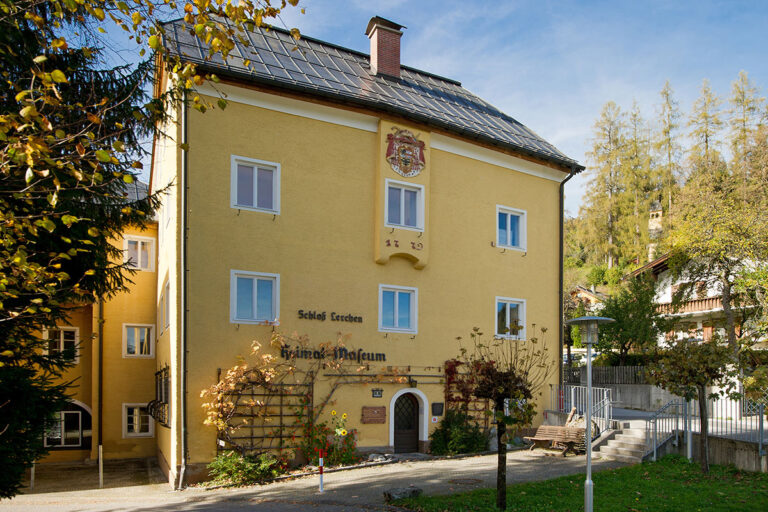
The surviving estate consists of a three-storey square residence, fragments of its former fortified enclosure, and a group of agricultural, service, and religious buildings. The present appearance of the main building was created after 1565 under Jakob Graf zu Schernberg. Its deeply lowered half-hipped roof, bay windows, and projecting southern bay give the residence its characteristic form.
Residence and enclosure
Main residence
The main building has a square plan and rises three storeys. A central bay projects from the south façade. Its first storey rests on stone consoles, while the upper part ends in a timber structure covered by a gabled roof. The ground floor contains barrel vaults with lunettes, which are curved openings or sections cut into a vaulted ceiling. On the upper floor, richly moulded coffered ceilings survive from the period of Jakob Graf.
Fortified ring wall
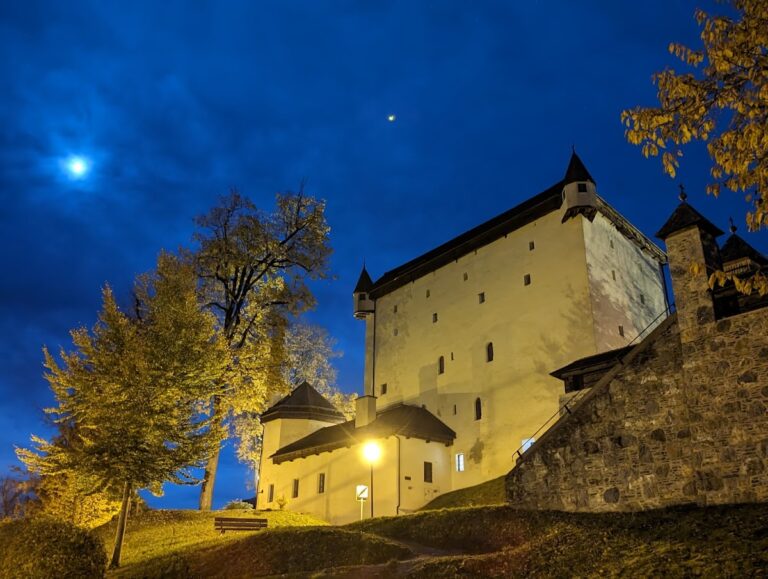
Before the 1865 fire, the estate was enclosed by a fortified ring wall with four towers. Two towers on the southern side survive, together with sections of the original enclosure around the residence. Their loopholes, like those in the remaining wall sections, have been blocked. The eastern entrance gate bears the date 1577 and is decorated with four stone hemispheres.
Outbuildings and grounds
Rear annex and farm buildings
A separate annex at the rear contains the privy installation. Beyond it are a dairy building and stables. An eastern storage door beneath the eaves allowed harvested produce to be brought into the building. Additional service buildings occupy the grounds and reflect the estate’s agricultural and domestic functions.
Chapel and reused stone
The reduced outer park contains a small, simply designed chapel. A reused stone fragment, probably brought from Radstadt, is built into the west side of the residence. Such a reused architectural element is called a spolie. The fragment carries the inscription “PARIS EX COM LODRONI ARCHIEPS SALISBURG F ANNO DOM MDXXXII.” It does not relate to Schloss Mauer itself, but refers to the fortification of Radstadt by Paris Lodron, prince-archbishop of Salzburg from 1612 to 1653. Those works belonged to the period of the Thirty Years’ War, the major European conflict fought from 1618 to 1648, when Salzburg’s fortifications were strengthened.
Nearby sites