Schloss Lerchen: A Medieval Castle and Local-History Museum in Austria


Site at a Glance
- Rating
- 4.3
- Popularity
- Very Low
- Country
- Austria
- Primary era
- Medieval
- External website
- Open
- Eras represented
- Medieval, Early Modern, Modern
- Civilizations
- Holy Roman Empire
- Site type
- Domestic
- Remains
- Castle
On this page11 sections
History
Schloss Lerchen is a medieval castle in Radstadt, Austria, whose history began in the second half of the thirteenth century. It was first mentioned in 1289, when it stood as a tower, and it later developed into a larger residence that retained elements of its Gothic character.
Medieval Origins and Destruction
The castle was captured, plundered, and burned during the Peasants’ Revolt of 1525–1526, an uprising in which rural communities challenged established political and religious authority. Michael Wilpendorfer began rebuilding Schloss Lerchen around 1530, and the Wilpendorfer family retained the property until 1633.
About a century after the rebuilding, the castle provided temporary shelter for the Benedictine nuns of Nonnberg, a women’s abbey in Salzburg. They stayed there for nine months while fleeing a plague epidemic in Salzburg. Around this period, ownership passed from the Wilpendorfers to Joseph Christoph Ziurletti von Lerchen.
Changes of Ownership and Eighteenth-Century Conversion
Captain Johann Schmiedinger purchased the castle in 1637. It was sold to Joseph Christoph Ziurletti von Lerchen in 1648, and his son Johann Christoph later left the estate by testament to the city of Radstadt. The city sold it to Felix Pflanzmann in 1695.
After further changes of ownership, the Salzburg Hofkammer acquired Schloss Lerchen in 1779. This administrative and financial office of the Salzburg archbishopric converted it into an official residence and a dwelling for the chief gamekeeper and forest supervisor. That work gave the building much of the appearance it retains today.
Nineteenth- and Twentieth-Century Uses
After Salzburg was incorporated into Austria, the castle was auctioned in 1823. Josef Schaidinger, a brewer and innkeeper from Radstadt, acquired it and established a brewery cellar there. The recorded owners after 1828 included Katherina Zallerin, Franz Benedikt Steinwender, the dean of Teisendorf, the municipality of Radstadt, Benedikt Geringer, Matthias and Theresia Wisenegger, Cyril and Maria Darin, and Leonhard Marangani, an Italian sawmill owner who acquired it in 1882.
Marangani substantially altered the interior, and his children sold the property to Rupert Prehauser in 1904. In 1905, St. Catherine’s Hospital in Radstadt purchased Schloss Lerchen and established a hospital and care institution there. The municipality of Radstadt took the property back in 1939.
An extension constructed in 1971–1972 accommodated a retirement home. Since 1985, the principal part of Schloss Lerchen has housed the Radstadt local-history museum, while the 1970s extension continues to serve as a retirement home. The municipality owns the castle, which remains in use.
Remains
Castle Structure
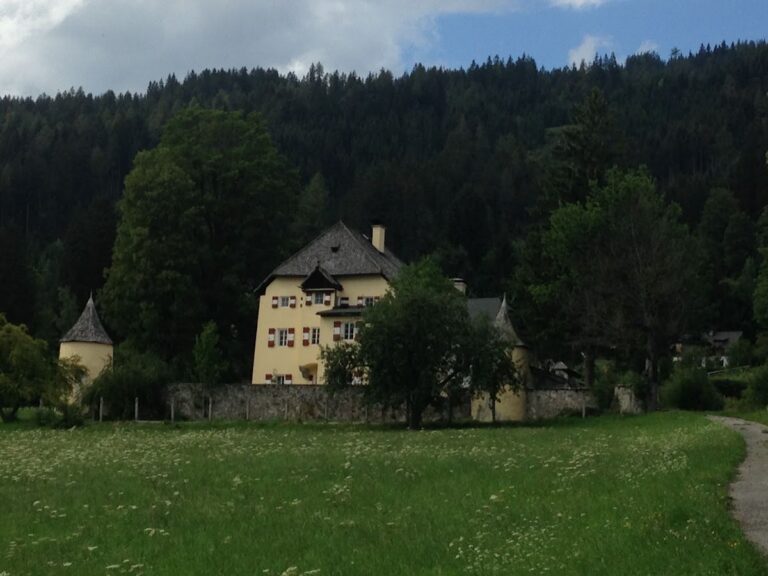
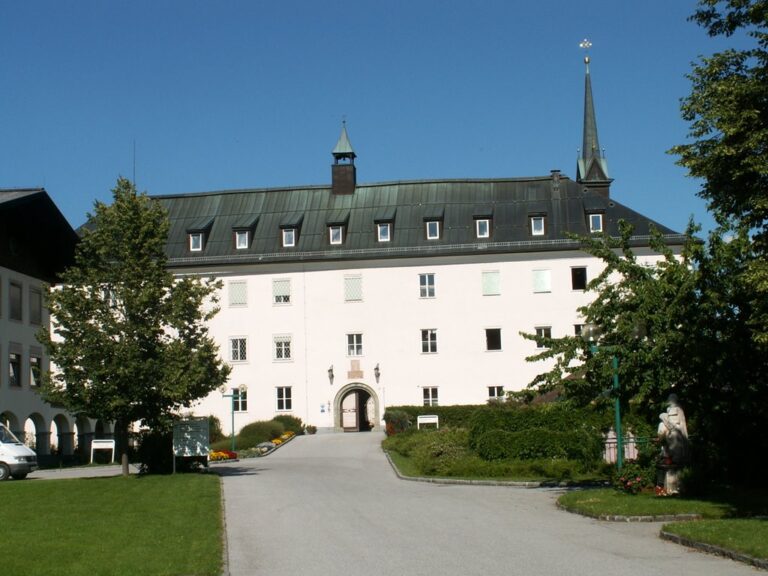
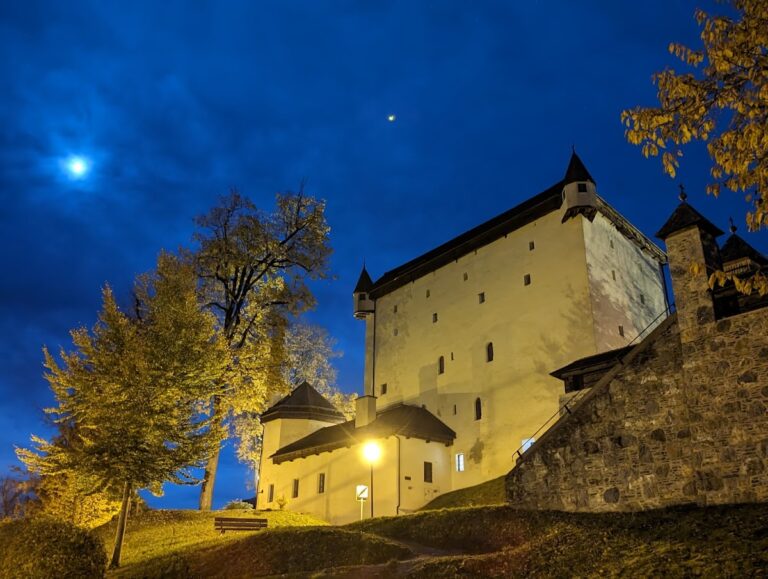
The original castle has a rectangular plan, three storeys, and a pitched roof clad in metal. Its Gothic core occupies the northeastern part of the complex within a separate three-storey block. Additions and alterations have substantially changed the appearance associated with a Salzburg country residence, and the building’s present form largely reflects work completed by the end of the eighteenth century.
A preserved bay window carries the coat of arms of Salzburg Archbishop Hieronymus von Colloredo, together with the date 1779. The feature links the surviving fabric to the period when the Salzburg Hofkammer converted the castle into an official residence and staff dwelling.
Local-History Museum
Ground Floor
The museum occupies all three floors of the main building. On the ground floor, exhibitions examine the region’s natural environment and its changes over time, including geology, landscape, the Ice Age, climate, and mining. The floor also contains an adventure tunnel designed for children.
First Floor
The first floor presents the history of Radstadt from the Roman period onward. Its displays include the sixteenth-century Peasants’ Revolt, examples of sacred art from Radstadt, and old views of the town.
Second Floor
The second floor explores major local occupations and the ways they changed over the centuries. Exhibits include tools and equipment used by rural doctors and midwives, workers in local ceramics production, and practitioners of other trades, together with examples of handicraft products.
Paul Hofhaimer Room
One museum room is devoted to Paul Hofhaimer, a Renaissance-era composer and organist associated with Salzburg and the surrounding region.
Nearby sites