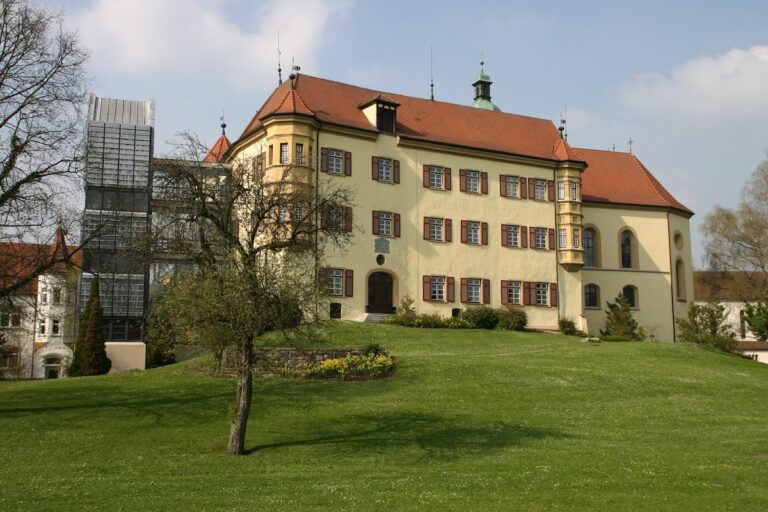
Schloss Benzenhofen: A Historicist Tudor-Style Castle in Germany


Site at a Glance
- Rating
- 4.8
- Popularity
- Very Low
- Country
- Germany
- Primary era
- Modern
- External website
- Open
- Eras represented
- Modern
- Civilizations
- German
- Site type
- Domestic
- Remains
- Castle
On this page13 sections
History
Schloss Benzenhofen is a historicist Tudor-style castle in Germany, near Berg in the Ravensburg district of Baden-Württemberg. Otto Benze and his wife acquired the building plot in 1897, and Benze commissioned the castle in 1898–1899. The project formed part of his effort to establish the disputed noble name “Benze von Benzenhofen” and to present an ordinary agricultural holding as a knightly estate.
Otto Benze and the creation of the estate
Benze had used the name “Benze von Benzenhofen” since his student years and worked increasingly during the 1890s to gain recognition as a member of the nobility. His marriage in 1894 to Marie Luise Lülling du Repaire de Truffin, who had French noble ancestry, apparently provided him with financial resources. At the beginning of 1897, he acquired the Châteaurenard estate near Avignon and several French noble titles from Prince Henri-François de Valori. He also purchased the Benzenhofen estate to lend legitimacy to the disputed title “von Benzenhofen.”
When Benze bought the property, it was an ordinary agricultural holding. Its original buildings included a dwelling house, barn, horse-powered machinery house, granary, and coach house. The new castle formed the center of a larger estate that also contained a bakehouse, laundry, smithy, meadows, gardens, and fields. Although the main construction took place in 1898–1899, interior completion continued until 1901 after Benze moved to Brussels to avoid a lengthy investigation into his claimed title.
Legal disputes and life at Benzenhofen
Benze continued to spend long periods in Brussels and Paris while legal proceedings over his title continued until 1905. From 1909, he lived mainly at Benzenhofen with his family. He and his wife were described as displaying pathological paranoia. Their fears included burglars, the theft of the castle’s paintings, and poisoning. Shots were fired at supposed intruders, food was collected from a nearby inn in a locked container, and the precautions affected servants, visitors, and their daughter Vicky. When Benze was away, the painting collection was stored at the State Gallery in Stuttgart.
Benze and his wife separated around the outbreak of the First World War. She moved to Geneva, where she died in 1921, leaving Benze as the castle’s sole owner. Tenant farmers managed the associated estate, most recently Benze’s brother-in-law Max Rotty, the brother of his second wife. Estate revenues barely covered operating costs, and the confiscation of Benze’s French property in 1922 after the war further weakened his finances.
Fire, debt, and forced sale
The estate barn burned in 1928. Benze ordered its reconstruction and added a feed silo, a structure for storing animal feed, that was greatly oversized for the estate’s small livestock operation. A dispute over the quality of the work followed after Benze withheld part of the contracted payment. Legal proceedings eventually required him to pay more than 7,000 Reichsmarks, the German currency used from 1924 to 1948. When he could not meet the judgment, paintings from the castle collection were seized.
Financial collapse continued. The estate entered compulsory administration in 1931, meaning that it was placed under externally supervised management because of Benze’s inability to meet his financial obligations. A forced sale, or legally enforced sale to satisfy debts, was ordered in 1932. On 21 June 1932, Anton Pfeiffer, a farmer from Zuberg, bought Schloss Benzenhofen for 60,000 Reichsmarks. His descendants remain the owners.
Collection and later history
During this period, Max Schefold of the State Gallery in Stuttgart prepared an extensive inventory of the artworks and other objects in the castle. The collection included paintings, valuable sculptures, porcelain, faience, and antique furniture. A painting by Peter Paul Rubens showing the Spanish Infante Don Ferdinand on horseback during the Battle of Nördlingen had been in Benze’s possession since 1904. Benze’s widow sold it in 1947.
Franz von Papen occupied an apartment in the castle from 1949 to 1952 and began writing his memoirs there in 1949. A German conservative politician and diplomat, von Papen had served as Chancellor of Germany in 1932 and later as Vice-Chancellor under Adolf Hitler. Schloss Benzenhofen was named the Baden-Württemberg Monument Foundation’s “Monument of the Month” for March 2021.
Remains
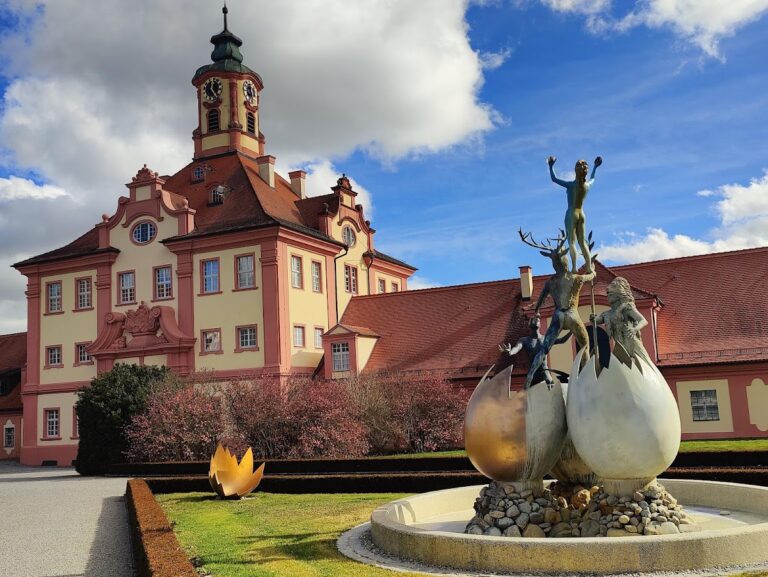
Schloss Benzenhofen is a two-story stucco building designed in the Tudor style, a form of historicism that revived architectural features associated with Tudor-period England. Its composition combines pointed arches, crenellations, towers, and ornamental gables around a strongly projecting central tower. The associated estate also included agricultural buildings, gardens, meadows, and fields.
Castle exterior
Front facade and central tower
A four-story square tower projects from the center of the front facade. The main portal occupies its base and is reached by an exterior staircase. Above the tower’s third story is a crenellated walkway, followed by a slightly narrower fourth story, also finished with crenellations. Crenellations are regularly spaced raised sections along the top of a battlement or parapet.
Round corner towers rise three stories on both sides of the front facade. Like the central tower, they are crowned with crenellations. Ground-floor windows are rectangular, while the windows on the first upper floor and on the upper levels of the central tower have Gothic pointed arches. Some of these windows retain the beginnings of tracery, the ornamental stone or masonry framework within a Gothic window.
Rear facade and roofline
The rear facade has small crenellated turret projections at the left and right. Between them stands a projecting central section with a tower-like form. The roof and its ornamental gables continue the defensive imagery of the exterior, since they too are crowned with crenellations.
Estate buildings
Rebuilt barn and feed silo
The estate barn was rebuilt after the 1928 fire, when a feed silo was added. The plans were prepared by the Ravensburg architect Heinrich Wurm, and the work was carried out by the master bricklayer Josef Lehn of Weiler near Berg. The silo was unusually large for the estate’s small livestock operation. The building dispute that followed led to the seizure of paintings when Benze could not pay the judgment.
Castle collection
Paintings and sculpture
Three paintings were seized over Benze’s unpaid building debt and auctioned at Fritz Nagel’s establishment in Stuttgart. They were The Flagellation of Christ by an unidentified Venetian master, a Flemish Christ on the Cross from the school of van Dyck, and Clio and Chronos before the Ruins of an Ancient Temple by Michel Honoré Bounieu. Together, they realized only slightly more than 500 Reichsmarks. Wurm received Ideal Landscape, attributed to Herman Swanevelt.
Other paintings associated with the castle included a Flemish Samson and Delilah from the circle of Rubens and two hunting scenes by C. H. Roy. The collection also contained a bronze Cupid with an Arrow, possibly by Jean-Antoine Houdon, along with porcelain, faience, and antique furniture. The later locations of these objects are not stated.
Nearby sites