Schloss Goldegg: A Medieval Fortress and Cultural Center in Austria


Site at a Glance
- Rating
- 4.4
- Popularity
- Very Low
- Country
- Austria
- Primary era
- Medieval
- External website
- Open
- Eras represented
- Medieval, Early Modern, Modern
- Civilizations
- Holy Roman Empire
- Site type
- Military
- Remains
- Castle
On this page14 sections
History
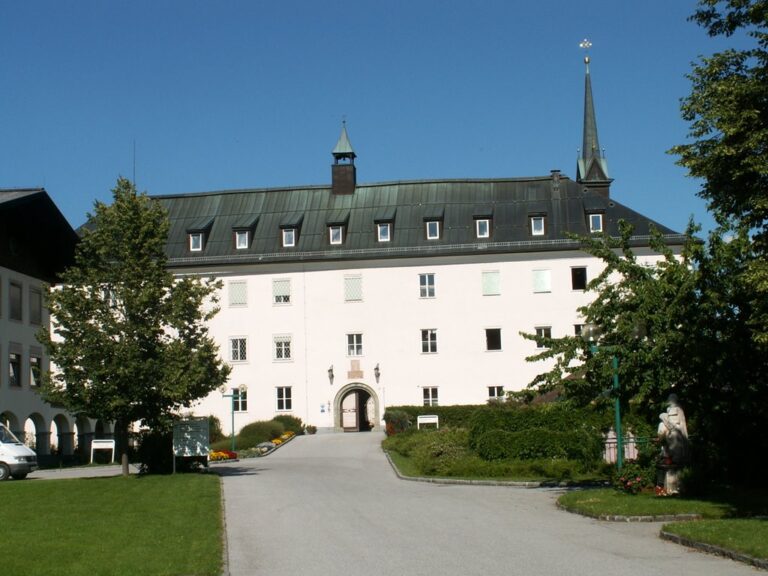
Schloss Goldegg is a medieval castle in Austria, built for the Lords of Goldegg in the early fourteenth century and later transformed into a Renaissance residence. It stands in the municipality of Goldegg in Salzburg’s Pongau district and served both as the seat of a Hofmark, a lordship district with lower-court rights, and as a defensive stronghold on the route between Pongau and Pinzgau.
The Lords of Goldegg and the New Castle
The first construction at Goldegg has no certain date. The Lords of Goldegg, a powerful Salzburg ministerial family whose members served an ecclesiastical ruler in administrative and military roles, are considered possible builders. They appear in written records from about 1180 and held extensive territories as Bavarian fiefs until 1327.
The family’s earlier castle at nearby Altenhof protected the road linking Pongau and Pinzgau. Wulfing I of Goldegg supported Ludwig IV of Bavaria during the German royal succession dispute, a conflict between Ludwig and Friedrich the Fair over the German crown. After Ludwig’s victory at Mühldorf in 1322, Salzburg Archbishop Friedrich III destroyed the castles at Altenhof and Taxenbach. He was later compelled to permit a new castle at Goldegg. Construction began in 1323 and was completed at the same time as the church.
The new castle became the administrative center of the Hofmark and guarded an important route. Its surviving complex retains the core of this early fourteenth-century stronghold.
Succession and Salzburg Control
Haug von Goldegg, the last member of his family, died on 19 September 1400. He had sold much of his property to Archbishop Gregor Schenk von Osterwitz in 1398, while his daughter Dorothea inherited Schloss Goldegg, the Hofmark of Wagrain, and forests in Rauris. When Dorothea died in 1438, the castle passed to her only son, Wolfgang von Freundsberg, who died without children in 1449.
During the resulting succession dispute, troops of Archbishop Friedrich IV occupied the castle. In 1450 the Goldegg inheritance was granted to the Gradner brothers, with the archbishop retaining a right of first purchase. After the Gradners fell from power in 1455, Ulrich von Freundsberg briefly recovered the castle. Archbishop Sigismund I von Volkersdorf regained it by purchase later that year, after which Salzburg officials administered the property.
Captain Ulrich Dienstl defended Goldegg during a week-long siege by rebellious peasants in 1463. Balthasar von Weißpriach, the archbishop’s brother, then became the castle’s custodian, an administrator who could also hold judicial and military responsibilities for a territorial ruler.
Sales, War, and Renaissance Rebuilding
In 1481, Archbishop Bernhard II von Rohr sold the castle to Wilhelm Graf, his custodian in Radstadt, and to his moneylender Konrad Strochner. The sale was made with a right of repurchase while the archbishop faced financial difficulties during his war against Emperor Friedrich III. Salzburg recovered the castle two years later, and several alterations probably followed.
Christoph Graf von Schernberg defended the Salzburg-loyal city of Radstadt during the Peasants’ War of 1526, an uprising that challenged established political and social authority in parts of the German lands. In 1527 Archbishop Matthäus Lang granted him Schloss Goldegg, together with its custodial and land-register offices, partly in recognition of his service and his advance of 3,000 gulden to the war treasury.
Christoph reshaped the medieval fortress into a more comfortable sixteenth-century residence. He added a wing between the towers and formed a closed courtyard. The representative Knights’ Hall was created during this rebuilding, giving the castle a ceremonial character alongside its earlier defensive role.
Decline and Administrative Use
By the early sixteenth century, changes in the communication routes had reduced Goldegg’s strategic importance. Christoph von Schernberg later sold the fief because the rebuilding had created financial difficulties. After Christoph the Younger died in 1612, Archbishop Wolf Dietrich von Raitenau confiscated the indebted estate as a reverted fief. The castle’s guns were moved to Hohenwerfen, and the custodial authority was granted for life to Baron Dietrich Khuen von Belasy. By then the building had already begun to deteriorate.
In 1640 the Hofmark of Goldegg and the St. Veit district court were merged into the Goldegg district court. For centuries, the castle remained the seat of the local custodian or district-court official. In 1821 it became an Imperial-Royal tax office, while the court servant’s house was converted into a criminal court with prison cells. A new staircase and a new custodian’s residence were added in 1838. The castle remained the seat of the Salzburg district court until 1854.
Restoration and Cultural Uses
Count Max O’Donell bought the castle from the Imperial-Royal district administration in 1859 and thoroughly restored it, creating its present appearance. The building remained uninhabited before being sold to Hubert Max Friedrich Graf von Galen in 1874.
After 1938, the castle was used as a camp for girls of the Reich Labour Service. From 1949, the Archdiocese of Salzburg operated a youth home and retreat house there. Countess Margarete von Galen sold the building to the archdiocese in 1959, and the municipality of Goldegg has owned it since 1973.
A thorough renovation preceded the 1981 Salzburg provincial exhibition Reformation, Emigration: Protestants in Salzburg. Schloss Goldegg subsequently became a cultural and educational center of the Pongau. It houses the Pongau Local History Museum, a seminar and cultural center, a painting academy, and a café. The cultural association Schloss Goldegg, founded in 1982, organizes the Goldegg Dialogues. The castle is protected as an Austrian artistic monument under protection number 35766.
Remains
Schloss Goldegg is a hillside fortress on a rocky outcrop at the north shore of Lake Goldegg, northeast of the parish church, at approximately 822 meters above sea level. Its surviving form combines the fourteenth-century castle core with later towers, a sixteenth-century residential wing and courtyard, and nineteenth-century restoration work.
Approach and Defensive Layout
Bridge, Gate, and Courtyard
A stone bridge on the eastern side leads to a gate with a round-arched portal. Beyond the entrance is a small rectangular courtyard. The route into the castle passes through two bays with groin vaults, vaulted ceilings formed by intersecting curved surfaces, that date from the foundation period. Masonry basket arches survive on the west side of the ground floor.
Corner Towers and Outer Buildings
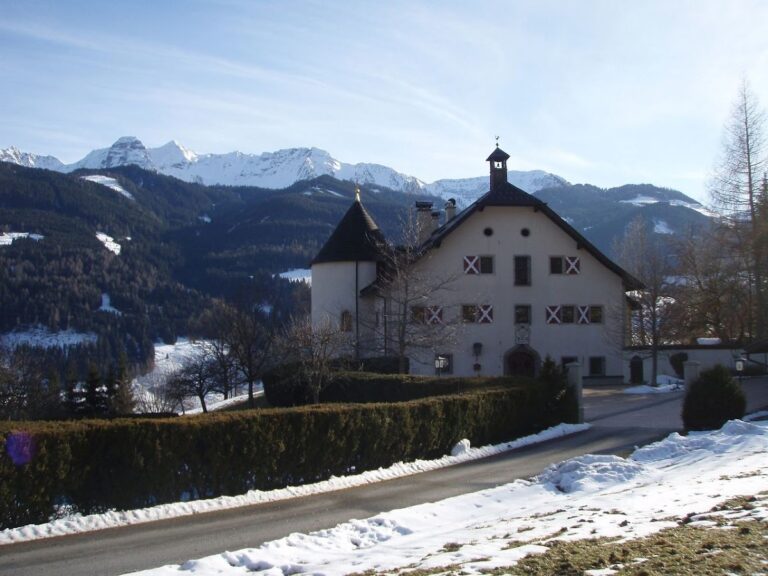
Four unequal corner towers reinforce the castle. Wooden crowns with loopholes and low roofs top the towers. The old palace, or original main structure, and the two southern corner towers belong to the Lords of Goldegg, while the northwest and northeast towers were built by Wilhelm Graf around 1500. The exterior windows were renewed, although narrow openings with keel arches and a bay window survive on the south side.
At the northern end of the eastern wall, an octagonal tower rises from a rectangular lower structure. A round tower is attached to the southern corner. Opposite the south side stands a second, somewhat lower building with a round tower at its western end. A reclining Baroque lion carved from yellow sandstone survives there.
Courtyard Fountain
The center of the courtyard contains a fountain with a red-marble column dating from the first half of the sixteenth century. Its position forms part of the courtyard arrangement created as the fortress was adapted to residential use.
Residential and Representative Interiors
Palace and Hall of Coats of Arms
The Palas, the principal residential building of a medieval castle, contains original fourteenth-century wooden furnishings on its first floor. Its second floor holds the large Hall of Coats of Arms. The hall’s wooden ceiling was assembled without a single nail.
Knights’ Hall
The Knights’ Hall occupies the second floor of the north wing. Christoph Graf von Schernberg had it built in 1536 as a representative Renaissance ballroom. Its pinewood ceiling carries 137 coats of arms arranged in 107 square fields, painted in tempera, a technique using pigments bound with a water-based medium, on wooden panels.
Sixty further coats of arms decorate the walls. They depict four representatives of the estates of the Holy Roman Empire, the central European political complex in which Salzburg was an ecclesiastical principality. The heraldic program includes the arms of Salzburg’s eight subordinate bishoprics, Regensburg, Freising, Passau, Brixen, Gurk, Chiemsee, Seckau, and Lavant, as well as the monasteries of Admont and St. Peter, the 24 members of the cathedral chapter, and 38 members of the Salzburg provincial nobility.
Frescoes cover the upper walls, while the lower half is lined with wooden paneling, a wall treatment made from framed or recessed wooden sections. Woodcuts by Hans Burgkmair, a German Renaissance painter and printmaker, made between 1515 and 1519 served as models for the painted figures and heraldic imagery. The painter responsible for the frescoes and ceiling panels is unknown. The castle’s surviving interiors are now incorporated into its use as a museum and cultural center.