Schloss Trumau: A Cistercian Moated Castle in Austria


Site at a Glance
- Rating
- 4.8
- Popularity
- Very Low
- Country
- Austria
- Primary era
- Early Modern
- Eras represented
- Medieval, Early Modern
- Civilizations
- Habsburg, Holy Roman Empire
- Site type
- Domestic
- Remains
- Castle
On this page11 sections
History
Schloss Trumau is a moated castle in Austria, established as a Cistercian agricultural estate in 1138. Its origins lay in a donation by Babenberg Margrave Leopold IV to Heiligenkreuz Abbey under Abbot Gottschalk, intended to strengthen the abbey’s economic position. The Cistercians, a reform branch of Western monasticism, resettled the civilian population and created a fortified grange, or monastic farm estate.
Cistercian Estate
The estate supported arable farming, viticulture, and sheep raising, and operated its own mill. Trumau gradually developed again around this agricultural center. Schloss Trumau remained connected with Heiligenkreuz Abbey for most of its history, although ownership was interrupted during periods of conflict.
Fifteenth- and Sixteenth-Century Conflicts
In 1462, the estate passed to Georg von Pottendorf, a mercenary commander who fought for Albrecht VI during the Habsburg brothers’ struggle for power in the Austrian lands. In 1468, the Bohemian mercenary commander Hinko von Feinfalt took it from him.
During the First Ottoman Siege of Vienna in 1529, the settlement consisted of seven houses. The estate was destroyed in 1548 and later underwent extensive rebuilding and alteration. In 1621, it was burned again during the conflicts involving Gábor Bethlen, the prince of Transylvania who opposed the Habsburgs in the political and military struggles of the early seventeenth century.
Castle Residence and Later Damage
Conversion of the estate into a castle began in 1650 under Abbot Michael Schnabel and was completed in 1667. The finished castle served as a summer residence for the abbots of Heiligenkreuz. Emperor Leopold I, the Habsburg ruler of the Holy Roman Empire from 1658 to 1705, is also reported to have visited it frequently.
The castle suffered heavy devastation during the Second Ottoman incursion in 1683, although it was probably relatively well fortified at the time. During the subsequent reconstruction, its towers were rebuilt at a lower height than before. Fires in 1811 and 1880 led to further rebuilding, after which the castle’s appearance was probably much reduced compared with earlier periods.
Twentieth-Century Changes
Between 1945 and 1947, Soviet occupation authorities installed a communications center in the castle. The building sustained substantial interior damage: partition walls were demolished, and the intermediate ceiling of the granary was removed so that the floor could be converted into a ballroom.
Restoration took place from 1993 to 1995. A museum founded in 1999 displayed prehistoric finds discovered during construction of the South Autobahn, but it later ceased to exist. In 2009, the International Theological Institute for Studies on Marriage and Family moved from the Carthusian charterhouse at Gaming to Schloss Trumau. The institution is now called the Catholic University College ITI. The chapel serves Byzantine, or Greek Catholic, worship and is used ecumenically by the Trumau parish and the Greek Catholic central parish of St. Barbara in Vienna.
Remains
Castle and Grounds
Main Castle
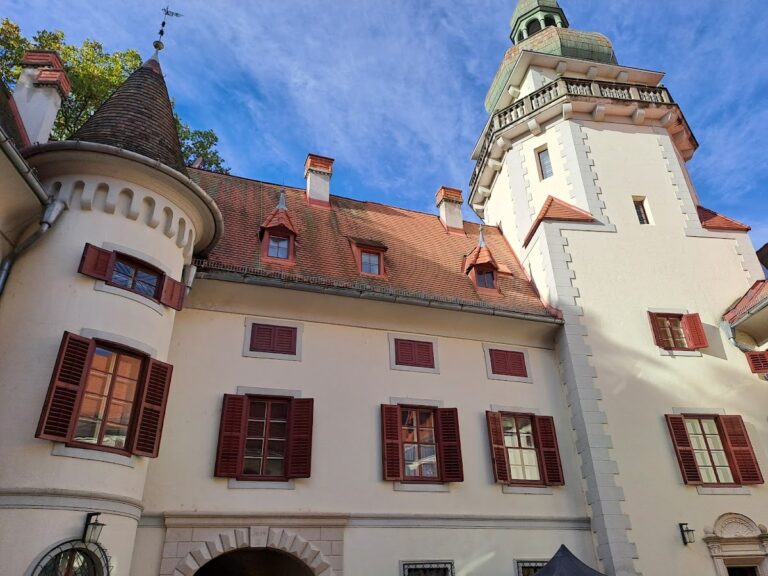
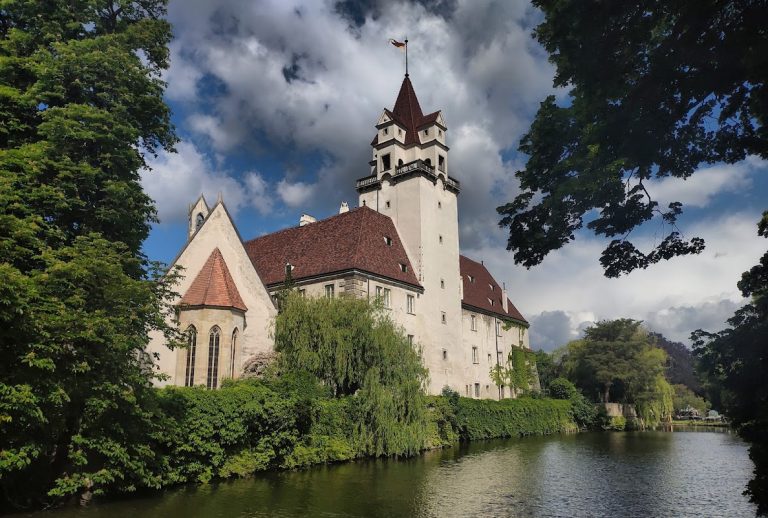
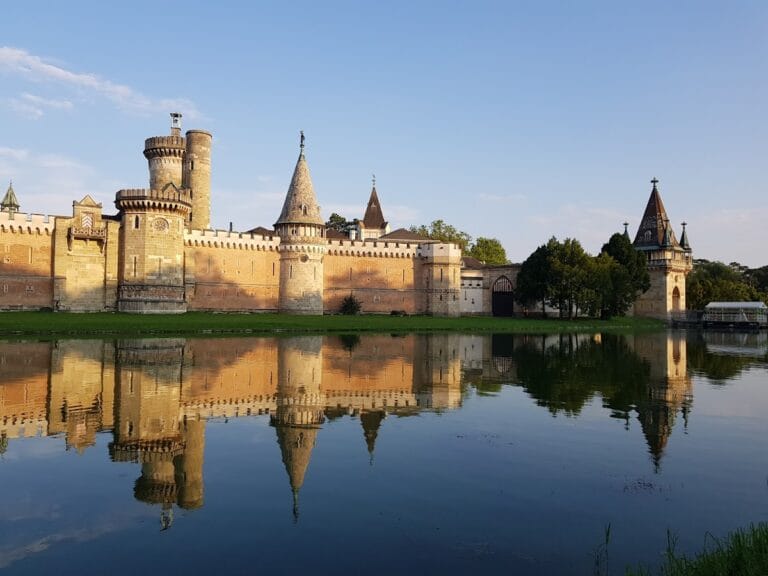
Schloss Trumau is a nearly square, two-storey building surrounded originally by a moat crossed by a drawbridge. Three corners carry round towers topped by conical roofs. The north wing is the oldest part of the castle, with foundation walls from the original twelfth-century building incorporated into its ground floor. The towers were rebuilt at a lower height after the damage of 1683.
Chapel
The castle contains a large chapel. Its altar painting by Johann Michael Rottmayr, completed in 1702, was stolen in 1945. In 1950, it was replaced by Alice Rougon’s copy of Martino Altomonte’s Coronation of the Virgin, a Christian image of Mary being crowned as Queen of Heaven.
Former Farmyard
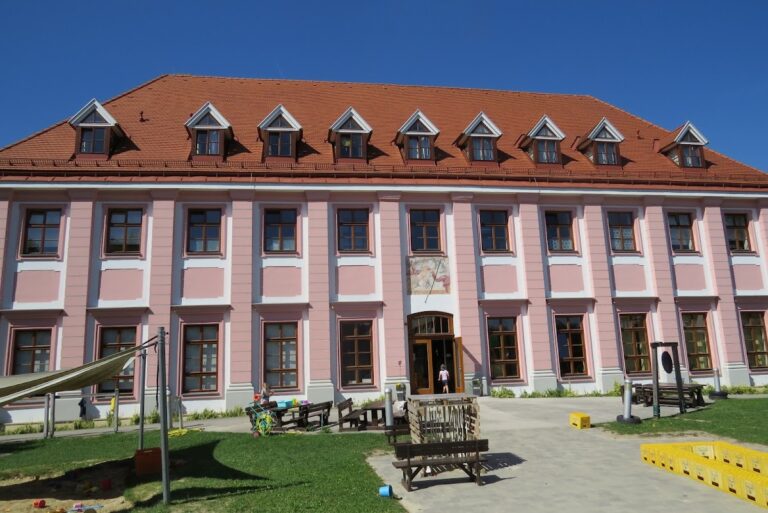
The former farmyard, or Meierhof, stands southeast of the castle. A Meierhof was a manorial farmyard serving an agricultural estate. The building dates from 1638 and was restored after the fire of 1880.
Castle Park
The castle park contains notably large plane trees. One of these trees is regarded as a natural monument.
Nearby sites