Schloss Rannariedl: A Fortified Danube Stronghold in Austria

Site at a Glance
- Rating
- 4
- Popularity
- Very Low
- Country
- Austria
- Primary era
- Medieval
- Eras represented
- Medieval, Early Modern, Modern
- Civilizations
- Holy Roman Empire
- Site type
- Military
- Remains
- Castle
On this page8 sections
History
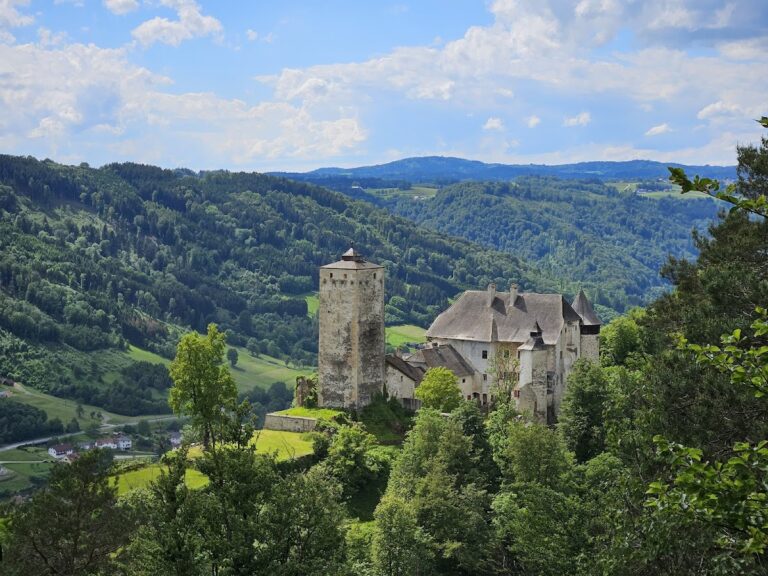
Schloss Rannariedl is a fortified castle in Austria, near Neustift im Mühlkreis, built around 1240 as a stronghold and fief of the Bishopric of Passau. As a feudal lord, the bishopric could grant castles to nobles while retaining territorial rights connected with them. Rising above the Danube near the mouth of the Ranna River, the castle controlled and taxed traffic on the river, giving it both military and economic importance.
The Falkensteiners and the medieval stronghold
The Falkensteiners, a noble family named after nearby Falkenstein Castle, occupied the stronghold during its early history. They are described as robber knights, reflecting their involvement in armed control and predatory activity. Financial difficulties forced them to pledge the castle in 1301. Gundacker von Tannberg held it as a pledge from 1384 to 1387, showing how the property could pass temporarily to a creditor rather than through straightforward inheritance.
The castle became involved in the Hussite Wars, fifteenth-century conflicts between the followers of the Bohemian reformer Jan Hus and opposing Catholic and imperial forces. During this period, Reinprecht von Polheim received Rannariedl for life, but returned it 23 years later. In 1484, Duke George of Lower Bavaria tried to bring the castle under his control. Its castellan, Nußdorfer, successfully defended it against capture. After legal proceedings, George received the property as a pledge, before finally ceding it to Maximilian I in 1506 during the Landshut War of Succession, a conflict of 1504 to 1505 over the inheritance of the Duchy of Bavaria-Landshut.
Habsburg pledges and military crises
The Habsburgs, the dynasty that ruled Austria and governed the Holy Roman Empire, pledged Rannariedl to Max Öder in 1512. Ownership and possession changed repeatedly during the sixteenth century. Hans Weisperger of Biberbach followed Öder, Hans Hofmann of Grünpichl acquired the castle in 1547, Achaz Öder held it from 1569, and Count Hans von Kevenhüller acquired it in 1581.
The castle was heavily armed in 1594, when the Ottoman threat prompted the use of fortified sites in the region as places of refuge. Despite these preparations, Rannariedl was captured and plundered during the Peasants’ War of 1595. Count Gottfried von Salburg bought the castle in 1620, and it remained with his family until 1725. The Clam family then acquired it. In 1765, the Bishopric of Passau reacquired part of the lordship, including the Seven Künische Villages.
Chapel, parish church, and modern ownership
The castle chapel was enlarged around 1780 and subsequently became the parish church of Rannariedl. It served that function from 1783 until 1953, giving the chapel a lasting religious role within the settlement and the castle complex.
Maria Anna Prunner acquired Rannariedl in 1824. The Ichzenthaler family owned it from 1840 to 1877, followed by Stephan Armer of Ammerstetten. The Upper Austrian People’s Credit Institution held the property in 1879, Johann Setzer acquired it in 1891, and the Hans family followed in 1897. Ludwig Prähofer owned it from 1909, and Mathilde von Urban acquired it in 1912. Dr. Peter Reinhold, a former German minister, bought the castle in 1940.
The Soviet occupying power held Rannariedl from 1945 to 1955. It later passed to the Agricultural Chamber and then to Lukas Reinhold. The Munich businessman Josef Schwaiger acquired the complex at auction in 1966 for five million schillings, and renovation followed between 1966 and 1969. The Liechtenstein company Ledi bought the building in 1975. It was auctioned again on 5 May 2015 and remains in private ownership.
Remains
Castle layout and medieval buildings
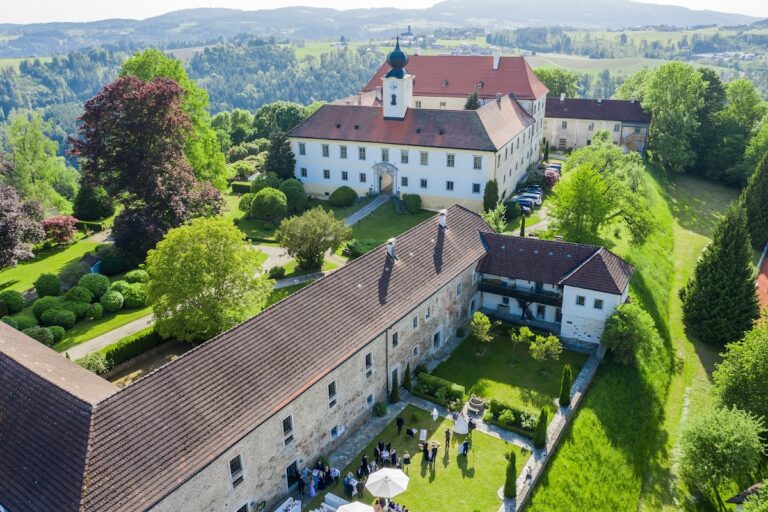
Schloss Rannariedl occupies a high position above the Danube in Rannariedl, within the municipality of Neustift im Mühlkreis in the Mühlviertel. Its elongated form was formerly enclosed by a strong ring wall with three fortified towers. The oldest part is the eastern Lower House, probably built by the Falkensteiners. The Upper House, which forms the present main castle, was constructed in the late thirteenth century.
The residential buildings of the Upper House enclose a courtyard. Three-storey arcades line three sides of this court, and these arcades date from the sixteenth century. Two Renaissance-style knights’ halls occupy the second upper storey. Renaissance architecture revived classical forms across Europe from the fifteenth century onward. The left side of the complex was added during the nineteenth century, extending the historic group beyond its medieval and early modern core.
Chapel and garden monuments
The former castle chapel is attached to the southeast side of the complex. Its interior contains an eighteenth-century Baroque pulpit, statues, and paintings. Baroque art was associated with elaborate and dynamic forms that predominated in the seventeenth and eighteenth centuries. The chapel’s enlargement around 1780 and its later use as the parish church are reflected in its place within the surviving castle buildings.
A well in the castle garden carries a statue of Saint Florian. At the rear of the castle stands a statue of Saint John of Nepomuk bearing the year 1731. These monuments form part of the documented historic fabric around the main buildings.
Estate buildings and artillery defence
The wider complex includes a nineteenth-century Meierhof, an estate farm serving a lordly or manorial property, and an eighteenth-century Troadkasten, a granary used for storing grain. The two buildings stand opposite each other and extend the castle’s physical remains beyond the principal residential structures.
Approximately 200 metres above the castle is a well-preserved cannon rondel dating from the sixteenth or seventeenth century. A cannon rondel is a rounded fortification designed to accommodate and deploy artillery. Its position forms part of the defensive landscape associated with Rannariedl and connects the surviving castle complex with the period when the stronghold was armed against military threats.
Nearby sites