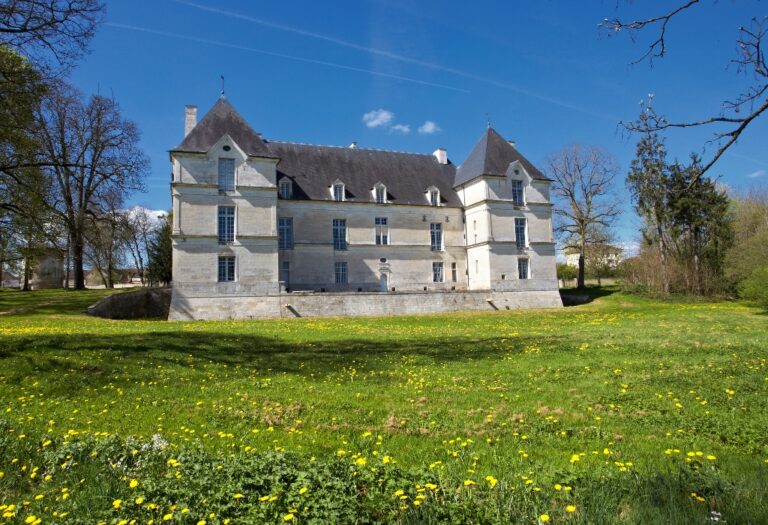
Château de Vaulichères: A Historic Château and Wine Estate in France


Site at a Glance
- Rating
- 4.2
- Popularity
- Very Low
- Country
- France
- Primary era
- Early Modern
- Eras represented
- Early Modern
- Civilizations
- French
- Site type
- Domestic
- Remains
- Elite Residence
On this page8 sections
History
Château de Vaulichères is a historic residential château and wine estate in France, located in Tonnerre. Built by the Clermont-Tonnerre family, a French noble house associated with the county of Tonnerre and the duchy of Uzès, its construction began between the sixteenth and seventeenth centuries.
From the Clermont-Tonnerre family to the Canelle lineage
In 1552, Louise de Clermont, Countess of Tonnerre and Duchess of Uzès, sold Vaulichères together with the lands of Bernouil, Soulas, and Milois to Jehan Canelle and his wife, Jacqueline de Perceval. Canelle served as receiver of royal taxes and levies at Tonnerre and had commissioned the Hôtel d’Uzès.
The estate passed to Jehan Canelle’s son, Henri Canelle, Lord of Vaulichères, and then to his grandson François Canelle. François was Lord of Bragelogne and provost of the marshal’s office in the electoral district of Tonnerre. His son-in-law, Paul de Chaulnes, later inherited the property. Chaulnes was the king’s procurator at Tonnerre’s salt granary, a royal institution that administered the salt tax and related judicial matters.
The chapel and eighteenth-century owners
Jean Gauthier de Tronchoy, an equerry, quartering officer, and valet de chambre to the Duke of Orléans, later owned Vaulichères. He commissioned the present chapel in 1690. It was blessed on 18 May 1693 and dedicated to the Virgin Mary.
Around the middle of the eighteenth century, François Jacquesson, Lord of Vauvignol and a gentleman of the king’s hunting household, became an owner with his wife, Victoire Maignan de Champromain. She was a niece of the architect Jacques-Germain Soufflot.
Admiral de Vence and the nineteenth-century wine estate
Admiral Jean Gaspard de Vence acquired the château and retired there in 1803. He spent his final years operating the wine estate and died in 1808. The property then passed to his daughter, the mother of Admiral Charles Joseph Dumas-Vence, who was born at Tonnerre in 1823.
During the Bourbon Restoration, the period after Napoleon’s fall when the Bourbon monarchy was restored in France, de Vence’s daughter sold the estate to Jean-Pierre-François d’Audigier and his wife, Hortense Zélie Delon. D’Audigier had directed the provisions service during the 1812 Russian campaign.
The Damotte family acquired Vaulichères in 1845 with the aim of developing a method for producing sparkling Tonnerre wine through champagnisation, a secondary fermentation process. Later owners included Gallien in 1869, Pierre Delinotte in 1880, Lascault and Garriau in 1919, Dr. Hugot in 1926, Dr. Israël, General Duron in 1939, Quarangui in 1953, and Baron and Baroness de Barolet in 1964.
Vineyard decline and continuation
Until the end of the nineteenth century, the Tonnerre vineyard was regarded as one of the oldest and most important in France. Vaulichères was among the largest estates in the region and had a reputation as the best wine estate in the Tonnerrois. Its vineyards were severely affected by phylloxera, a vine pest that devastated European vineyards during the nineteenth century. Château de Vaulichères remains a wine estate.
Remains
Chapel
The present chapel, commissioned in 1690, was dedicated to the Virgin Mary after its blessing on 18 May 1693. Its interior included a gilded tabernacle decorated with statuettes of Christ, Saint Peter, Saint Paul, Saint Clare, and Saint Dominic.
Two small subsidiary chapels flanked the main chapel, including one dedicated to Saint Roch. The tombs of Jean Gauthier de Tronchoy and his wife, Anne Milon, are located inside the chapel.
Vineyards
The Clos de Vaulichères estate currently covers eight hectares of vineyards planted with Pinot Noir and Chardonnay. A further hectare consists of older vines classified under the Chablis appellation, a legally defined designation linking wine to a geographical area and production rules.