Burgruine Harchheim: A Rock Castle Ruin in Austria


Site at a Glance
- Rating
- 3.6
- Popularity
- Very Low
- Country
- Austria
- Primary era
- Medieval
- Eras represented
- Medieval
- Civilizations
- Holy Roman Empire
- Site type
- Military
- Remains
- Castle
On this page7 sections
History
Burgruine Harchheim is the remains of a hilltop rock castle in Austria, in the Tullern district of Sankt Aegidi, Upper Austria. It is also locally called Ruine Burgstall and is known as Burgruine Struben. The castle was probably the ancestral seat of the old Bavarian Struben family, whose early members were ministeriales, legally unfree medieval servants who carried out military, administrative, or court duties for a lord or ecclesiastical institution.
The Struben Family and Passau
The Struben family served the Bishopric of Passau, an ecclesiastical principality whose prince-bishop combined religious authority with territorial rule. The supposed association between the castle and a Harchheim family is incorrect. That family belonged to Hartheim near Alkoven, rather than to the castle site at Sankt Aegidi.
A Contested Boundary
The lower course of the Kleine Kesselbach formed a natural boundary between lordships, municipalities, and parishes connected partly with Passau and partly with Austria. Disputes over this area continued for centuries. A treaty concluded in 1765 between Maria Theresa, the Habsburg empress, and Leopold III, prince-bishop of Passau, assigned Sankt Aegidi to Austria.
The Castle as a Judicial Seat
In 1536, the governor of Upper Austria ordered that criminal residents of Niederkeßla should be tried and imprisoned in the castle. The Burgstall, a former castle site where little masonry survives, was already badly ruined at the beginning of the sixteenth century. Its judicial role therefore ended when the seat was transferred to Sankt Aegidi in 1583.
Later Reuse of the Building Material
Much of the castle’s building material was reused in the Church of St. Pankratius. Pankrazius, the abbot of Engelszell, an ecclesiastical abbey in Upper Austria, built the church in 1550 on the site of an earlier building. Emperor Joseph II, Maria Theresa’s successor, closed it in 1784, after which the existing St. Pankratius Chapel was erected in its place.
Remains
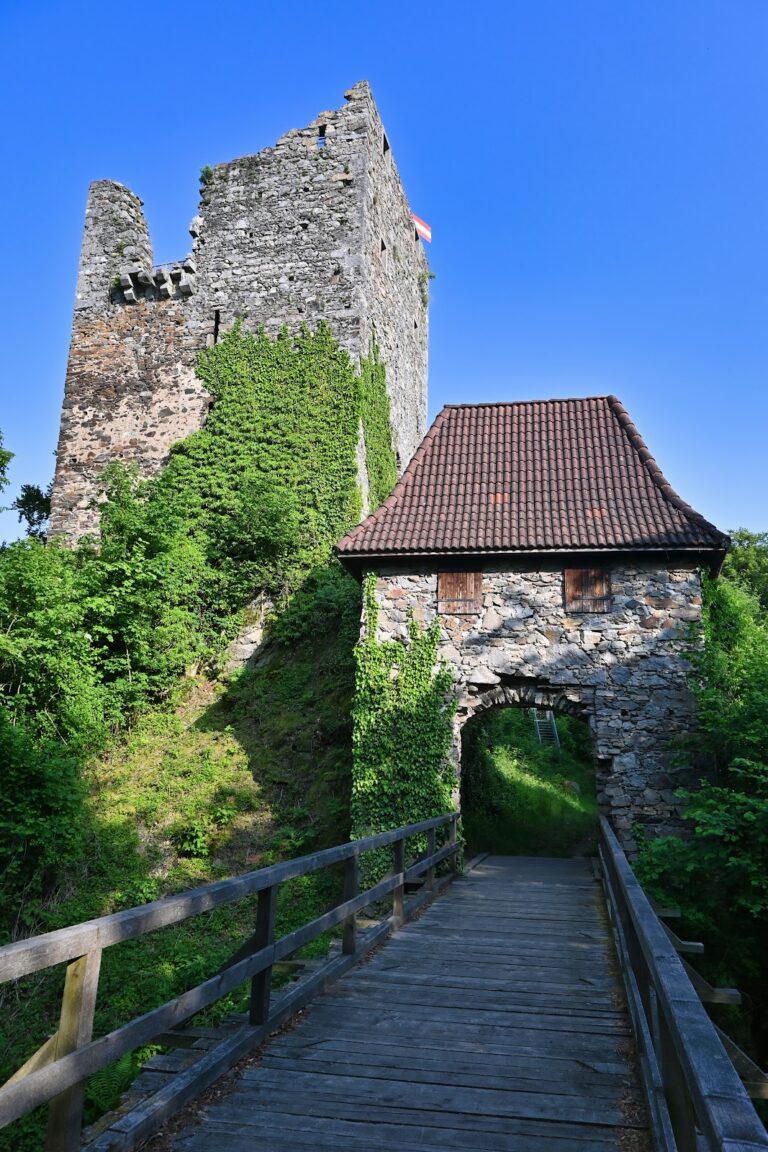
The former castle occupies a rock above the Kleine-Kösslbach gorge, on the right bank of the Kleine Kesselbach, within a nature reserve. Its surviving fabric consists of a roughly one-storey-high square or rectangular masonry enclosure at the edge of steeply descending cliffs. The walls form the valley-facing side of a rectangular building placed at the steepest and deepest point of the rock.
Surviving Rock-Castle Enclosure
The enclosure is built from rubble masonry with dressed blocks at the corners. Its walls reach approximately two metres in thickness. Their exposed position protected them from being removed for the construction of St. Pankratius Church, allowing this portion of the former castle to survive at the cliff edge.
The surviving walls represent the valley-facing part of the former rectangular building, while the castle hill is understood through its rocky position above the gorge. Together, the masonry and terrain show how the castle used the steepest part of the rock as the setting for its enclosure.
Nearby sites