Burg Altjochenstein: A Medieval Spur Castle in Germany


Site at a Glance
- Rating
- 4.5
- Popularity
- Very Low
- Country
- Germany
- Primary era
- Medieval
- Eras represented
- Medieval
- Civilizations
- Duchy of Bavaria, Holy Roman Empire
- Site type
- Military
- Remains
- Castle
On this page6 sections
History
Burg Altjochenstein is a medieval spur castle in Germany, located at Riedl near Jochenstein within the market town of Untergriesbach in Bavaria. It was probably built during the first half of the twelfth century, although the surviving archaeological complex is broadly dated to the eleventh or twelfth century. The castle may originally have formed a single complex with neighboring Burg Neujochenstein.
The Jochenstein Family
The castle was associated with the Jochensteiners, also called the Johannsteiners. They were probably ministerials, members of the medieval service nobility who held military, administrative, or official duties for a higher-ranking lord. Their likely overlords were the Lords of Griesbach, whose ancestral seat lay nearby at Untergriesbach. During the twelfth and thirteenth centuries, the Lords of Griesbach possessed extensive lands in the surrounding region.
The name Jochenstein first appears in written records in 1222. Castle nobility connected with the site is recorded in 1264 through Alkherus de Jokenstein and again in 1269 through Eswain of Jochenstein. These references place the castle and its family within the regional political structure of the high medieval period.
Abandonment and Later Status
Burg Altjochenstein was probably abandoned during the thirteenth century. Around the beginning of the fourteenth century, the Bishopric of Passau, an ecclesiastical principality whose bishop held both religious and territorial authority, received rights of use at one of the Jochenstein castles and later acquired it outright. It remains uncertain which castle was involved, although Burg Neujochenstein is considered the more likely candidate.
The Jochenstein family appears to have died out during the fourteenth century, after which the site fell into ruin. Today, the Bavarian State Office for Monument Protection lists the ruin both as a protected architectural monument and as an archaeological monument, including buried medieval remains and finds within the castle area.
Remains
Setting and Defensive Layout
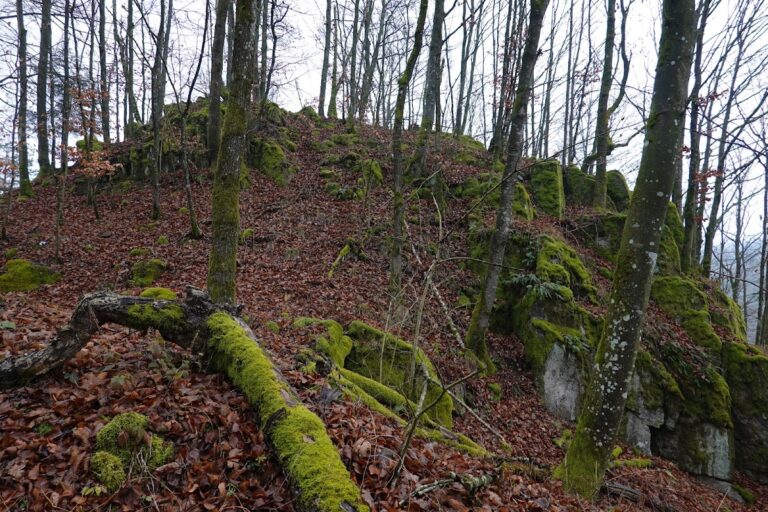
The small castle occupies a southeast-facing spur of the Donauleiten above the Danube Valley, near the German-Austrian border. The ground descends about 250 metres to the south toward the Danube, while the gorge of the Neuwiesbach borders the spur on its eastern and northeastern sides. These steep natural boundaries helped protect the site. A neck ditch crosses the entire spur on the northwest, separating the castle from the rising hillside. Several metres farther inward, a second neck ditch probably divided the core castle at the tip of the spur from its outer bailey. A spur castle uses this kind of projecting ridge, steep slopes, and artificial ditches to strengthen its defenses.
Residential Tower and Fortifications
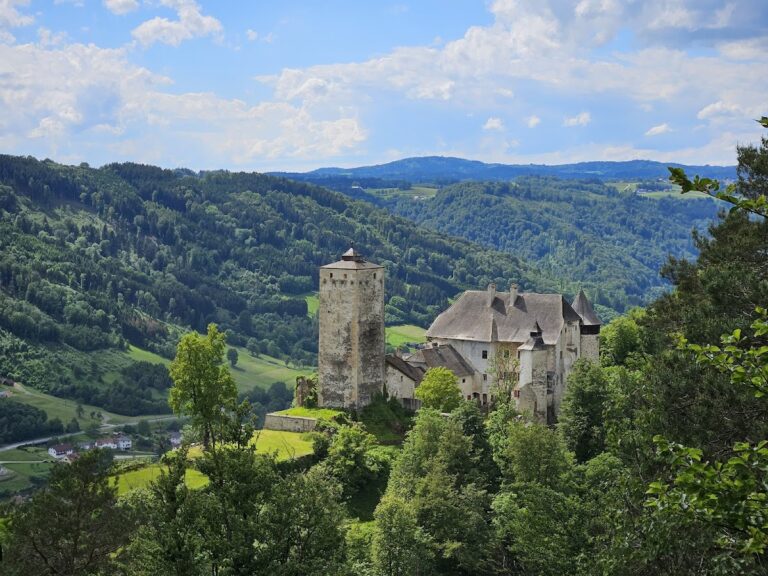
The core castle was centered on a residential tower measuring approximately 13 by 9 metres. Its surviving walls rise as high as 8 metres. Built from unworked rubble stone set in mortar, the walls are between 1.8 and 3 metres thick. A vaulted cellar remains beneath the tower, providing evidence of the building’s substantial construction and residential role.
The protected architectural remains also include parts of the residential building and a zwinger, a defensive area or passage connected with the castle fortifications. The structures survive as a ruin, while buried medieval remains and archaeological finds extend the evidence beyond the standing masonry.
Nearby sites