Boyneburg: An Imperial Castle in Hesse


Site at a Glance
- Rating
- 4.6
- Popularity
- Very Low
- Country
- Germany
- Primary era
- Medieval
- Eras represented
- Stone Age, Iron Age, Medieval
- Civilizations
- Celtic, Holy Roman Empire
- Site type
- Military
- Remains
- Castle
On this page9 sections
History
Boyneburg is a ruined medieval hilltop castle in Germany, in the municipal area of Sontra near Wichmannshausen. First documented in 1107, it occupied an important position between imperial estates in the Harz and Wetterau and later became closely connected with the history of Hesse. The site and the Boyneburg family appear under many historical forms, including Bemelburch, Bumeneburc, Boimeneburch, and Boyneborg. Regional names such as Bemelburg, Bomeneburg, and Boeneburg remain associated with the ruin and the mountain.
Early fortifications and the Northeim counts
A refuge fortification stood on the mountain in prehistoric and early historic times. In the eleventh century, the Counts of Northeim gained possession of the mountain and probably established the first timber defenses. The castle was named Bemelburch in a 1107 charter issued by King Henry V, the German king who became Holy Roman Emperor in 1111. Because its garrison had carried out raids, Henry ordered the castle destroyed. He then granted it as an imperial fief to Count Siegfried III of Northeim, son of Otto of Northeim, who rebuilt it.
After Siegfried III died in 1108, his relative Siegfried IV of Northeim took control of Boyneburg and by 1123 styled himself Count of Boumeneburc. He died in 1144 as the last male descendant of the Northeim family, and the castle returned to the emperor as a forfeited fief.
Imperial castle and political center
Between 1150 and 1160, Abbot Markward of Fulda took over the castle, which needed repair, and restored it to protect the monastery’s possessions in the surrounding region. Emperor Frederick I Barbarossa first visited Boyneburg in 1156, when it was described as an imperial castle. He held a court assembly there in 1166 and an imperial assembly in 1188. That same year, he endowed the priest’s post at the castle chapel. In 1189, he departed from Boyneburg for the Third Crusade, the campaign launched by European rulers after Jerusalem had been reconquered by Muslim forces. Barbarossa died during the crusade in 1190.
Imperial ministerials, dependent service nobles who carried out military, administrative, and court duties, held Boyneburg as castle guards from at least 1138. They adopted the castle’s name, and during the thirteenth century the Boyneburg family divided into three branches. The castle’s position between important imperial estates in the Harz and Wetterau gave it continuing political importance within the empire.
Transfer to the landgraves of Hesse
After the Thuringian-Hessian War of Succession ended in 1264, Landgrave Henry I of Hesse received eight fortified settlements on the Werra, including Eschwege, from Henry of Meissen. On 12 May 1292, King Adolf enfeoffed Henry I with Eschwege and the imperial castle of Boyneburg as an hereditary imperial principality. This grant gave Henry the status of an imperial prince.
The transfer led to more than two centuries of conflict with the former imperial ministerials at Boyneburg, who refused to recognize the landgraves’ feudal authority. A settlement between the landgraves and the Boyneburg family was reached in 1449. From 1460, the Boyneburgs held the castle as a hereditary Hessian fief, although they had already left the summit and moved to residences on their estates below the mountain.
Decline and continuing tradition
A bailiff still lived at Boyneburg after 1571, and the castle remained in good condition in 1595. It then began to decay. Troops commanded by Johann Tserclaes, Count of Tilly, plundered it in 1626 during the Thirty Years’ War, the seventeenth-century conflict that devastated much of Central Europe. Croatian troops partially burned the castle in 1637. A bailiff remained until 1672, after which the castle was abandoned and local residents used its materials as a quarry.
The Boyneburg family still owns the ruin. Archaeological excavations have examined the site because of its importance to imperial and Hessian history. The castle area is legally protected as a monument, and the surviving remains lie within the Boyneburg and Schickeberg near Breitau nature reserve and FFH protected area. The mountain itself is used for forestry.
An Ascension Day observance known as the Bread Distribution Festival preserves a local religious tradition. Its legend concerns three Boyneburg sisters and a dream in which the youngest foresaw her death in a storm. After a storm lasting three days, she is said to have gone outside the castle in prayer and disappeared when struck by lightning. Her supposed testament established a yearly distribution of food and gifts to the community on the anniversary of her death. The service may be conducted only by a pastor from the Datterode district. Bread and bacon are distributed, with some loaves thrown into the crowd by the present lord of the castle, Baron von Boyneburgk, and others given to nearby communities, schoolchildren, and older residents.
Remains
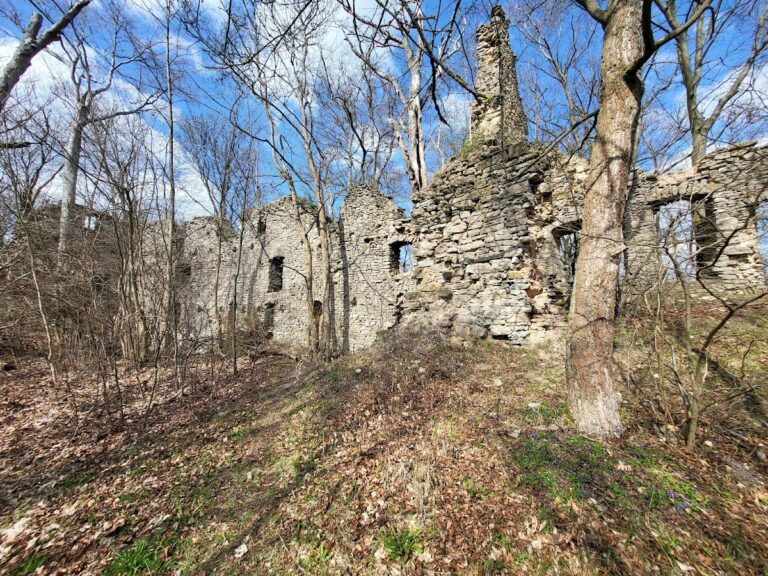
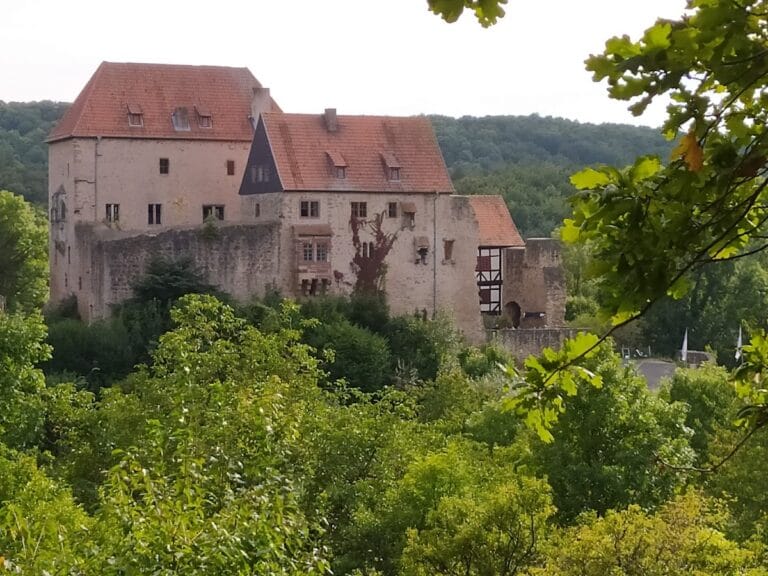
Boyneburg occupied approximately 4.5 hectares of partly wooded and partly open summit terrain on the 513-metre Boyneburg limestone mountain. Steep slopes descend toward the Netra, Ulfe, and Sontra waterways. The surviving ruins stand on the northern part of the mountain, on a steep slope at about 490 metres above sea level. The narrow northern side faced the descending slope, while the broader southern side faced the rising hillside.
Castle layout and defenses
The core castle had a trapezoidal plan and was separated from the outer bailey, the subsidiary fortified area beyond the main castle, by a neck ditch, a ditch cut across a connecting ridge. Three ditches protected the outer bailey, and their lines remain recognizable. Together, these earthworks preserve the main division between the castle’s central stronghold and its outer defensive area.
Keep and chapel
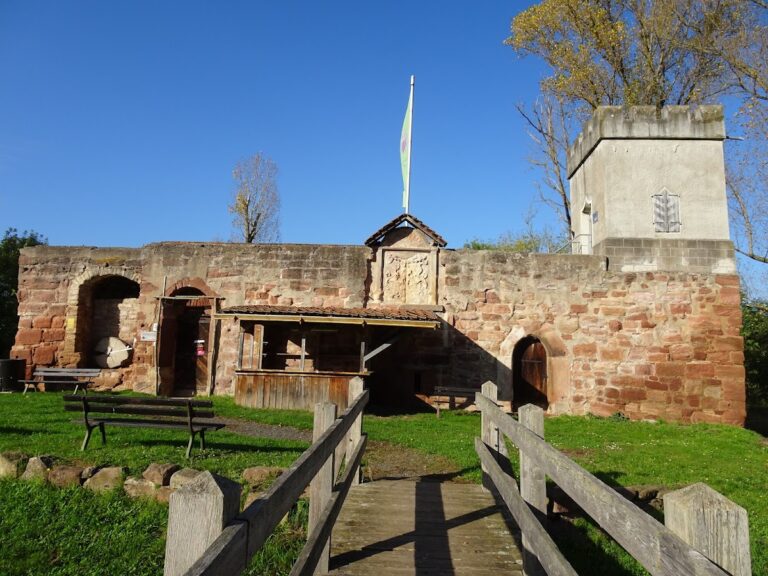
The keep, or bergfried, the principal defensive tower of a medieval German castle, was pentagonal. Two of its walls survive to approximately 25 metres in height, along with several foundation remains and the chapel. The masonry combines rubble stone with bossed ashlar blocks, carefully shaped stone blocks with raised central faces. A gatehouse attached to the keep was rebuilt on its original site in 1952 and 1953.
Archaeological phases
The archaeological remains represent several periods of occupation and defense. They include evidence of a Neolithic settlement, fortifications from the Celtic period, and medieval fortifications dating from the High Middle Ages through the Late Middle Ages.
Nearby sites