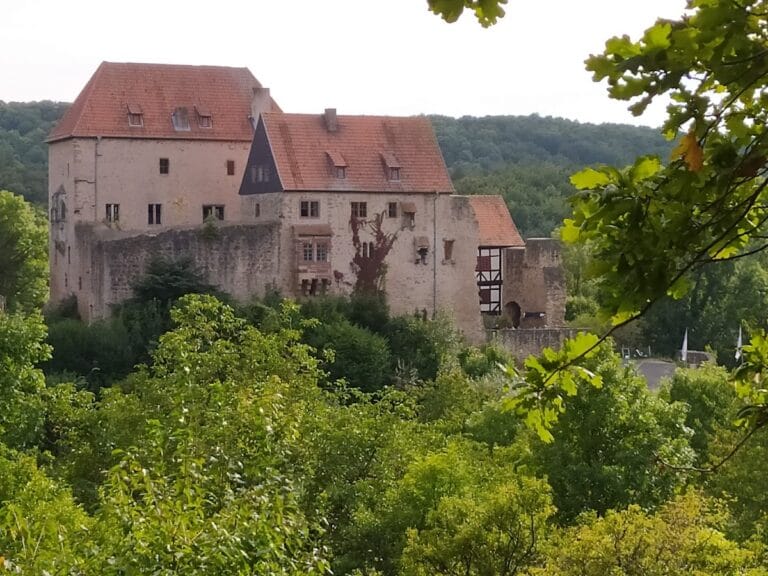
Brandenfels: A Medieval Hilltop Castle in Germany


Site at a Glance
- Rating
- 4
- Popularity
- Very Low
- Country
- Germany
- Primary era
- Medieval
- External website
- Open
- Eras represented
- Medieval
- Civilizations
- Holy Roman Empire
- Site type
- Military
- Remains
- Castle
On this page6 sections
History
Brandenfels is a ruined medieval hilltop castle in Germany, built around 1250 near Markershausen, a locality of Herleshausen in northern Hesse. It was initially associated with ministeriales, medieval service nobles who held administrative or military responsibilities for a higher-ranking lord.
Foundation and Shared Ownership
Brandenfels later became a jointly held castle, meaning that several co-heirs or noble families owned and administered separate shares. Several noble families retained interests in the castle for a long period. By 1500, ownership was divided between the Treusch von Buttlar and von Kolmatsch families.
Dispute and Transfer
The two families were already in conflict by at least 1399, when a castle peace agreement regulated relations and responsibilities among the rival co-owners. The dispute was settled in 1550. Georg von Kolmatsch transferred his share of Brandenfels and the Markershausen outlying estate to the Treusch von Buttlar family in exchange for their holdings at Wommen. After this exchange, the Treusch von Buttlar family became the sole owner of Brandenfels and the surrounding villages.
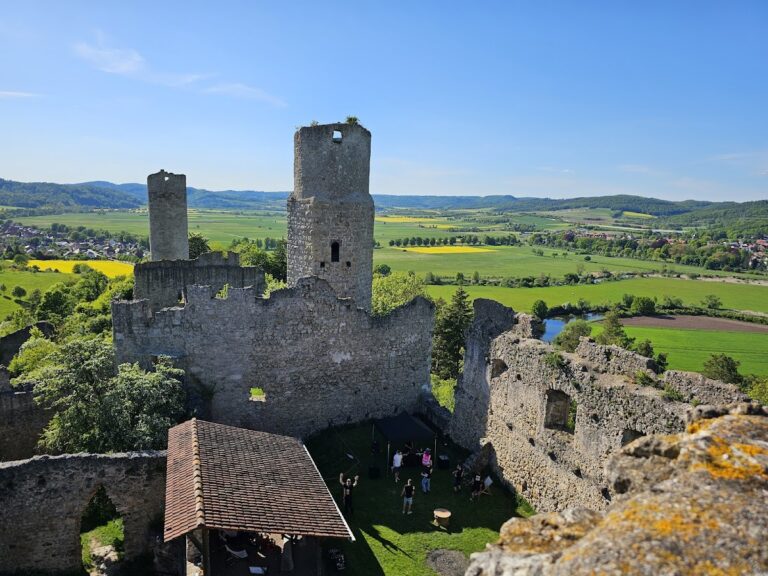
The castle is now a ruin on the Schlossberg. Its present condition reflects the long transformation of a medieval residence and stronghold into a surviving archaeological site.
Remains
Hilltop Setting and Defenses
Brandenfels occupies the southeastern summit of the Schlossberg in the Ringgau, at 452.3 metres above sea level. The central summit of the mountain reaches 451.8 metres. The castle stands on the southern edge of the South Ringgau upland, where the foothills descend in successive steps toward the Werra valley. The Nesse flows southwest of the site, while its tributary, the Schindgraben, lies to the east.
The castle plan forms an irregular quadrilateral. A neck ditch about 10 metres deep defended the western side, and a shallower ditch protected the north. On the east and south, the steeply descending mountain slopes provided natural protection. The ruined site lies across the Werra valley from the highly visible Brandenburg ruin in Thuringia.
Construction and Survival
The castle was built with rubble-stone masonry and included vaulted cellars. These surviving elements belong to the physical remains of the hilltop complex, whose ruined structures occupy the summit within the former defensive enclosure.
Nearby sites