Kirche Bischhausen: A Historic Evangelical Church in Germany
Site at a Glance
- Rating
- 4.6
- Popularity
- Very Low
- Country
- Germany
- Primary era
- Medieval
- External website
- Open
- Eras represented
- Medieval, Early Modern
- Civilizations
- Holy Roman Empire
- Site type
- Religious
- Remains
- Church
On this page13 sections
History
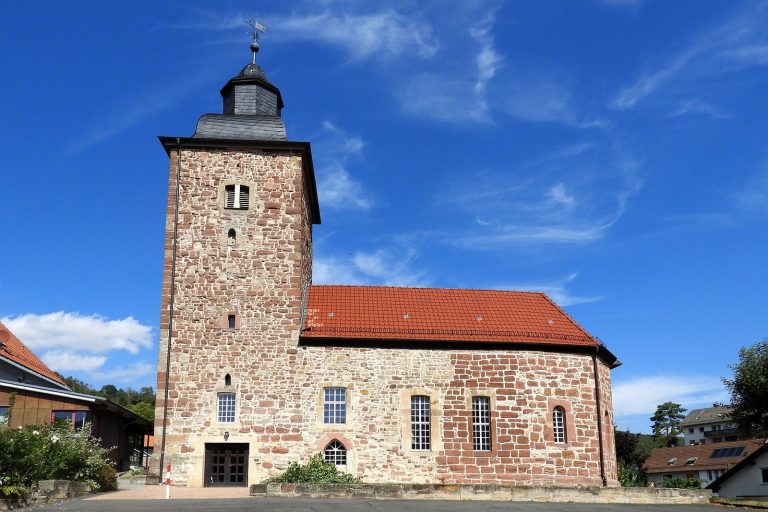
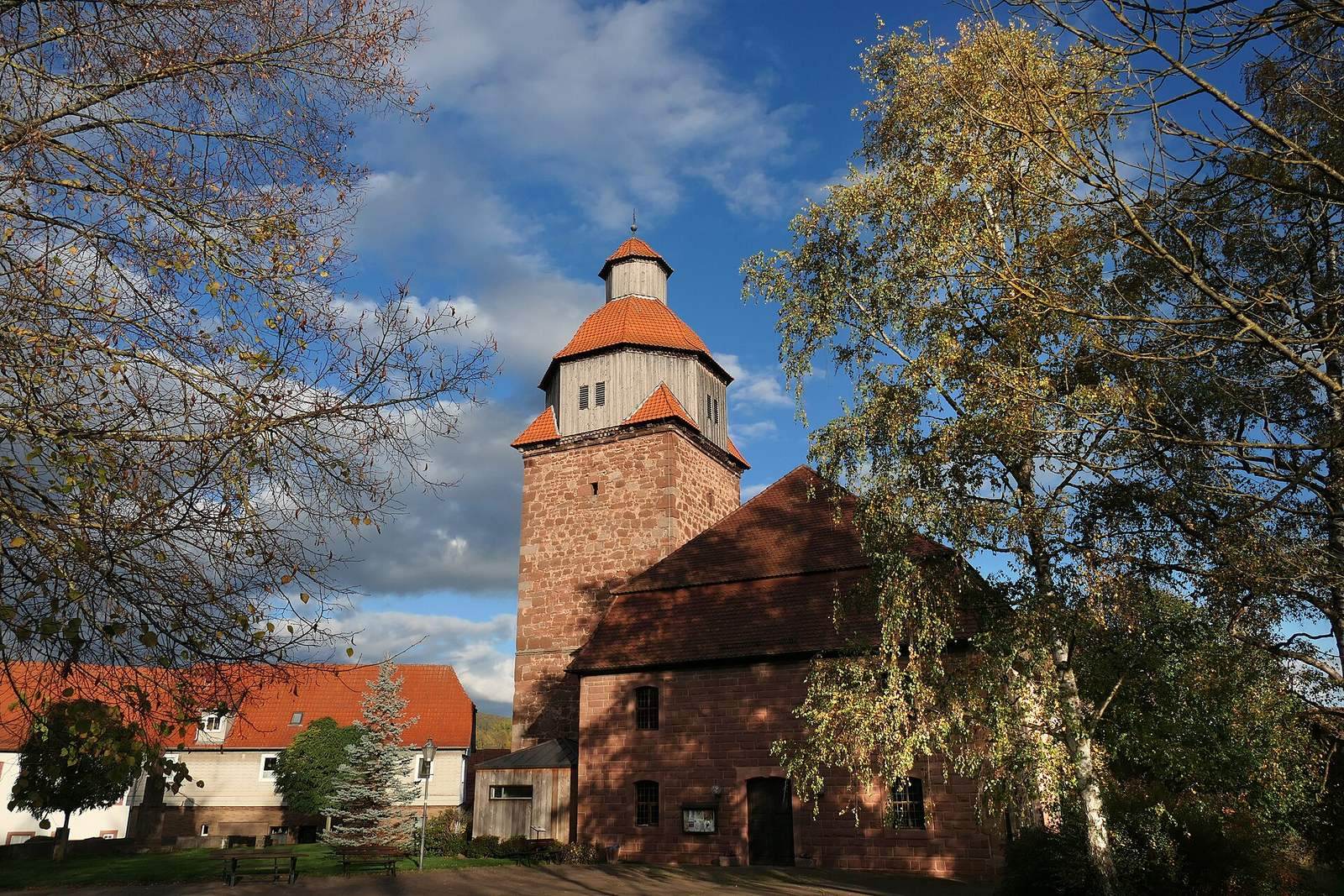
Kirche Bischhausen is a historic Evangelical church in Germany, in Bischhausen, now part of Waldkappel, whose medieval development includes a cruciform church built during the twelfth and thirteenth centuries and a late Gothic choir added in 1505. The church stands on the Kirchberg within Bischhausen’s protected historic ensemble and remains the center of the local parish.
Early Foundations and Medieval Development
A predecessor building on the same site was first mentioned in 786. Its foundation walls were excavated in 1975 and 1976, providing physical evidence for the early history of the church site.
In the early thirteenth century, the Lords of Boyneburg built a castle on the site. The castle’s central keep, the principal fortified tower of a medieval castle, had a chapel attached to it. That chapel was replaced by a cruciform church during the twelfth and thirteenth centuries. A choir was added on the eastern side in 1505.
Later Alterations and Parish Role
In 1590, the tower received a cap in place of its earlier defensive walkway. Between 1789 and 1800, the corners of the cruciform hall were closed, producing an almost square nave. The nave was demolished in 1975 except for its south wall and was subsequently rebuilt.
Bischhausen and Kirchhosbach now form the Bischhausen parish, with the parish office based at Bischhausen. The parish belongs to the Waldkappel cooperation area within the Werra-Meißner church district of the Evangelical Church of Kurhessen-Waldeck, a Protestant regional church in central Germany.
Protection and Natural History
The church is protected as a cultural monument for its historical, artistic, and urban-planning value. Its exposed position contributes to the protected historic ensemble of Bischhausen. The church is listed in the Hesse monument register under number 38769, while the ensemble is listed under number 38762.
In 2006, the church was certified by NABU Hesse as a bat-friendly building. Female greater mouse-eared bats gather beneath the roof each year to give birth and raise their young, and regular counts have recorded approximately 1,000 animals. The species is listed in Annex II of the European Union’s Habitats Directive, which identifies species whose conservation requires specially protected areas within the Natura 2000 network.
Remains
The church has an almost square nave formed from the former cruciform hall and covered by a mansard hipped roof. A mansard roof has two slopes on each side, while a hipped roof slopes upward from all sides. The surviving south wall belongs to the earlier structure retained during the 1975 demolition, after which the nave was rebuilt.
Bell Tower
Stone Base and Timber-Framed Upper Section
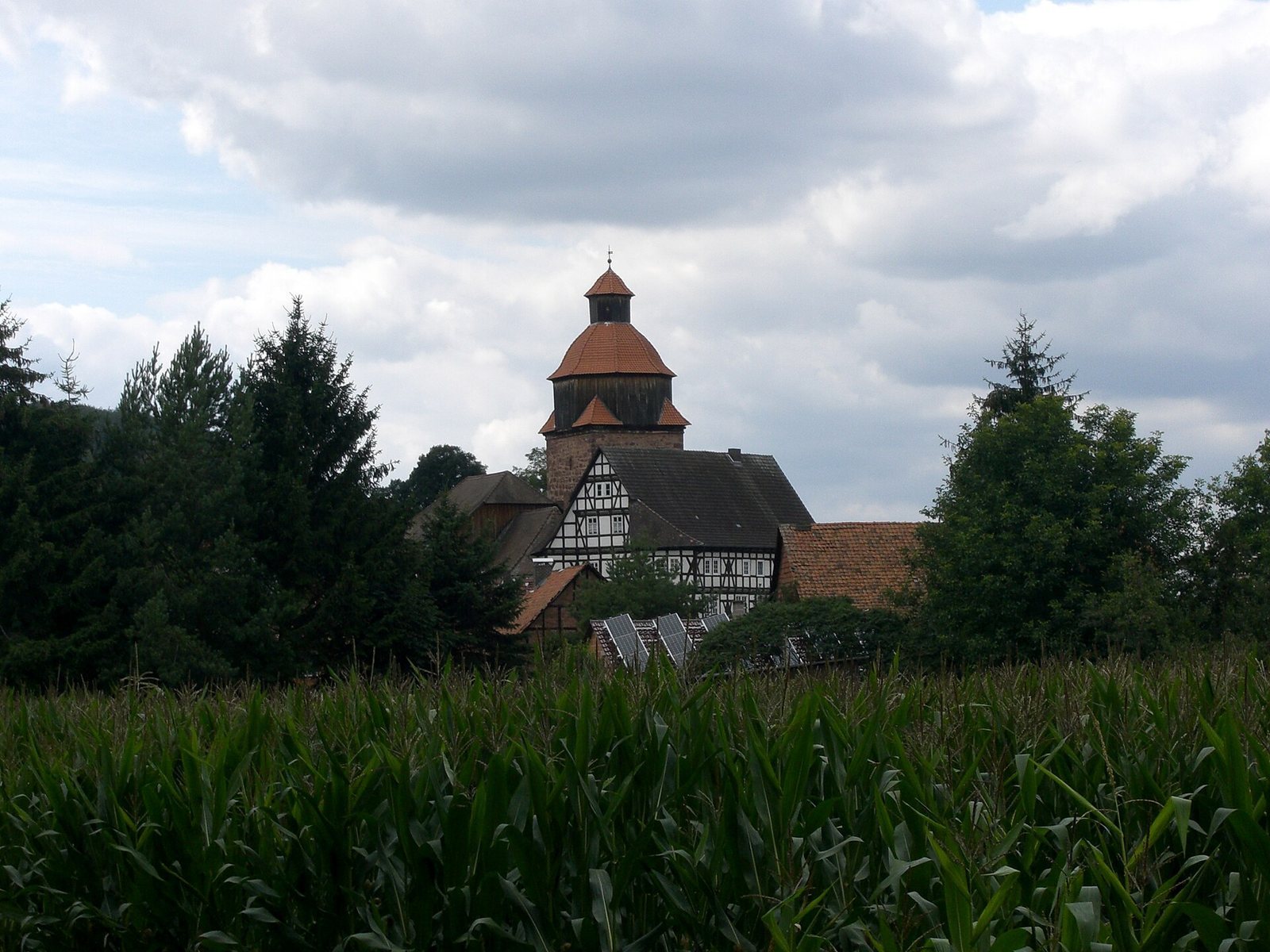
The lower part of the tower is built of stone and retains several loopholes, narrow openings once used for observation or the discharge of weapons. Above it rises an octagonal timber-framed section clad with boards. The bell frame stands behind sound arcades, and three bells have hung there since 1957. The oldest bell dates from the early sixteenth century.
Interior Opening and Roof
A bell-shaped cap topped by a lantern crowns the tower. Its upper stories were formerly accessible only from outside. At ground level, a pointed arch opens from the tower into the hall, while a ribbed cross vault, whose intersecting ribs form a cross-like framework, encloses the upper part of the interior and rests on consoles.
Choir and Interior Furnishings
Late Gothic Choir
The late Gothic choir ends in three sides. Its tracery windows contain fish-bladder ornament, a curving late Gothic pattern formed from pointed, flame-like shapes. Grave slabs are attached to the choir walls.
Boyneburg Epitaph
A 1595 epitaph, a commemorative monument for the dead, honors Reichard von Boyneburg and Margarete von Wallenstein. Sculptor Andreas Herber depicted the deceased kneeling before a cross and surrounded the composition with numerous coats of arms representing their ancestors.
Organ and Baptismal Font
The church contains an organ with a Baroque case dating from around 1725. A baptismal font from the early sixteenth century stands before the opening into the tower.
Protected Lime Tree
A lime tree stands at the church’s southwest corner. It was entered in the Eschwege district register of natural monuments under number 24 during the nature-protection reorganization of the 1930s. Protection under the Reich Nature Conservation Act took effect in the Kassel administrative district on 1 November 1936, and the tree is now listed as natural monument number 636.524 in the Werra-Meißner district.