Cadzow Castle: A Royal Hunting Residence and Hamilton Family Stronghold


Site at a Glance
- Rating
- 3.5
- Popularity
- Very Low
- Country
- United Kingdom
- Primary era
- Early Modern
- External website
- Open
- Eras represented
- Early Modern
- Civilizations
- Kingdom of Scotland
- Site type
- Military
- Remains
- Castle
On this page8 sections
History
Royal origins and medieval Cadzow
Cadzow Castle is a ruined castle in Scotland, United Kingdom, standing near Hamilton in South Lanarkshire. The present building was constructed around 1530 in the sixteenth century by Sir James Hamilton of Finnart, replacing an earlier royal castle. Its history is linked to the medieval settlement of Cadzow, royal hunting, and the Hamilton family.
An earlier castle is believed to have been built in the twelfth century as an occasional royal residence for David I, king of Scotland from 1124 to 1153. Royal charters were issued at Cadzow as early as 1139. Alexander II, Alexander III, and later Robert the Bruce, or Robert I, are also believed to have used the site, chiefly as a hunting lodge. Tradition places an even earlier hunting lodge at Cadzow, maintained by the ancient kings of Strathclyde, a medieval Brittonic kingdom gradually incorporated into Scotland during the twelfth century.
The position of this earlier castle remains uncertain. Archaeologists favour Hamilton Motte, a raised earthwork associated with a fortified residence, beside the former settlement and religious foundation. Castlehill, now beneath a housing estate, is another possible location. The present ruin therefore belongs principally to the later castle rather than providing a confirmed location for the earliest royal residence.
The Hamilton estate
The Cadzow estate was divided in 1222 and the castle subsequently passed to the Comyns. Their lands were forfeited after they supported John Balliol during the struggle for the Scottish crown. In the early fourteenth century, Robert the Bruce granted the estate to Walter FitzGilbert de Hambeldon, who became the first Baron of Cadzow and an ancestor of the dukes of Hamilton.
The medieval settlement of Cadzow, also known as Cadyou, was renamed Hamilton in 1455 in honour of James Hamilton, 1st Lord Hamilton. The older settlement near the M74 motorway later became known as Netherton, distinguishing it from the “Hitoun” of Cadzow.
Sixteenth-century conflict and destruction
Sir James Hamilton of Finnart built the present castle around 1530. He also constructed nearby Craignethan Castle, placing Cadzow within the building history of an influential Hamilton lord.
James Hamilton, 3rd Earl of Arran, was confined at Cadzow Castle in April 1566 after spending four years imprisoned in Edinburgh Castle for an alleged plot against Mary, Queen of Scots. Mary stayed at Cadzow after escaping from Lochleven Castle in 1568. The Hamilton family supported her, and forces commanded by the Earl of Mar, regent for the future James VI, destroyed the castle in retaliation during the late sixteenth century.
Eighteenth-century transformation and preservation
The castle was partly rebuilt in the eighteenth century as a folly, a deliberately picturesque building or ruin intended mainly as a landscape ornament. It stood within the duke of Hamilton’s park, in an area formerly included among the hunting and pleasure grounds of Hamilton Palace known as Hamilton High Parks.
Cadzow Castle is a Scheduled Monument, a legally protected archaeological or historic site of national importance. Historic Environment Scotland, Scotland’s national body for caring for and protecting historic sites, now owns and manages the ruin. Its unstable condition has required extensive scaffolding and has prevented entry into the structure, while paths in Chatelherault Country Park allow views of the castle.
Remains
Gorge setting and surviving castle fabric
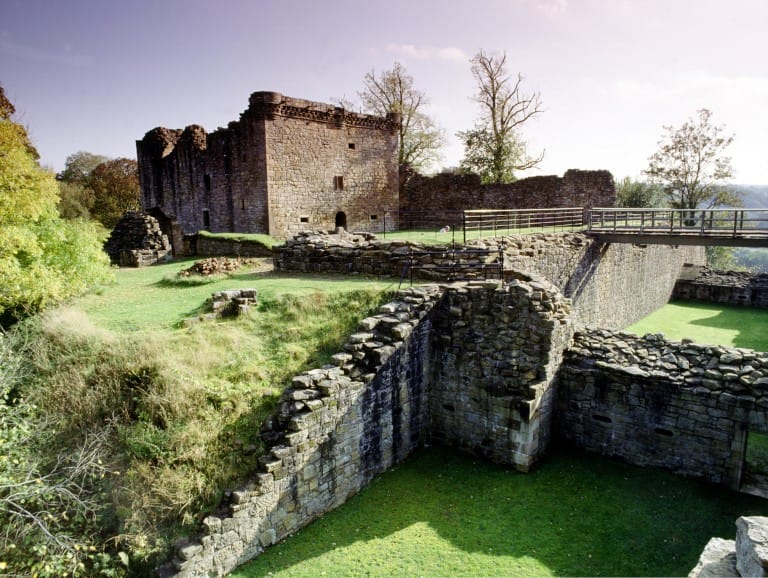
Cadzow Castle stands about 1.6 kilometres southeast of central Hamilton, above a wooded section of the Avon gorge overlooking the Avon Water. It occupies what is now Chatelherault Country Park. The Duke’s Bridge crosses the gorge at a high level and provides a prominent view of the ruins.
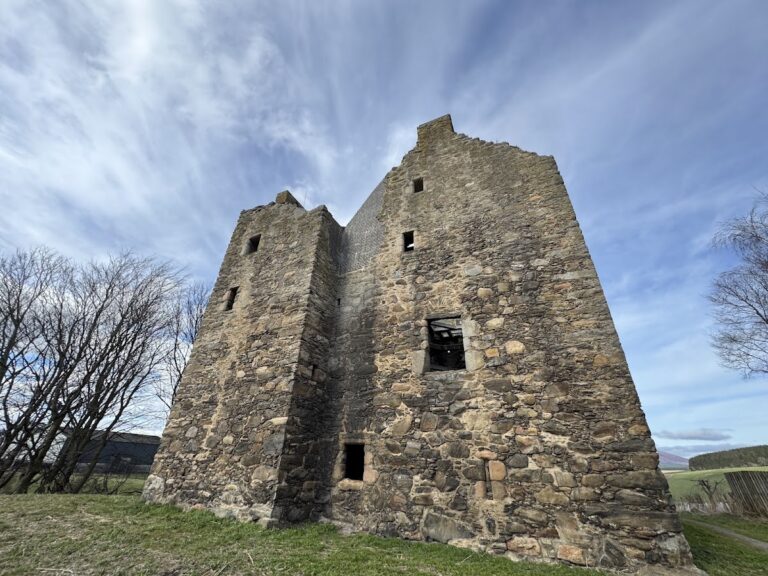
The surviving fabric dates principally from the castle’s construction around 1530 and its partial rebuilding in the eighteenth century. The ruin is substantially supported by scaffolding because of its unstable condition. The castle structure itself is not open to the public, but footpaths within the surrounding country park provide views of the remains.
Possible locations of the earlier castle
Hamilton Motte lies beside the former settlement and surviving remains near the M74 motorway. Archaeologists regard this raised earthwork as a possible site for the earlier Cadzow Castle. Castlehill, now occupied by a housing estate, is a second proposed location. These possibilities distinguish the setting of the medieval royal residence from the position of the sixteenth-century ruin above the Avon gorge.