Château de Reynel: A Historic Castle in France


Site at a Glance
- Rating
- 4.3
- Popularity
- Very Low
- Country
- France
- Primary era
- Early Modern
- Eras represented
- Medieval, Early Modern
- Civilizations
- French
- Site type
- Domestic
- Remains
- Castle
On this page9 sections
History
Medieval Stronghold and Lordship
Château de Reynel is a historic castle in Reynel, France, occupying a steep spur above a narrow valley. Its medieval defensive role faced the Holy Roman Empire, a long-lasting political entity in central Europe, and later Lorraine. The position gave the site strategic importance as an advanced frontier post.
The lordship of Reynel was elevated to a county by Pepin the Short, the eighth-century king of the Franks, in 757. It later became a marquisate under François II, king of France from 1559 to 1560, in 1560. The estate passed successively through the Reynel family and its descendants, the Joinville and Neuchâtel families, before being acquired by the Amboise family.
Wars, Destruction, and Reconstruction
The castle suffered during the Wars of Religion, the sixteenth-century French civil and religious conflicts, and during the Thirty Years’ War, the major European conflict fought from 1618 to 1648. By the middle of the seventeenth century, the medieval complex had become severely dilapidated.
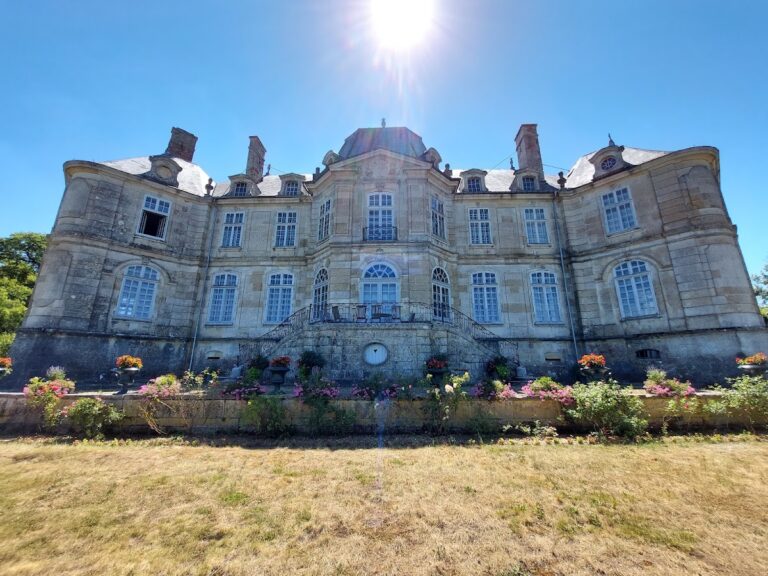
When Claude-Joseph de la Rue, Count of Mareilles and Aubeterre, bought the property from the Clermont d’Amboise family in 1763, he removed the surviving remains apart from a round tower. The present castle was then reconstructed between 1763 and 1772.
Nineteenth-Century Ownership and Preservation
In the nineteenth century, the castle first belonged to the Collin family, known as de Civry, which acquired it around 1844. It later passed to Louis François de Beurges, Count of Beurges. His son, Henri Charles Louis de Beurges, owned the Manois forges, while his daughter Osine often stayed at Château de Reynel with her parents.
The Count of Beurges slightly changed the castle’s appearance by adding a northern pavilion beside the chapel, between two round towers with conical roofs. Since 1942, restoration carried out by the current owner has saved the building from abandonment. Château de Reynel has been listed in the supplementary inventory of Historic Monuments since 1989. The nineteenth-century French poet Paul Verlaine also composed several verses at the castle.
Remains
Setting and Main Layout
Château de Reynel stands on a steep spur above a narrow valley, with a body of water lying between wooded slopes. The present complex is organized around a long main residential building, which contains the principal living and reception spaces. On the courtyard side, two rectangular pavilions are attached obliquely to the building and face east.
Surviving Medieval and Later Features
Round Tower and Former Keep Site
A round tower was the sole surviving remnant of the earlier castle when reconstruction began in the eighteenth century. In the southern angle between the main building and one pavilion, a terrace now occupies the site of the former keep, the principal fortified tower of a medieval castle. The terrace overlooks the valley.
Northern Pavilion and Towers
The castle’s appearance was modified during the nineteenth century by the addition of a northern pavilion beside the chapel. This element stands between two round towers capped by conical roofs, forming part of the later arrangement of the complex.