Gessler Castle: A Medieval Hill Castle in Switzerland
Site at a Glance
- Rating
- 4.5
- Popularity
- Low
- Country
- Switzerland
- Primary era
- Medieval
- External website
- Open
- Eras represented
- Medieval
- Civilizations
- Habsburg
- Site type
- Military
- Remains
- Castle
On this page9 sections
History
Gessler Castle, also called Gesslerburg Castle or Küssnacht Castle, is a medieval hill castle in Küssnacht, Switzerland, built during the ninth century. Its origins are only partly understood, but the site developed into a centre of local administration and noble residence before becoming associated with the legend of William Tell.
Early Medieval Origins
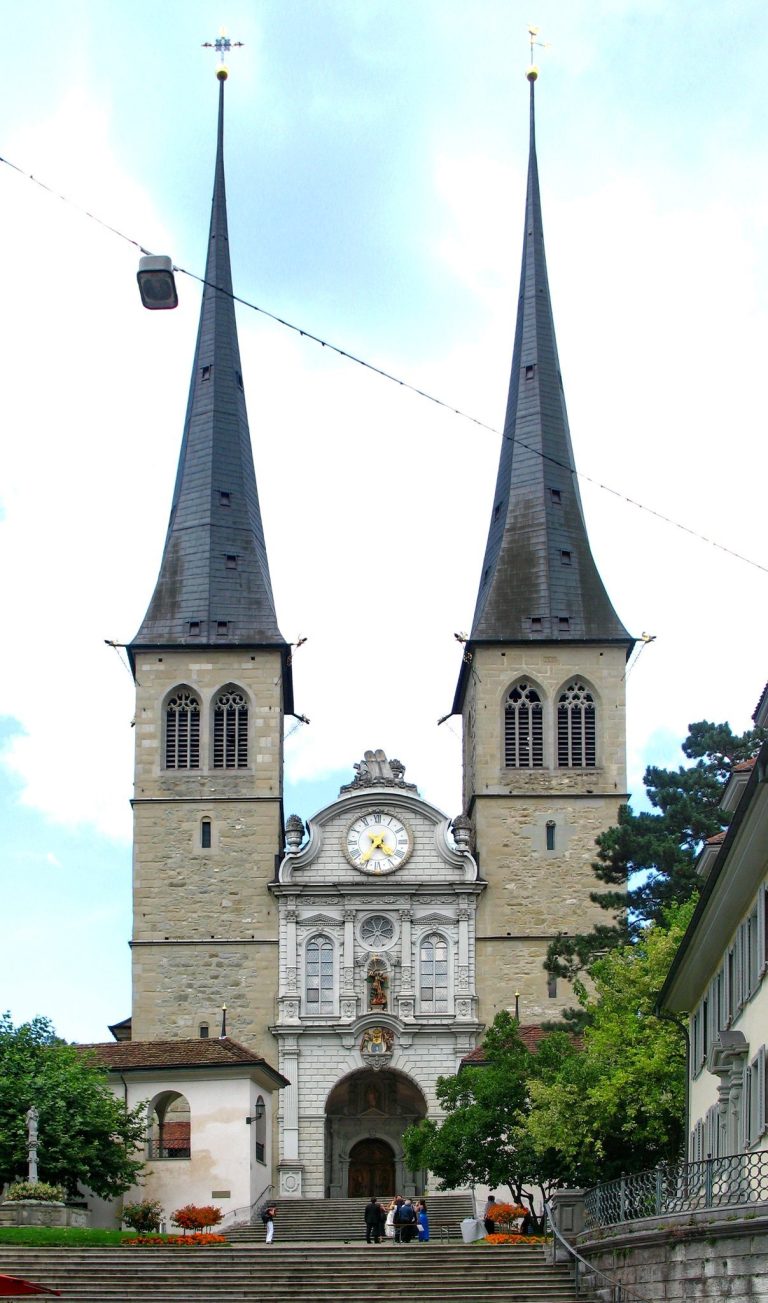
In the second half of the ninth century, the nobleman Recho donated his possessions in Küssnacht to the Benedictine monastery of St. Leodegar in Lucerne. Those holdings probably included an early medieval castle. The first written reference to the site dates from 1263, when it was mentioned as “in castro nostro Chüssenach.”
In 1291, the monastery sold Küssnacht to King Rudolf I of Habsburg. The Habsburgs were a major European ruling dynasty whose territories and officials extended into what is now Switzerland. Their appointed lords in Küssnacht later used the title “nobles of Küssnacht,” linking the castle with the administration of Habsburg possessions in the area.
Habsburg Administration and Noble Residence
Ritter Eppo II, who served as Vogt of Küssnacht from 1282 to 1315, governed the territory on behalf of a higher lord. He demanded taxes, dues, and compulsory labour from the inhabitants of the bailiwick. A Vogt combined administrative and judicial responsibilities, and a dispute in 1302 nearly led to Eppo’s death. The castle’s occupants may also have received income from tolls on the trade route between Lucerne and Zurich.
Objects recovered from the site indicate that the castle’s inhabitants possessed considerable material resources and took part in knightly tournaments. The male line of the Küssnacht nobles ended around 1352 with Ritter Hartmann, who was the son-in-law of Zurich mayor Rudolf Brun.
A conflict in 1352 pitted Zurich and the Swiss Confederates against Duke Albert II of Austria. The fighting may have affected the castle, although the precise connection remains uncertain. Fire traces show that the complex was partly destroyed in the middle of the fourteenth century. It was later rebuilt with substantial alterations, creating a changed form of the medieval castle.
The von Silenen Family and Confiscation
During the fifteenth century, the castle became the residence of the von Silenen family. Jost and Kaspar von Silenen were traditionally said to have been born there. Kaspar von Silenen, who lived from 1467 to 1517, later became the first commander of the Pontifical Swiss Guard, the military corps established in Rome by Pope Julius II to protect the pope and the Apostolic Palace.
The Swiss Confederates accused Kaspar von Silenen of recruiting Swiss mercenaries, a practice prohibited by the Confederates. He was condemned to death in absentia, meaning that the sentence was issued while he was not present, and his property, including the castle, was confiscated. After his death in 1517, the castle passed to the Canton of Schwyz.
Quarrying and the Tell Tradition
From the fifteenth century onward, the ruins were used as a source of building stone. At the beginning of the eighteenth century, stone from the castle was also used in constructing Küssnacht’s parish church. Quarrying and the removal of material continued to reduce the remains, and the castle’s decline lasted until the end of the nineteenth century.
The ruins became associated with William Tell, the legendary Swiss hero traditionally said to have resisted Habsburg rule, and with the nearby Hohle Gasse, the historic route linked by tradition to Tell’s attack on the tyrannical bailiff Hermann Gessler. The earliest known connection between the castle and Gessler appears in a Tell play from 1512 to 1513. In the seventeenth century, the historian and statesman Aegidius Tschudi described the castle as Gessler’s residence and associated it with a prison.
Friedrich Schiller’s 1804 drama William Tell renewed interest in the Gessler and Tell tradition and helped popularize the story beyond Switzerland. Romantic representations of the ruins followed, including a lithograph made around 1840 by Charles Rodolphe Weibel-Comtesse.
Excavation and Preservation
The Swiss Confederation purchased the ruins in 1908 on the initiative of Federal Councillor Josef Zemp, with the intention of preserving them as a national memorial site. Robert Durrer directed excavations carried out between 1908 and 1916 for scholarly and archaeological research. The work exposed buried parts of the castle complex and recovered objects dating from the thirteenth to the seventeenth centuries.
The finds demonstrated the considerable material resources of the castle’s inhabitants. Conservation and partial reconstruction began in 1917 and continued through successive phases. Erosion-protection work followed in 2003 and 2004, and again in 2018 and 2019. Gessler Castle has been owned by the Swiss Confederation since 1908 and is recognized as a Swiss heritage site of national significance.
Remains
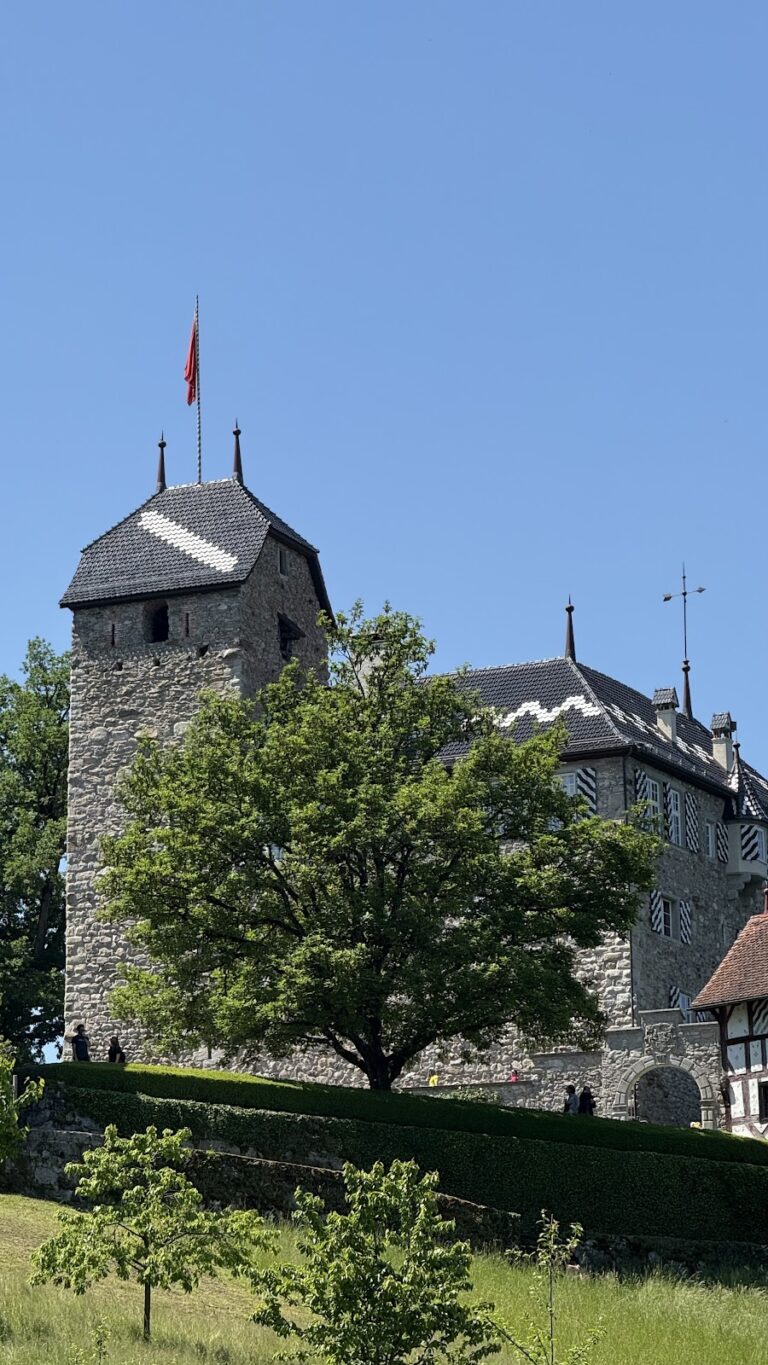
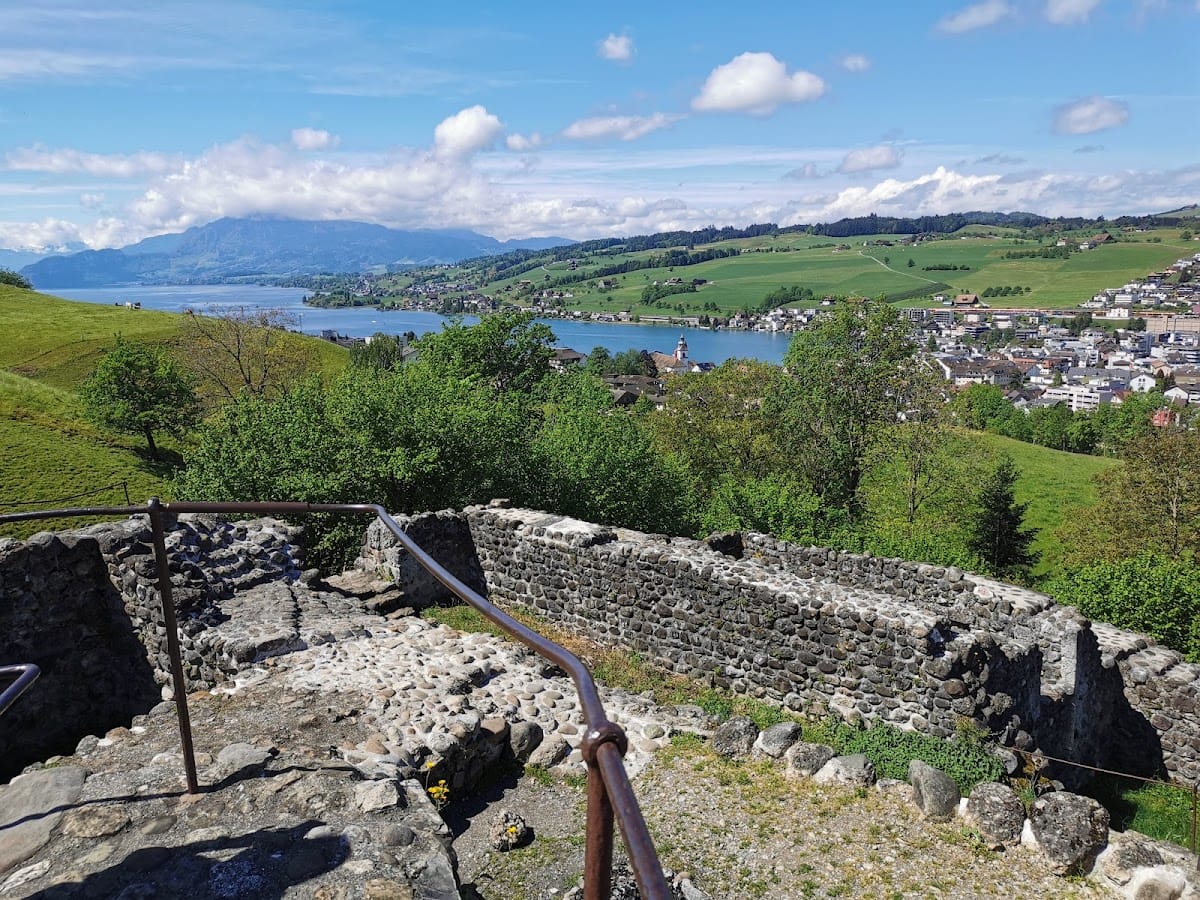
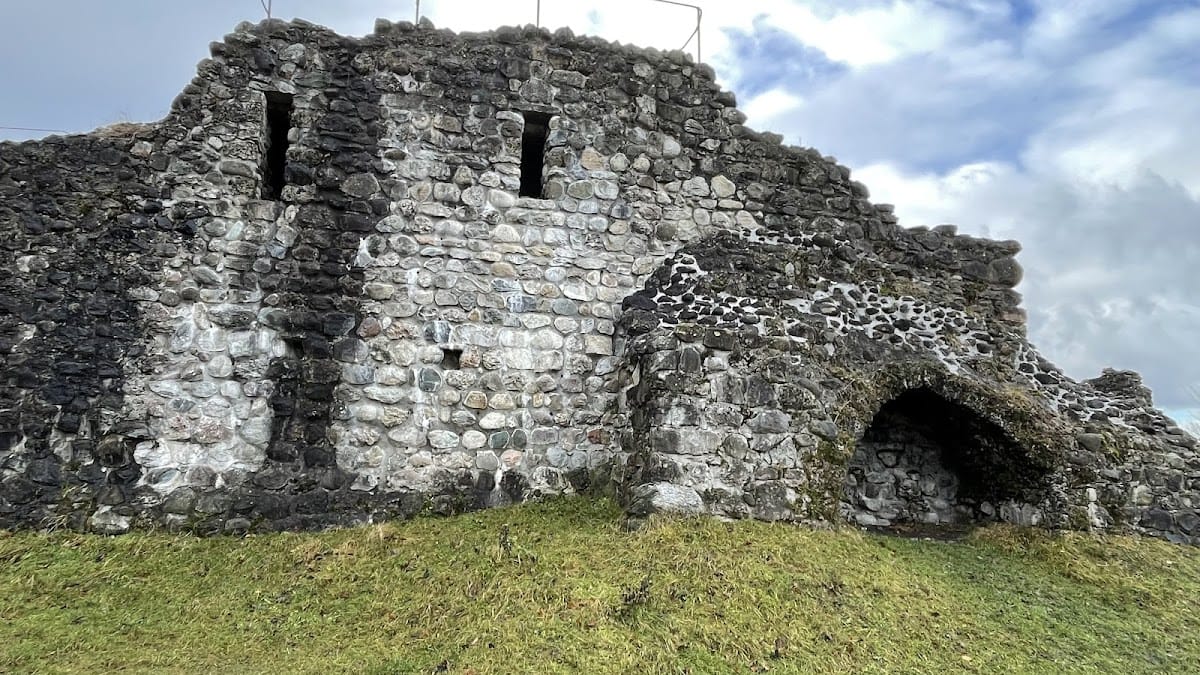
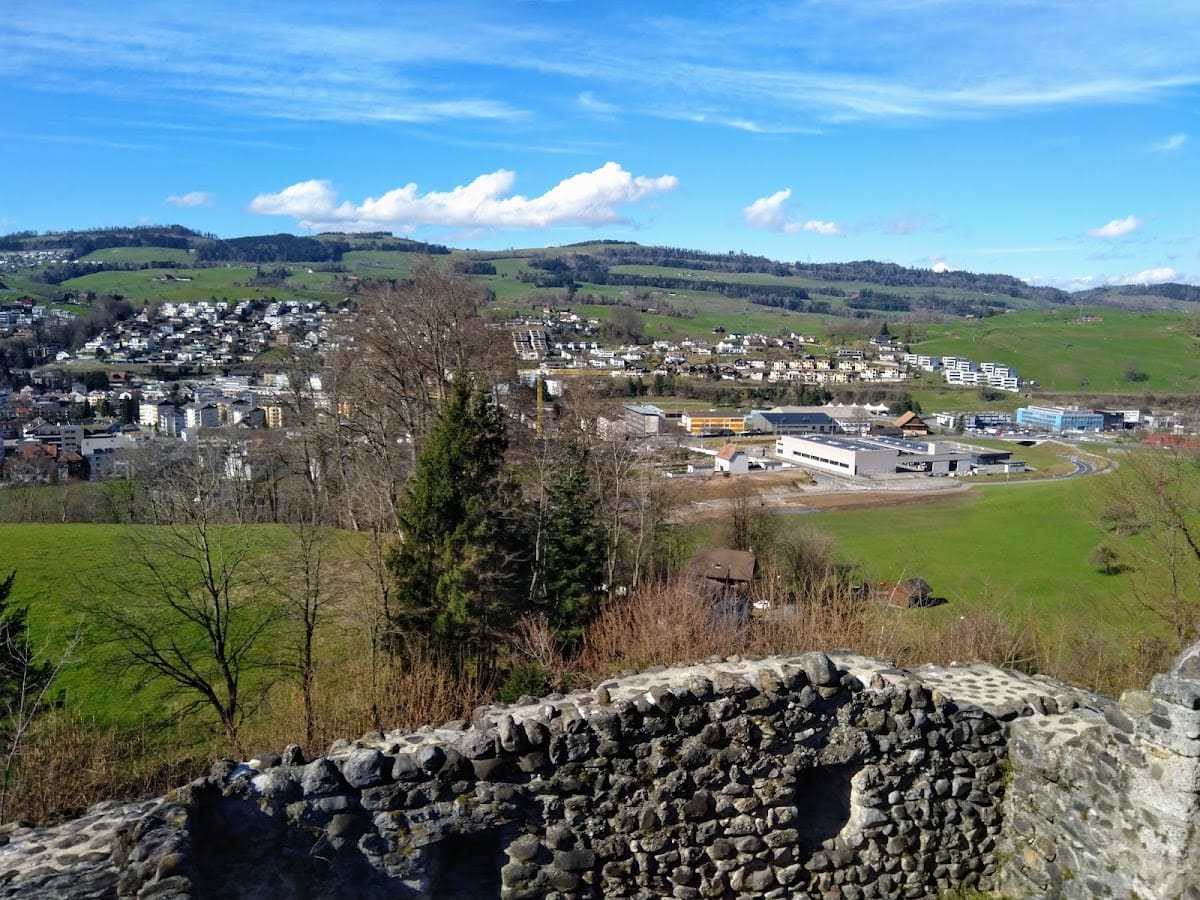
Gessler Castle occupies a hilltop east of the village of Küssnacht, above the Dorfbach. The stream descends from the Seebodenalp toward the lake, while the castle ruins occupy the elevated ground above it. The surviving complex is ruinous, reflecting the partial destruction and rebuilding of the mid-fourteenth century, later quarrying, and the removal of stone for the parish church.
Hilltop Ruins and Excavated Complex
Excavations revealed buried remains of the castle complex beneath and around the surviving ruinous fabric. The mid-fourteenth-century rebuilding incorporated extensive changes after the fire that had partly destroyed the earlier castle. Later removal of stone reduced the physical remains, while conservation and partial reconstruction from 1917 onward stabilized and restored parts of the site.
Archaeological Finds
Objects recovered during excavation date from the thirteenth through the seventeenth centuries and illuminate the long occupation of the castle. The most important find is a pot helmet from the second quarter of the fourteenth century. This rounded medieval helmet covered the head and usually extended over the face and the sides of the neck. The helmet is now held by the Swiss National Museum.