Castell de Vulpellac: A Gothic-Renaissance Castle-Palace in Spain
Site at a Glance
- Rating
- 4.4
- Popularity
- Low
- Country
- Spain
- Primary era
- Early Modern
- External website
- Open
- Eras represented
- Medieval, Early Modern
- Civilizations
- Crown of Aragon, Spanish
- Site type
- Military
- Remains
- Castle
On this page11 sections
History
Castell de Vulpellac is a civil Gothic-Renaissance castle-palace in Vulpellac, Spain, whose documented history reaches back to the twelfth century. The site became a fortified noble residence and was transformed into a Renaissance palace during the sixteenth century, when it was controlled by the Sarriera family.
Medieval Lords and Fortification
Gausbert Guillem de Vulpellac, an early medieval nobleman associated with the locality, is documented there in 1137. In 1269, the lord of Vulpellac and the Bishop of Girona, who held superior lordship over the place, agreed that a fortification should be built. By 1286, Guillem de Palol was lord of Vulpellac and a feudal dependent of the lord of Peralada. The bishop’s rights over the parish were recorded again in 1319.
Control of the castle belonged to the Sant Sadurní family by 1322. Sibila de Sant Sadurní married Guillem Sarriera in 1352, and in 1358 Guillem bought jurisdiction over the place from the Count of Empúries. The Sarriera family also held the castles of Anglès, Montsoriu, Cartellà, and Solterra. Its lineage included the fourteenth-century physician Arnau Sarriera.
The Sarriera Family and the Renaissance Rebuilding
Joan Sarriera, Guillem’s grandson, married Violant Margarit i Bertran, daughter of Bernat Margarit i de Pau, during the second half of the fifteenth century. In 1471, while serving as captain of Girona during the Catalan Civil War, a fifteenth-century conflict in the Crown of Aragon involving rival political factions and competing claims to royal authority, Joan changed allegiance to King John II.
In 1514, Antoni Sarriera and his wife, Elionor, gave the castle to their son Miquel when he married Violant, daughter of Joan de Biure. Miquel Sarriera, lord of Vulpellac during the first half of the sixteenth century, presided over the castle’s period of greatest prominence. Antoni Sarriera was still documented as lord of Vulpellac in 1523.
In 1533, Miquel Sarriera had much of the fortress rebuilt and converted into a Renaissance castle-palace. The chapel was reconstructed during the same campaign. Miquel also killed Baldiri de Agullana and the Baron of Llagostera, a nobleman holding the baronial title associated with Llagostera, in Barcelona while aligned with the Cartellà family and serving as Batlle General of Catalonia, a senior administrative and judicial office.
A local legend connects Miquel Sarriera with an inscription in the castle. It says that, after hearing false rumours about his wife from the lord of Cruïlles, he imprisoned her and eventually had her walled up alive in a tower. After learning that the accusation was false, he imprisoned and killed his rival, then travelled to Rome to seek the Pope’s forgiveness. On his return, he ordered the inscription carved during a rapid refurbishment of the castle.
Later Changes and Heritage Protection
Around 1725, the building underwent further reforms and was later converted into a farmhouse. Its protected status includes recognition as a Cultural Asset of National Interest, Catalonia’s principal statutory heritage designation, and registration as a Spanish cultural-interest monument under reference RI-51-0000573. The heritage designation dates from 1931 or later.
Remains
Castle Layout and Defensive Fabric
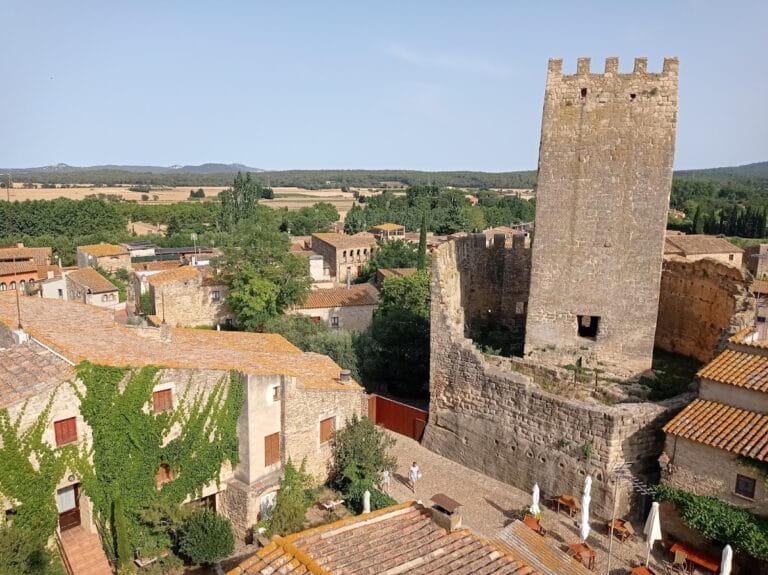
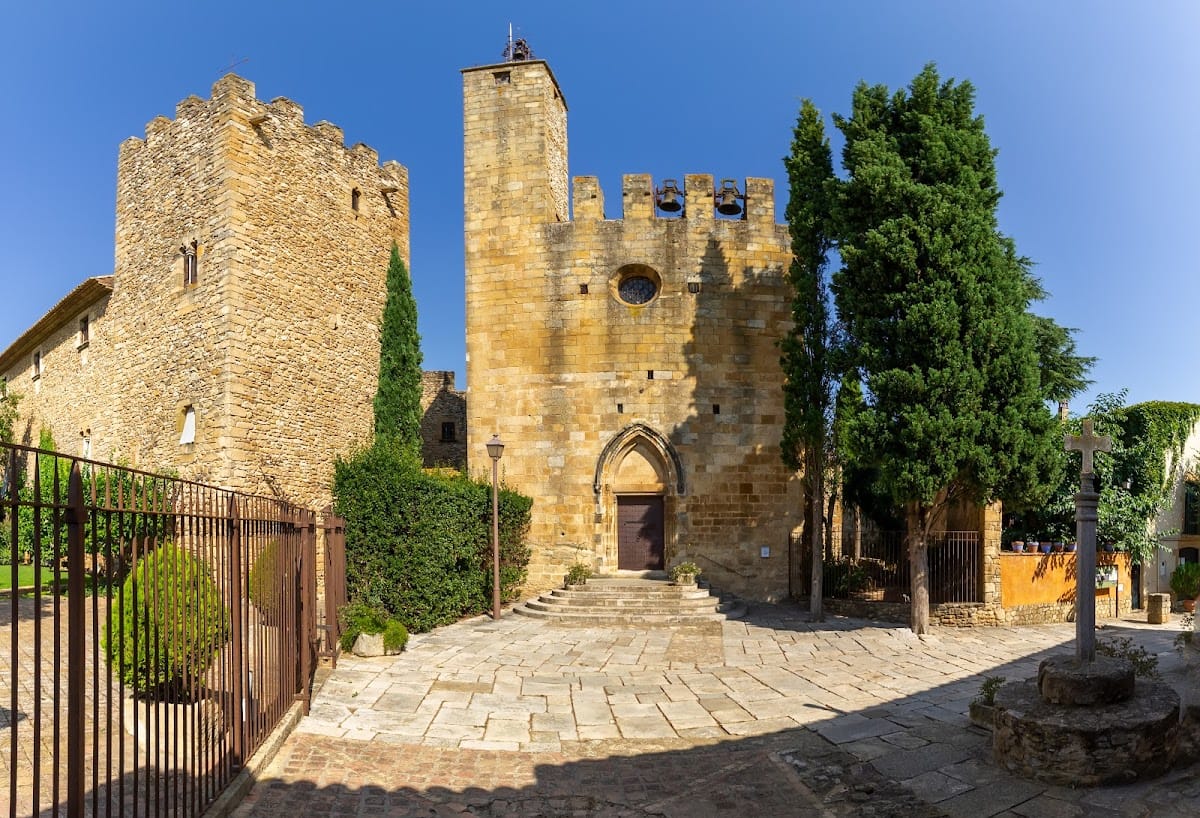
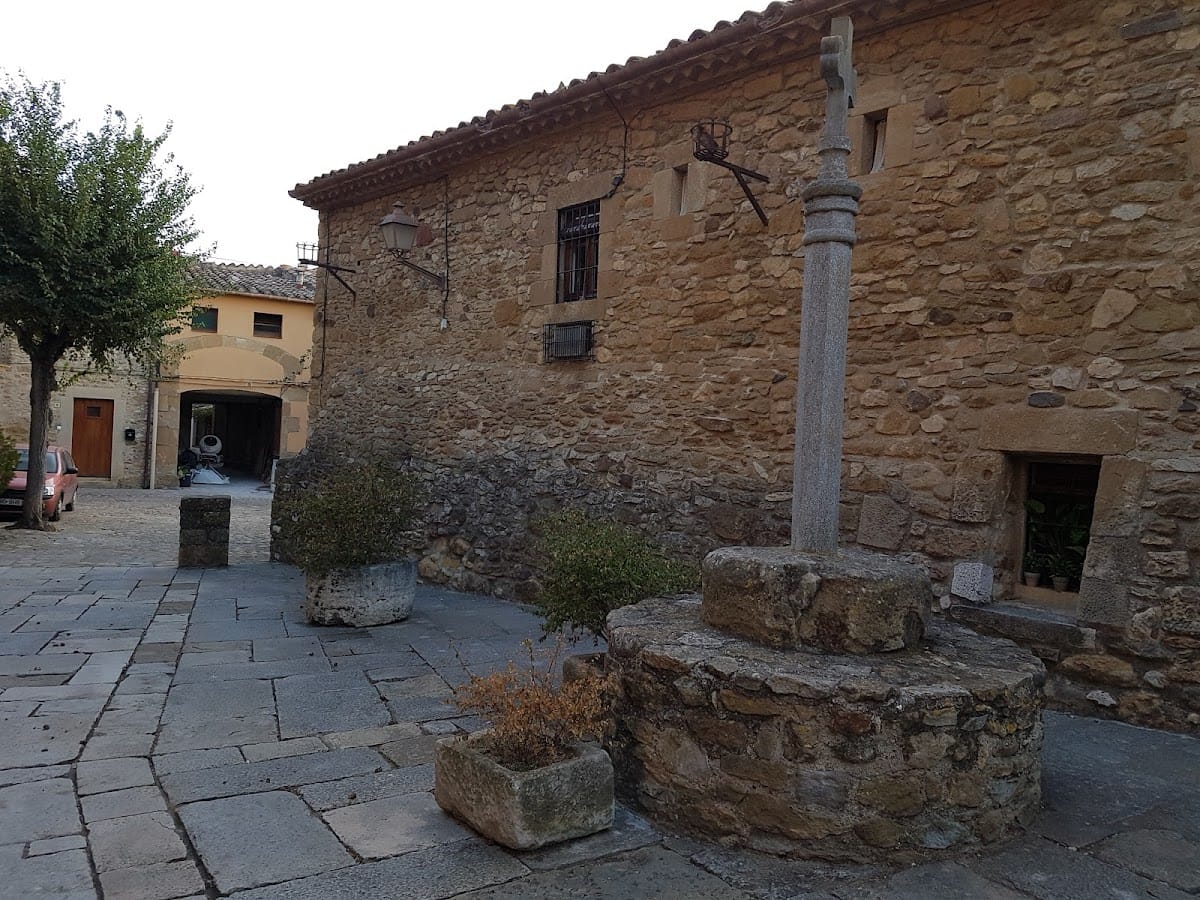
Castell de Vulpellac is a two-storey complex formed by three structural sections around a small trapezoidal courtyard. The chapel closes the courtyard on its southern side. A stone well stands within the courtyard, while a staircase attached to the walls leads to the upper part of the building. The western section has a two-pitched roof, and the other sections are topped by rectangular crenellations. These were stepped before the latest restoration.
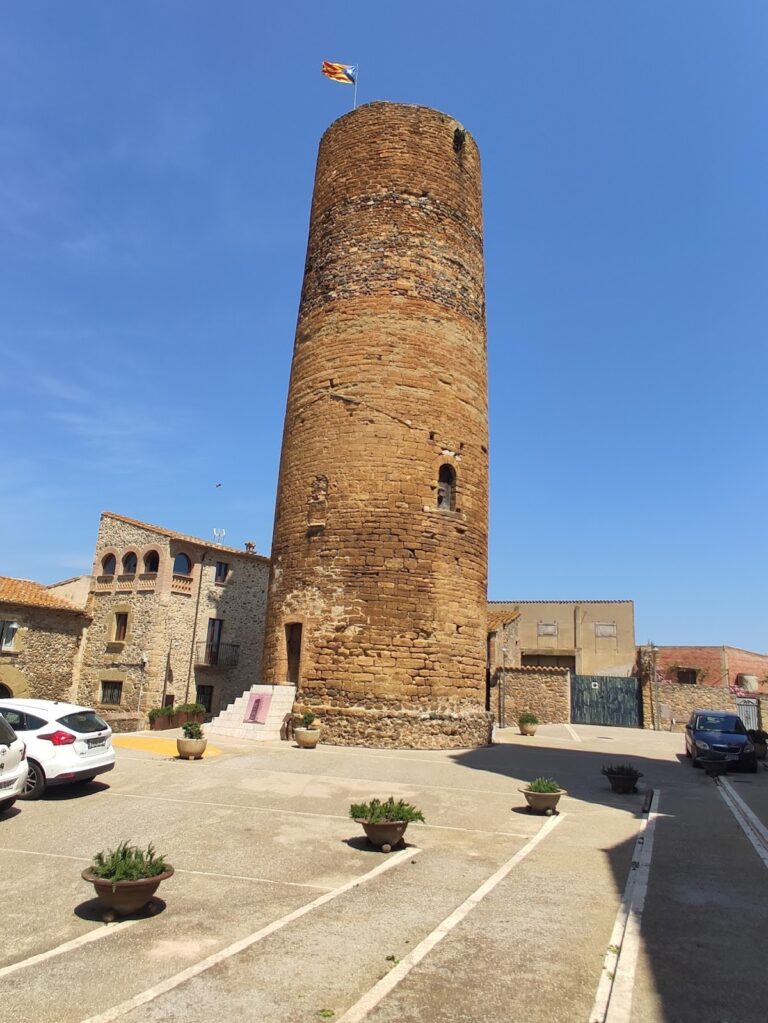
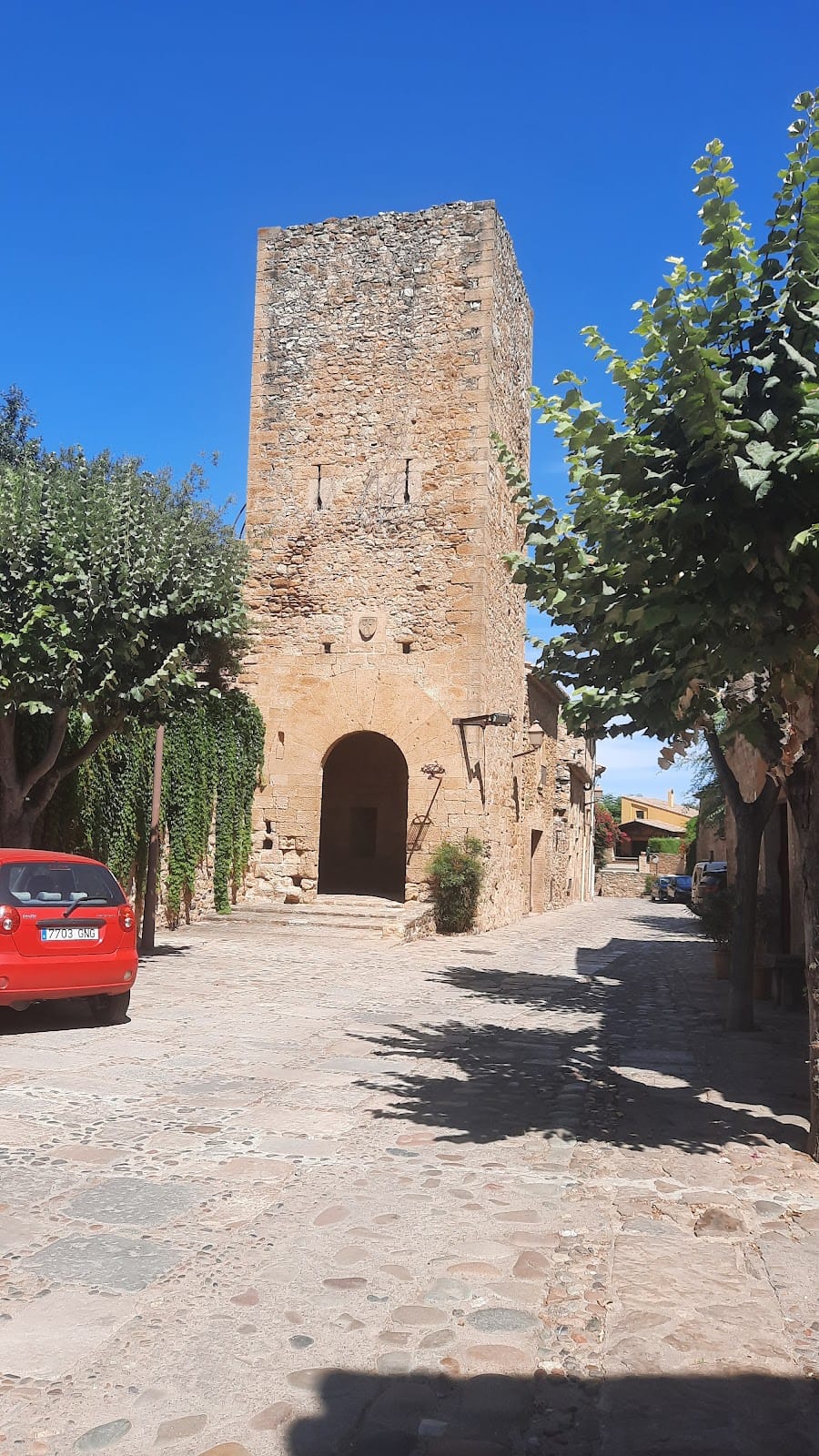
The castle was once enclosed by a surrounding wall, fragments of which survive. Narrow loopholes, or defensive openings, remain in the fabric, and portions of the former enclosure have been incorporated into houses built against it. A square tower at the northeastern portal is the best-preserved tower. Its entrance has a straight lintel. Another cylindrical tower stands southwest of the village, embedded among houses.
Keep
The keep, the castle’s principal fortified tower, is a rectangular structure dating from the fourteenth century. It has few Gothic openings, loopholes, crenellations, and wooden floors. The tower was built over the remains of an earlier tower, and its base contains herringbone masonry, a technique in which small stones are laid in angled rows resembling a fishbone pattern. Its surviving structure belongs to the thirteenth and fourteenth centuries and rises from a roughly three-metre-high base that may come from an older construction, possibly of the ninth or tenth century. Herringbone masonry is especially visible in the southern and western walls.
Gothic and Renaissance Palace Features
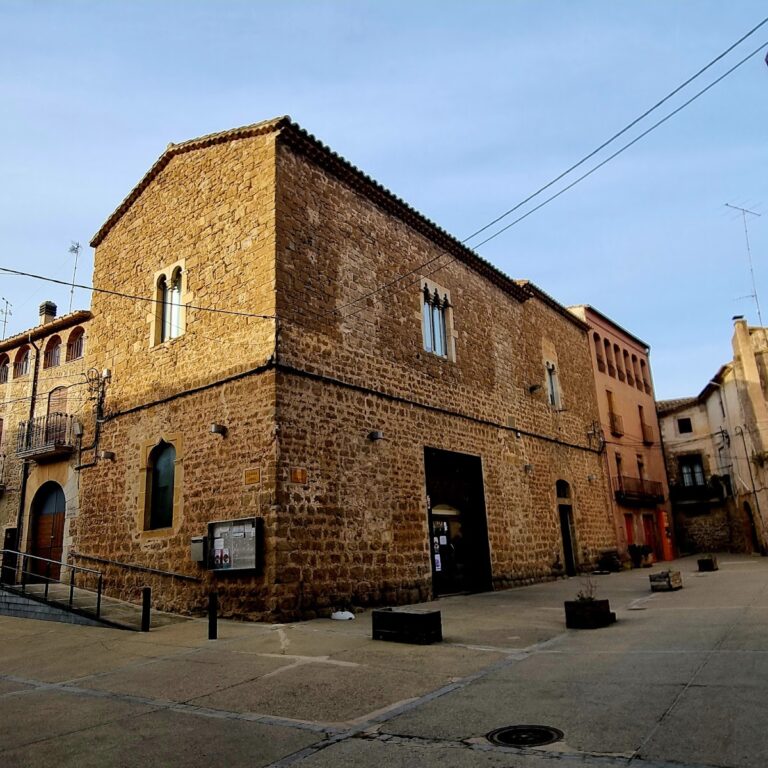
Most of the windows are Gothic, with trefoil arches. Some were reconstructed during the later restoration from earlier Gothic elements after having been remodelled in the eighteenth century. Other windows date from the late fifteenth or sixteenth century and have ogee forms or fully Renaissance designs.
Inscriptions and Interior Rooms
A Renaissance window on the eastern facade bears the inscription “Ego sum qui pecavi, 1533, Miquel Sarriera,” meaning “I am the one who sinned.” The same text appears in several other locations in the castle, while biblical inscriptions occur throughout the palace. The principal hall has pointed diaphragm arches, transverse arches supporting the roof structure, and a coffered ceiling formed from recessed decorative panels. Other interiors include vaulted lower rooms and chambers on the main floor.
Gallery Tiles
Part of the gallery flooring survives. Groups of four tiles carry the coats of arms of the Sarriera, Rocabertí, and Biure families alongside the inscription associated with Miquel Sarriera. Other tiles have blue borders, and additional decorated tiles remain elsewhere in the building.
Chapel
The sixteenth-century chapel is a single-nave building with a rib vault, an interior pentagonal apse, and a semicircular apse on the exterior. Its facade is made from finely squared ashlar and has a portal with pointed archivolts, a plain tympanum, and a lintel, topped by a rose window. Crenellation-like forms at the upper part of the facade serve as a small bell gable, and a tall bell tower stands beside the northern side of the facade. The side walls are built of rubble masonry.
The chapel’s nave and presbytery are whitewashed. Relief decoration appears on the vault keystones, and the supports from which the ribs spring bear Sarriera coats of arms. Fragments of Baroque painted decoration also survive. Two chapels were opened on each side of the nave during the seventeenth century, and those on the northern side were later demolished. A sacristy was added beside the southern side of the presbytery, while a window opened in the northern wall is now blocked.
Nearby sites