Burg Schwabsburg: A Medieval Hilltop Castle Ruin in Germany
Site at a Glance
- Rating
- 4.5
- Popularity
- Low
- Country
- Germany
- Primary era
- Medieval
- Eras represented
- Medieval, Modern
- Civilizations
- Holy Roman Empire
- Site type
- Military
- Remains
- Castle
On this page8 sections
History
Burg Schwabsburg is a medieval hilltop castle ruin in Germany, near Nierstein. Probably founded around 1210, it was first mentioned in 1257, when a royal charter issued by Richard of Cornwall, the elected King of the Romans, identified it as a strongpoint of Staufen rule on the Rhine. The Staufen, or Hohenstaufen, dynasty was a medieval German ruling family whose imperial authority extended across territories and political interests along the Rhine.
Imperial and Electoral Rule
During the fourteenth century, the Empire pledged the castle to the Archbishop of Mainz for 60 years. The archbishop was among the most powerful church princes of the Holy Roman Empire and one of the electors involved in choosing the German king. Burg Schwabsburg later became the property of the Electors Palatine, hereditary imperial princes who also held the Palatinate’s electoral office.
In 1316, the knight Wigand von Dienheim received Schwabsburg as a fief because of his high standing with Emperor Louis IV, also known as Louis the Bavarian. Von Dienheim died on 26 November 1331.
Destruction and Demolition
The castle was destroyed during the Thirty Years’ War, the European conflict fought from 1618 to 1648 amid dynastic, territorial, and religious struggles. Its destruction formed part of the devastation of the left-bank Palatinate. The army responsible was led either by the Spanish commander Ambrosio Spinola or, from spring 1621, by his successor Gonzalo Fernández de Córdoba.
After the ruined castle was auctioned, it was demolished in 1799. Burg Schwabsburg is now designated as a cultural heritage monument in Rhineland-Palatinate.
Remains
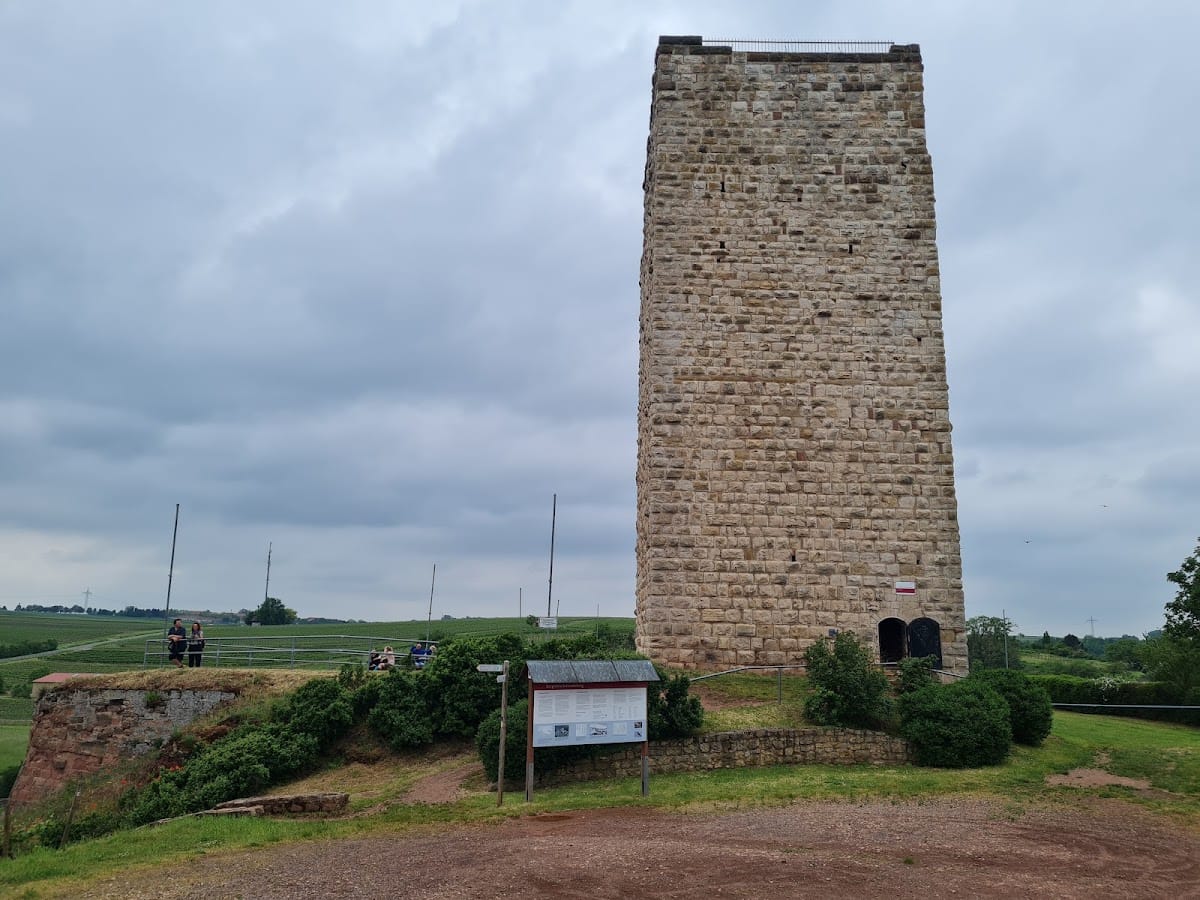
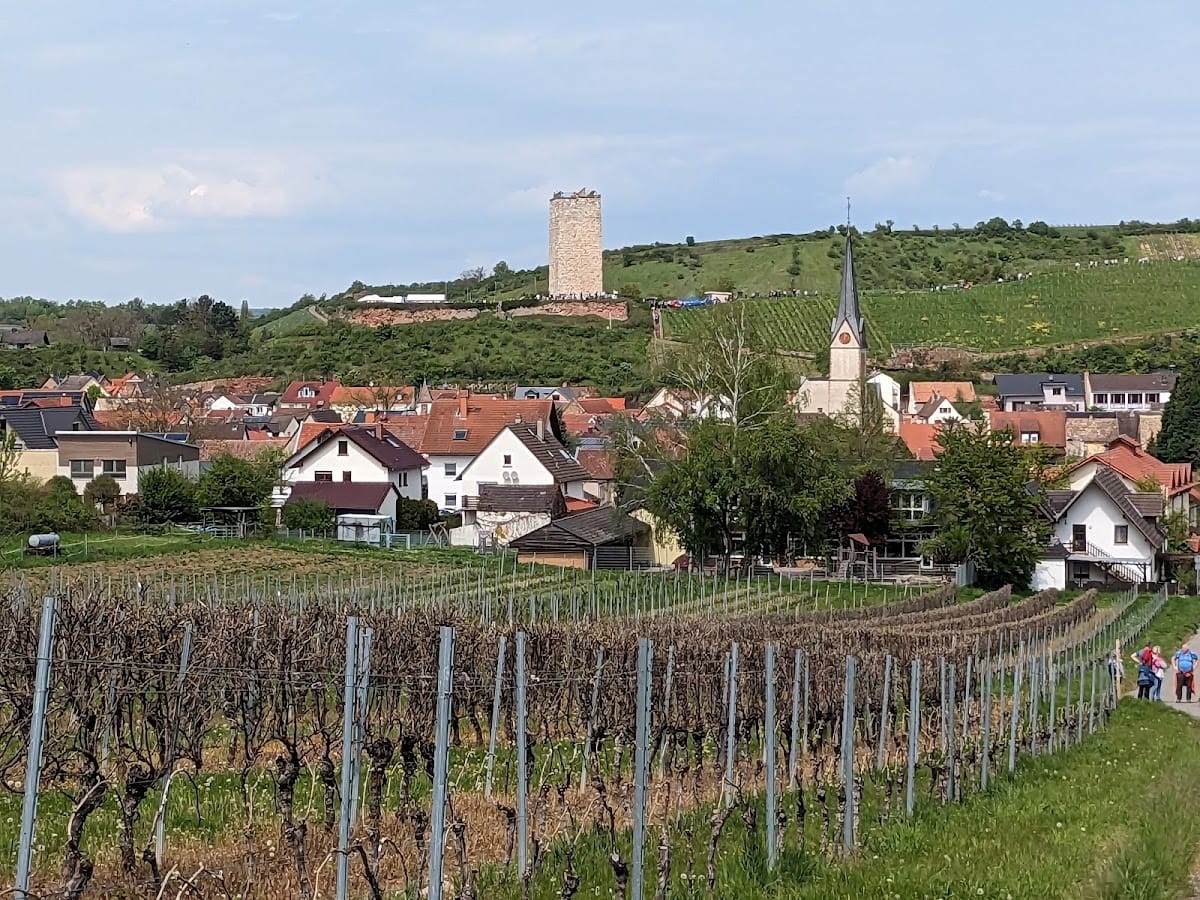
The surviving remains stand at approximately 120 metres above sea level on a mountain spur enclosed in a U-shape by Schwabsburg, a district of Nierstein. Only the principal fortified tower, or keep, and parts of the defensive wall enclosing the former castle complex remain. The tower and walls are faced with bossed ashlar, cut stone blocks with raised, roughly finished centres.
Keep and Defensive Walls
The Keep
The approximately square keep measures between 10.2 and 10.4 metres on each side from its base to a point about four metres below the top. Above a slight offset, its sides measure approximately 9.7 to 9.9 metres. Because the ground rises unevenly around the tower, its height varies from 24 metres at ground level to the viewing platform at the north corner to 22.2 metres at the east corner. The walls are approximately 3.5 metres thick and contain only a few narrow loopholes, or openings for observation and ranged defense, rather than ordinary windows.
The original high entrance is on the southwest side, 11 metres above the ground. A later entrance on the northeast side is a lockable round-arched door 1.53 metres high, reached by three stone steps. Inside, a straight stone stairway with new steps leads to a clockwise-turning steel spiral staircase installed in 1963 and 1964. The spiral staircase has 65 steps, with the original high entrance reached after 44 of them. A further landing leads to a steeper stone stairway that turns slightly left and rises through 28 higher steps to the viewing platform.
The Curtain and Shield Walls
Parts of the curtain wall, the defensive wall enclosing the castle complex, survive around the keep. The western shield wall, a particularly strong section protecting the castle’s most vulnerable side, was approximately 2.8 metres thick. Like the tower, the surviving wall sections are faced with bossed ashlar blocks.
Upper Platform and Interior
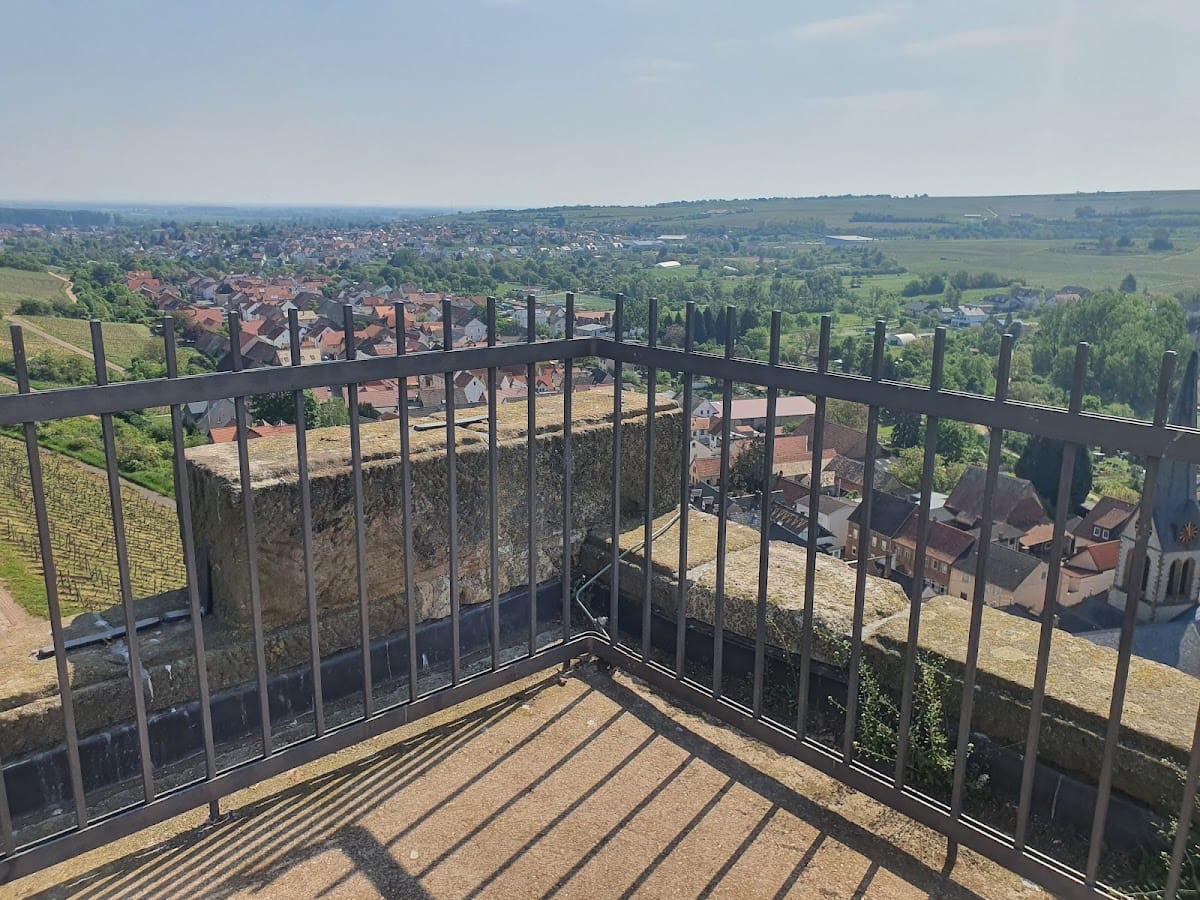
The weather-protected exit opens toward the northeast and rises 2.3 metres above the platform. The platform covers the entire upper surface of the keep and is enclosed by a metal railing 1.1 metres high. An interior lighting system controlled by motion detectors was installed because of the darkness inside the tower.
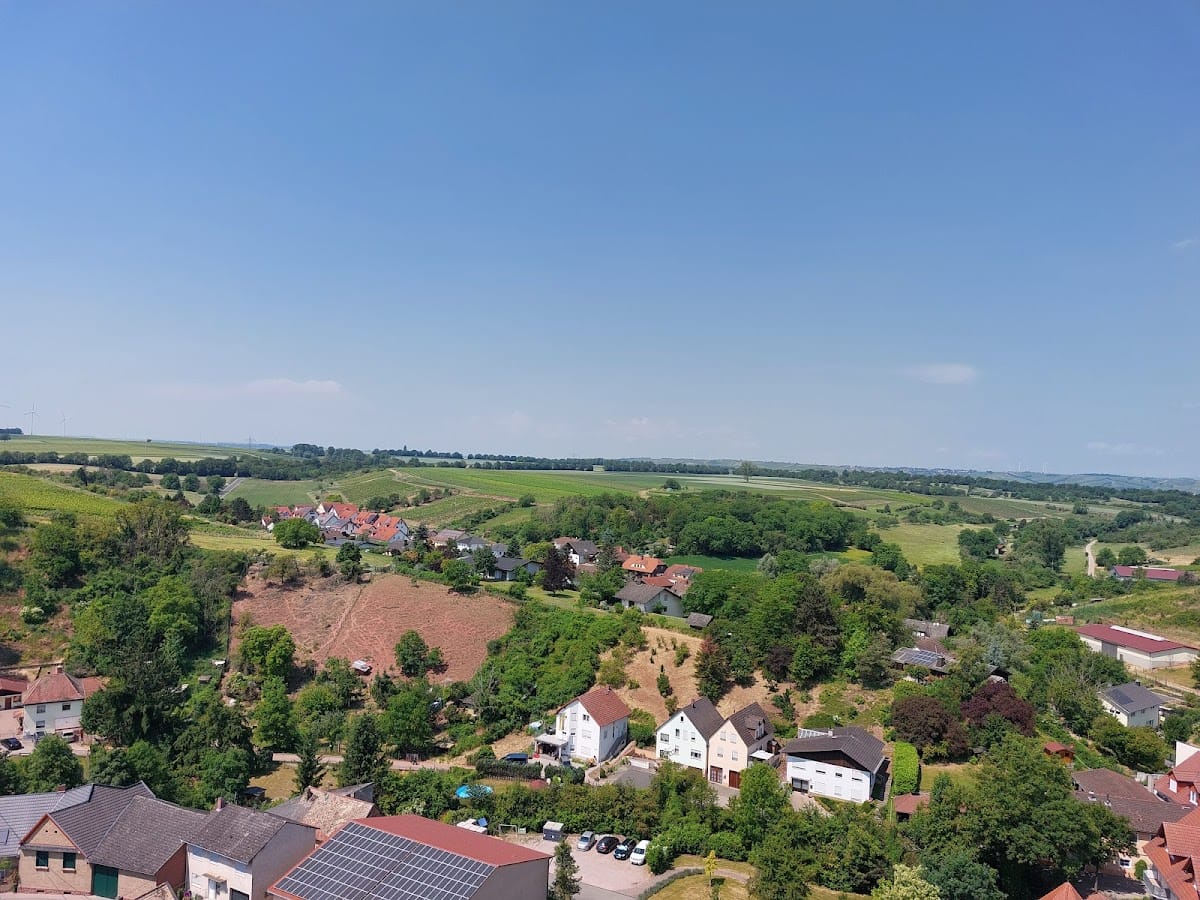
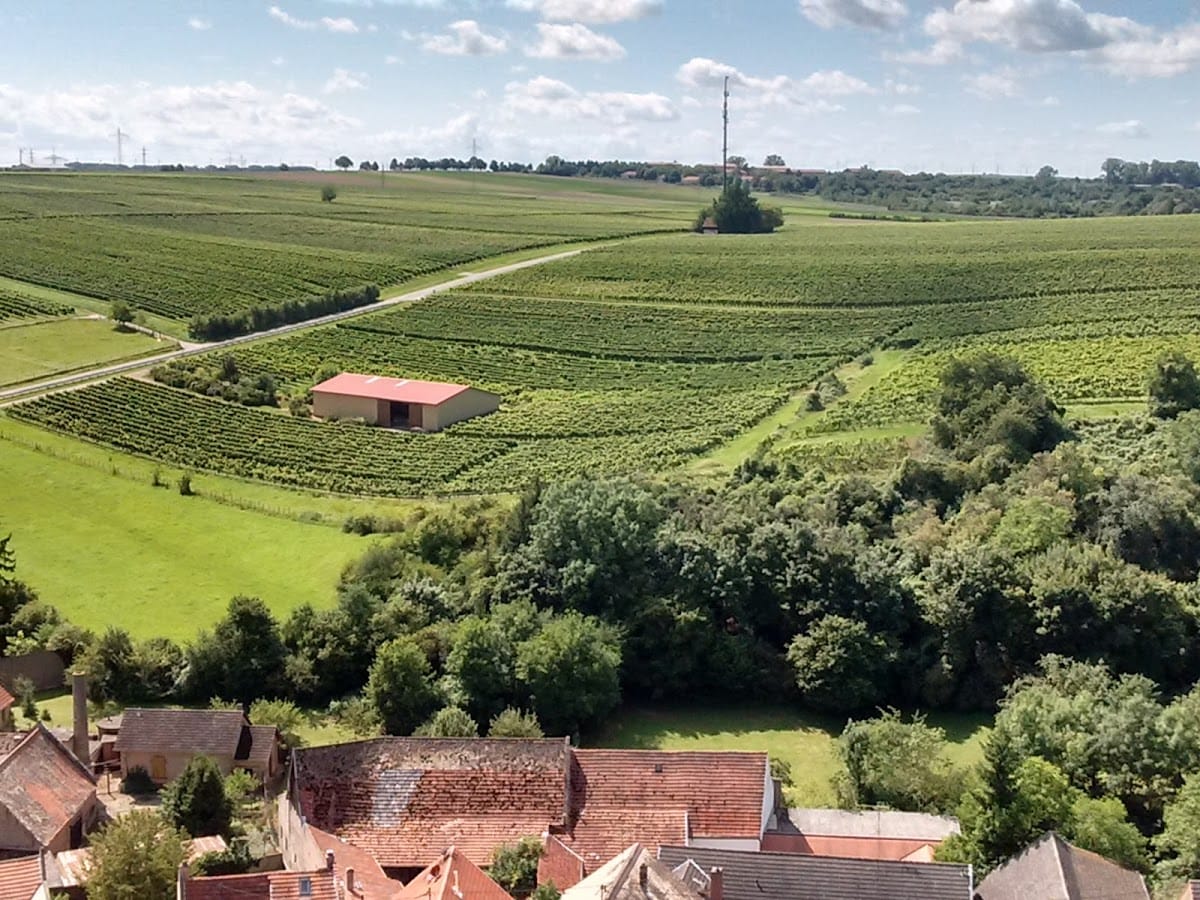
From the platform, views extend toward Nierstein, across the Rhine plain, and over Schwabsburg toward the surrounding vineyards.