Burg Hoheneybach: A Medieval Hilltop Castle near Geislingen
Site at a Glance
- Rating
- 4
- Popularity
- Very Low
- Country
- Germany
- Primary era
- Medieval
- Eras represented
- Medieval
- Civilizations
- Holy Roman Empire
- Site type
- Military
- Remains
- Castle
On this page8 sections
History
Burg Hoheneybach was a high medieval hilltop castle near Eybach in Geislingen, Germany, associated with the Lords of Eybach and later held by several lower-noble families. The castle stood on the Himmelsfelsen and was part of the feudal and legal landscape controlled by Ellwangen Abbey and the Counts of Helfenstein.
The Lords of Eybach and Ellwangen Abbey
The Lords of Eybach are indirectly attested in 1265 and 1281. They may have belonged to the ministerials, a class of dependent medieval nobles who served higher lords or ecclesiastical institutions in administrative, military, and estate-management roles. In 1291, the Count of Helfenstein sold the castle, named castrum Iwach in the record, to Ellwangen Abbey. The abbey then granted it as a feudal fief to members of the lower nobility.
Konrad von Ahelfingen, who had previously been based at Kocherburg, received Hoheneybach as a fief in 1317. His son Ulrich held it in 1347 and 1353. In 1368, Ulrich pledged to keep the castle permanently open to Ellwangen Abbey, confirming the abbey’s continuing authority over the stronghold. At least Ulrich also used Hoheneybach as part of his name.
Later noble holders
Marriage connections brought members of the noble family vom Stein zu Klingenstein into the castle’s associated legal complex, although they later formally renounced their claims. Before 1412, the Hoheneybach fief passed to the lower-noble family von Randeck. In that year, Wolf von Zillenhart confirmed that he had received the castle and its appurtenances.
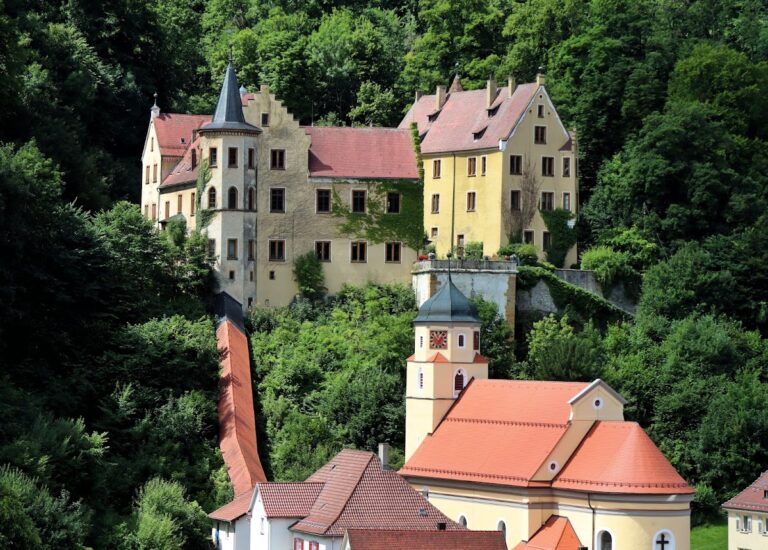
From 1456, Hoheneybach was the ancestral seat of the von Degenfeld family. During the mid-sixteenth century, the Degenfelds built Schloss Eybach below the Himmelsfelsen, and the church in Eybach became their burial place. Burg Hoheneybach was destroyed during the Thirty Years’ War, the major European conflict fought from 1618 to 1648 that especially affected the German lands. The castle was probably still inhabited in 1711, but by 1724 it had become a ruin.
Remains
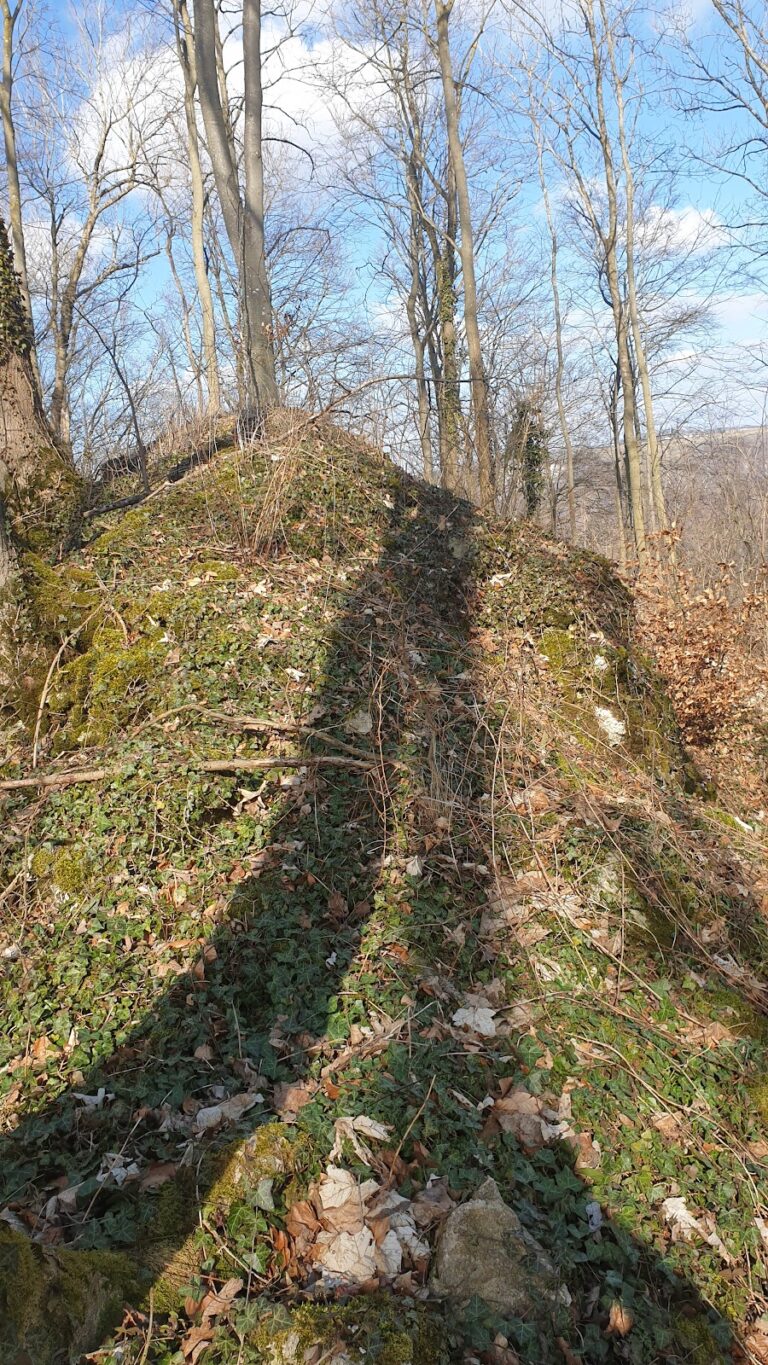
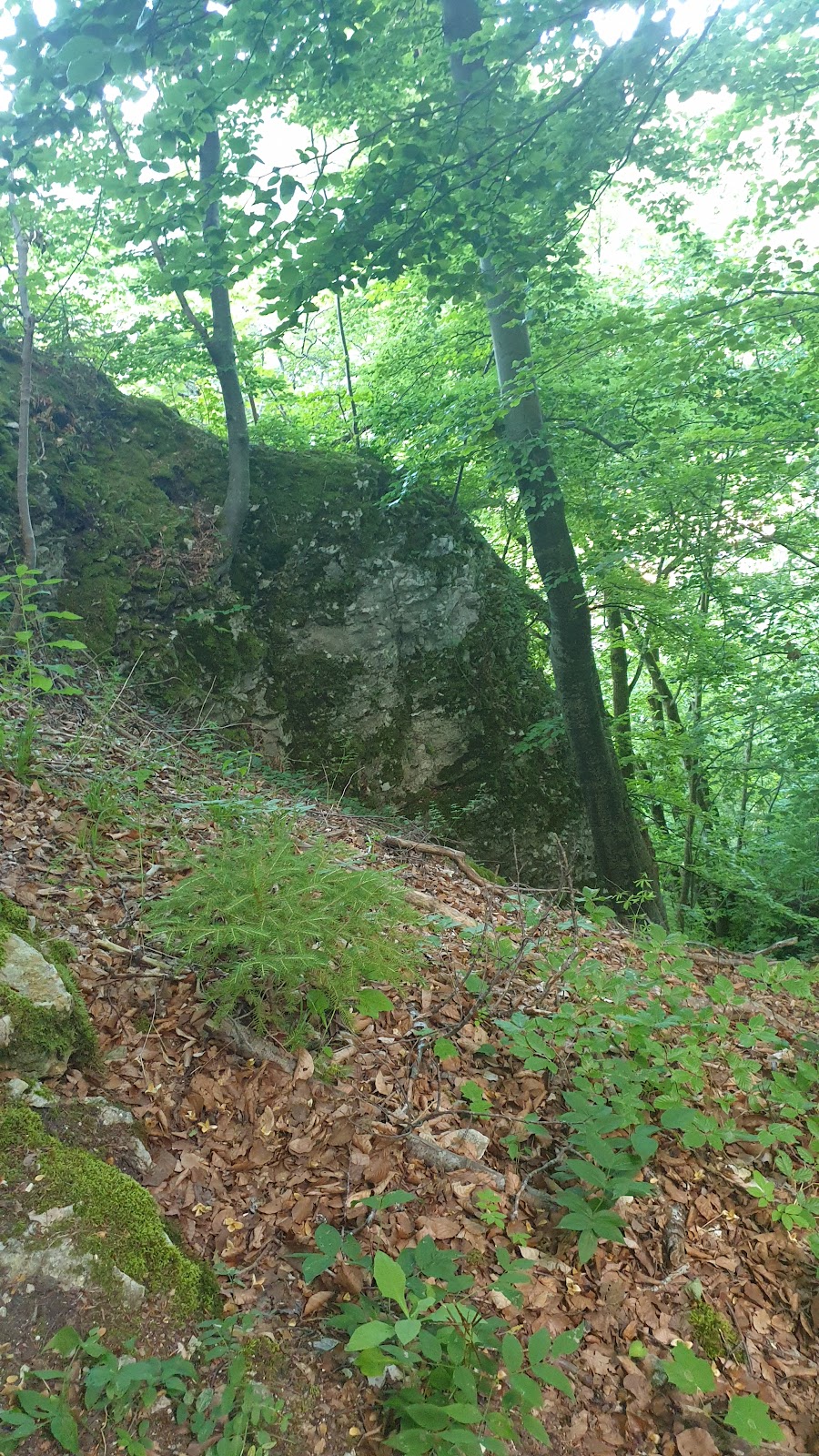
The former castle is now represented by terrain traces, surviving wall fragments, and defensive earthworks on the 602-metre-high Himmelsfelsen near Eybach. The site occupies a rocky height with a high plateau, a steeply descending rock face, and a narrow approach cut by a deep neck ditch. The surviving features outline the position of the former stronghold without preserving its buildings as a complete architectural complex.
Defenses and castle plateau
Neck ditch
A neck ditch crosses the approach behind the Himmelsfelsen. Cut across the rocky height as a defensive barrier, it reaches approximately 13 metres in depth and remains one of the clearest physical features of the castle site.
Palas and wall remains
The high plateau marks the location of the palas, the principal residential and representative building of a medieval castle. Wall remnants survive at the northern corner of the former castle, together with remnants of tuff-stone facing. The site plan also identifies the castle area and a viewpoint beside the steep rock face.
Relationship to Schloss Eybach
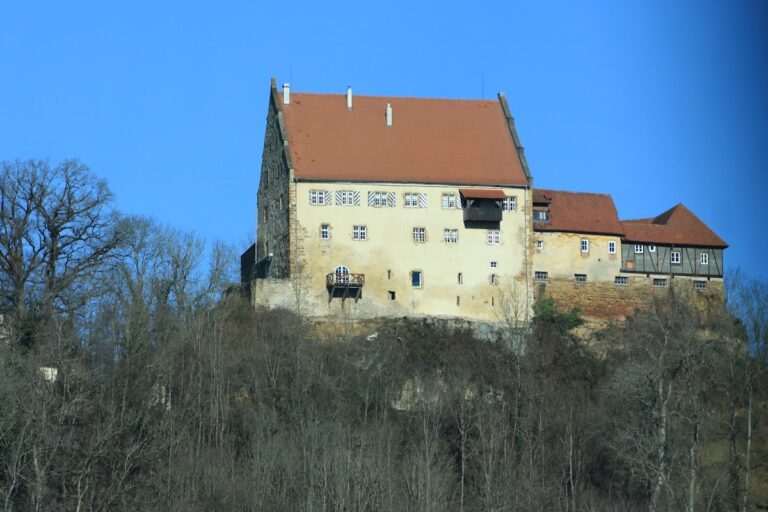
Schloss Eybach lies below the Himmelsfelsen. Its position forms part of the surviving spatial relationship between the later Degenfeld residence and the former castle above it, as seen from the castle site.