Burg Staufeneck: A Medieval Hilltop Castle in Germany
Site at a Glance
- Rating
- 4.5
- Popularity
- Low
- Country
- Germany
- Primary era
- Medieval
- External website
- Open
- Eras represented
- Medieval
- Civilizations
- Holy Roman Empire
- Site type
- Military
- Remains
- Castle
On this page9 sections
History
Burg Staufeneck is a ruined hilltop castle above Salach in Germany, built by the Lords of Staufeneck during the medieval period. Its origin is dated either to 1080 or to 1240, and its early history is linked to the Staufer dynasty, a medieval German ruling house that produced several kings and emperors of the Holy Roman Empire. The proposed family relationship rests partly on the lion shown in both families’ coats of arms. Staufeneck served as an imperial ministerial castle, a fortress associated with a person who served the ruler or the empire, often from the lower nobility.
From the Staufeneck lords to the Rechberg inheritance
The Lords of Staufeneck retained the castle until 1333, when it passed to the Lords of Rechberg zu Staufeneck. Their line ended in 1599 with the death of nine-year-old Albrecht Hermann. The inheritance then went to his mother, Gertraud von Schutzbar genannt Milchling, and to his aunts. One of them, Maria Magdalena, sold her share to Duke Friedrich I of Württemberg, who secured access to the castle by force.
On 19 September 1601, Friedrich I sold Hohenrechberg while keeping half of Staufeneck. Gertraud held the other half as her widow’s residence. The duke sold his remaining share to her on 16 February 1604. Gertraud later married Count Ludwig von Löwenstein, the son of Ludwig III von Löwenstein, and sold Staufeneck in 1623 to Friedrich von Württemberg. Friedrich then transferred it to Georg Ludwig von Freyberg, Baron of Justingen and Öpfingen.
Seventeenth-century owners
Georg Ludwig von Freyberg and his wife died in 1631, leaving the castle to their daughter Anna Margaretha under the guardianship of Heinrich, Bishop of Augsburg. Her husband, Generalwachtmeister Wilhelm von Guyn, also known as William Gunn, bought Staufeneck in 1642. After his death in 1661, his widow sold the castle in 1665 to Ferdinand von Degenfeld.
Ferdinand’s niece, Luise, Raugravine of the Palatinate, later inherited the property. When she died in 1733, ownership passed to Christoph Martin von Degenfeld-Schonburg, the son of her sister Karoline Elisabeth.
Decline and modern reuse
Staufeneck increasingly deteriorated after 1800. It was uninhabited from 1844, and large sections were demolished. Anselm Schott, a German Benedictine monk and liturgical scholar known for influential German-language editions of the Roman Missal, was born in an ancillary building in 1843. That building is now called the Anselm-Schott-Haus.
The 27-metre-high keep became accessible again in 1926, and hospitality operations began in the western part of the ruin in 1927. Lore Wörner and her husband, Erich Straubinger, took over the restaurant in 1973 and developed it into an upscale establishment with a banquet hall. The castle complex has formed part of the Staufer Route, a regional heritage route associated with sites connected to the Staufer dynasty, since 1977.
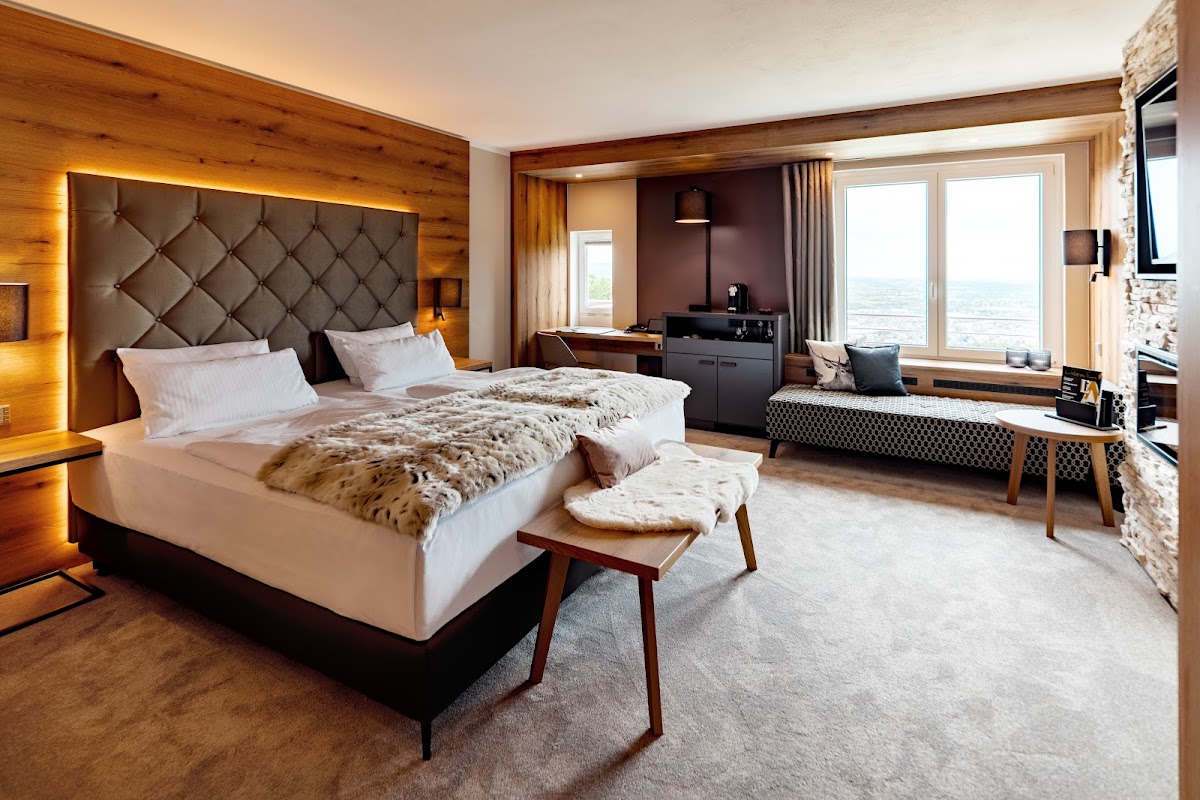
In 1990, the Straubinger family acquired the ruin and restaurant from the city of Böblingen. From 2000, a hotel was established under the direction of Klaus Schurr and opened in December 2002. The restaurant was modernized in 2012, and the complex continues to operate as a hotel and restaurant within the castle remains.
Remains
Layout and surviving fabric
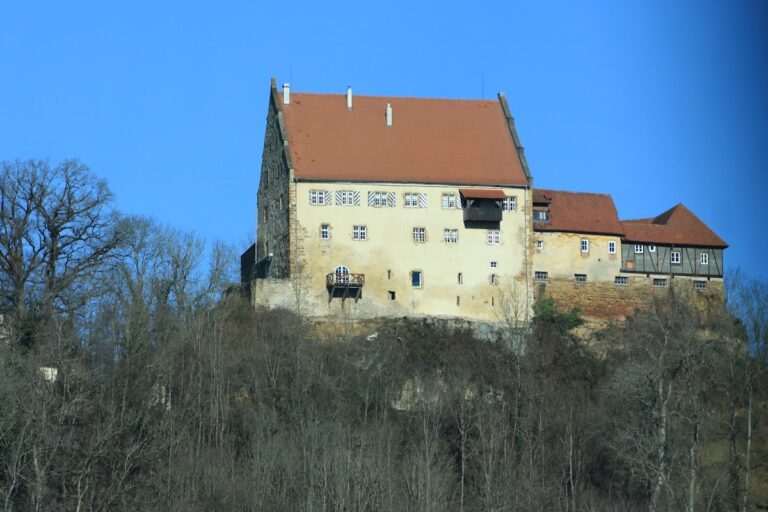
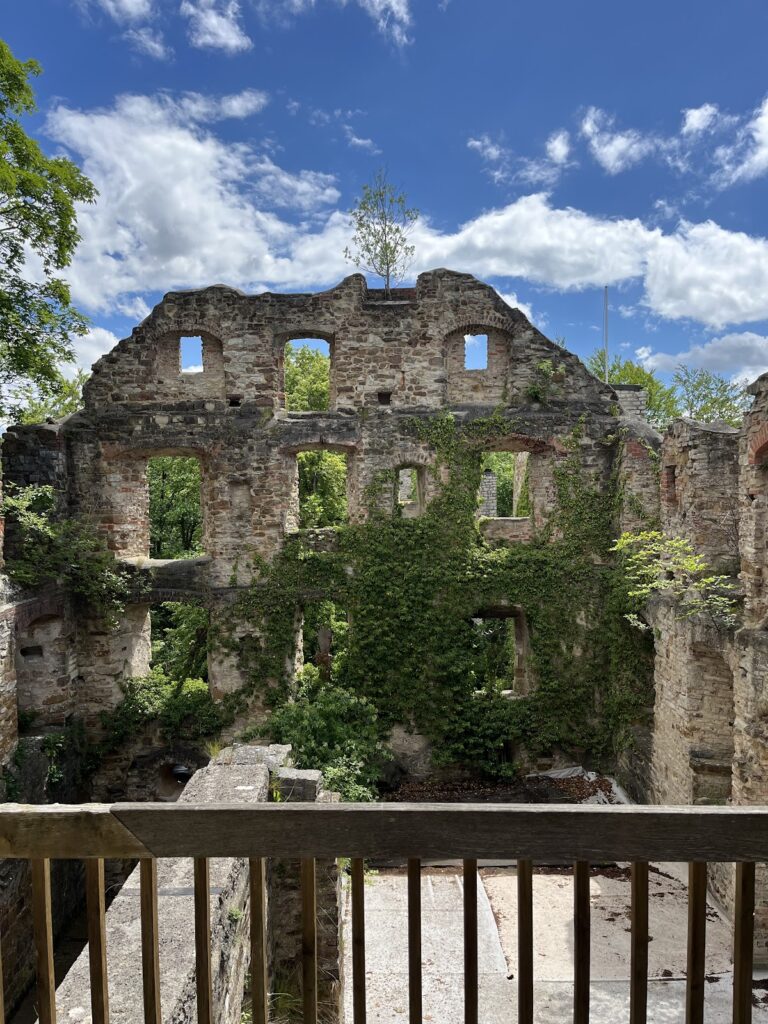
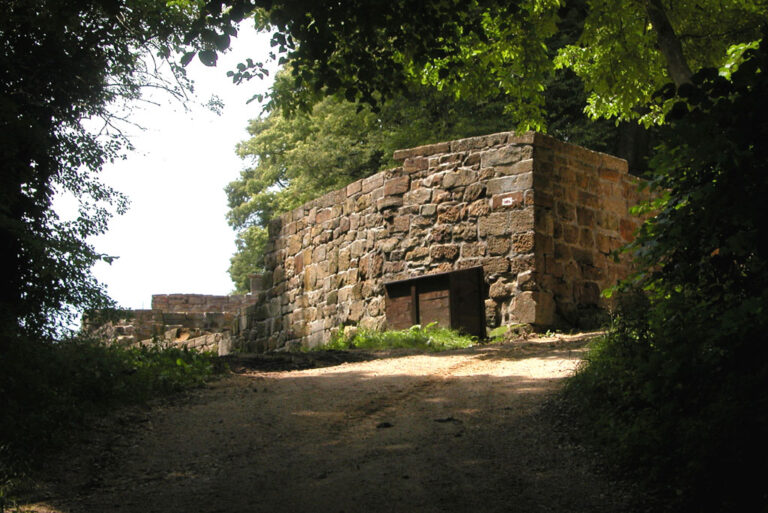
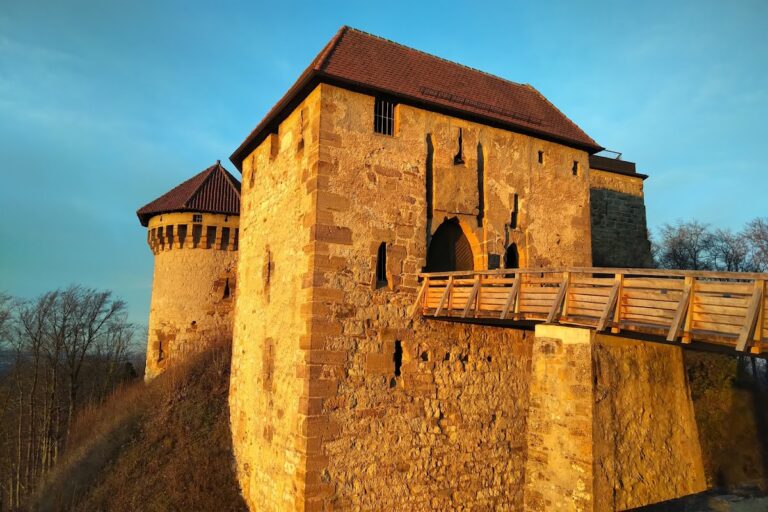
Burg Staufeneck occupies a spur above Salach in the Filstal, at approximately 529 metres above sea level on the southwestern spur of the Rehgebirge. Burg Ramsberg lies on the opposite southeastern spur. Substantial parts of the castle complex survive, with masonry characterized by Buckelquader construction. This medieval fortification technique uses roughly dressed stone blocks whose outer faces project in a bossed, hump-backed form.
The keep
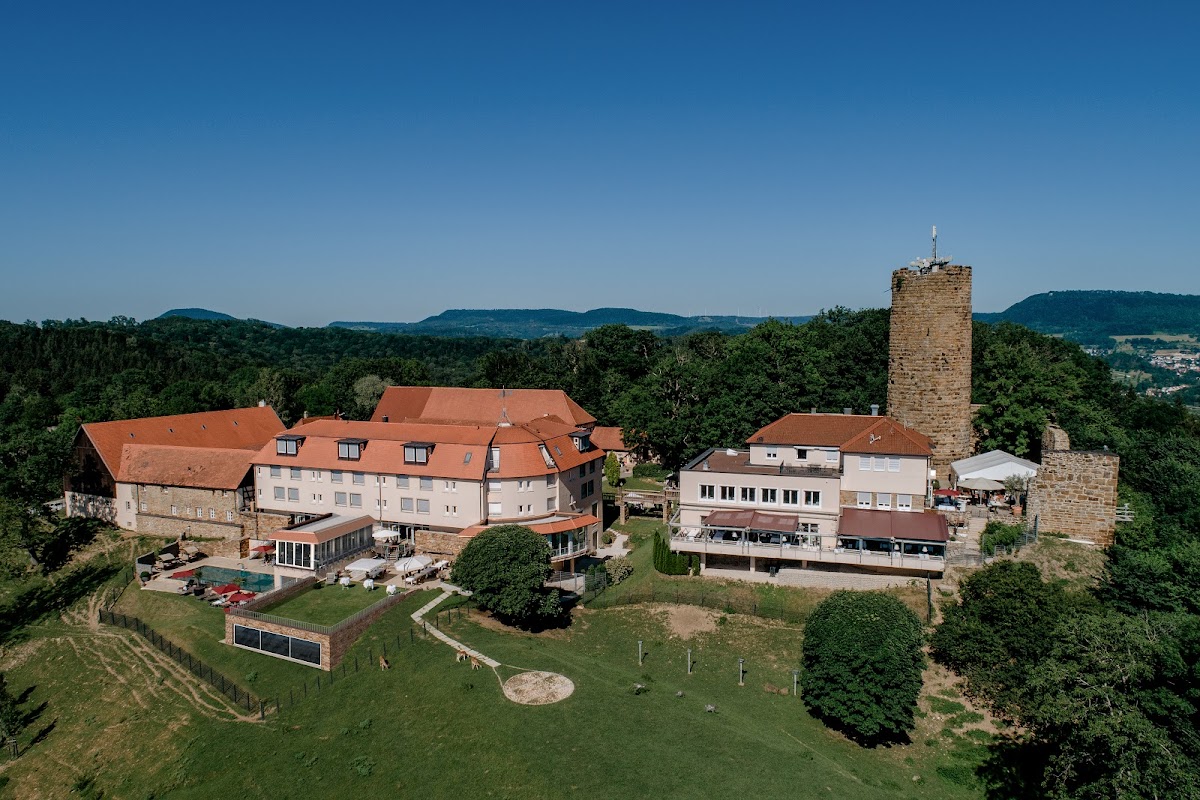
The 27-metre-high keep is the principal surviving fortified tower. A keep was the main tower of a castle and could serve defensive and residential purposes. The tower was made accessible again in 1926 and remains a defining element of the ruined complex.
Anselm-Schott-Haus
An ancillary castle building survives as the structure now known as the Anselm-Schott-Haus. Its association with Anselm Schott derives from his birth there in 1843.
Western ruin and modern complex
The western part of the ruin contains the hotel and restaurant complex. These operations represent the modern reuse of surviving castle fabric within the historic remains.