Château de Chilly-Mazarin: A Historic Château and Town Hall in France
Site at a Glance
- Rating
- 5
- Popularity
- Very Low
- Country
- France
- Primary era
- Modern
- Eras represented
- Classical, Medieval, Modern
- Civilizations
- French
- Site type
- Civic
- Remains
- Town Hall
On this page11 sections
History
Château de Chilly-Mazarin is a château in Chilly-Mazarin, France, whose origins reach back to a medieval building constructed by the Counts of Dreux in the thirteenth century. The estate was substantially remodelled between 1627 and 1632 for Antoine Coëffier de Ruzé d’Effiat, lord of Chilly and holder of the offices of Superintendent of Finances and Grand Master of the Artillery of France.
The seventeenth-century transformation
The remodelling, carried out by the architect Métezeau, reshaped the château as a formal French estate. Its grounds included a geometrically planned garden, a canal, moats, and water basins. Simon Vouet and François Perrier decorated the château, and the sculptor Jacques Sarrazin contributed to its ornamentation. In 1659, Molière performed Le Dépit amoureux there before Louis XIV, the French king whose reign lasted from 1643 to 1715.
After Antoine Coëffier’s death, the château passed to his grandson Armand-Charles de La Porte de La Meilleraye, Grand Master of the Artillery of France, and to his wife, Hortense Mancini. Mancini was the niece and heir of Cardinal Mazarin, the Italian-born cardinal who served as chief minister of France during Louis XIV’s minority. Through their descendants, the estate later passed to the Durfort-Duras and d’Aumont families.
Demolition and rebuilding
Louise d’Aumont sold the château in 1804 to the businessman Louis Joseph Lecocq. He demolished its two wings, and in 1822 he divided and resold the estate as two separate lots. That same year, Louis Isidore Jardin acquired the principal residential building, demolished it, and replaced it with a Neoclassical bourgeois residence. The residence was remodelled in 1903.
Protection and municipal use
During the 1920s, the estate belonged to François-Ignace Mouthon, a press proprietor who served briefly as mayor of Chilly-Mazarin from 1929 to 1930. The aqueduct inspection pavilion became a protected French historic monument on 10 May 1926. Protection was extended on 29 March 1929 to include the moats, bridge, and entrance pavilion.
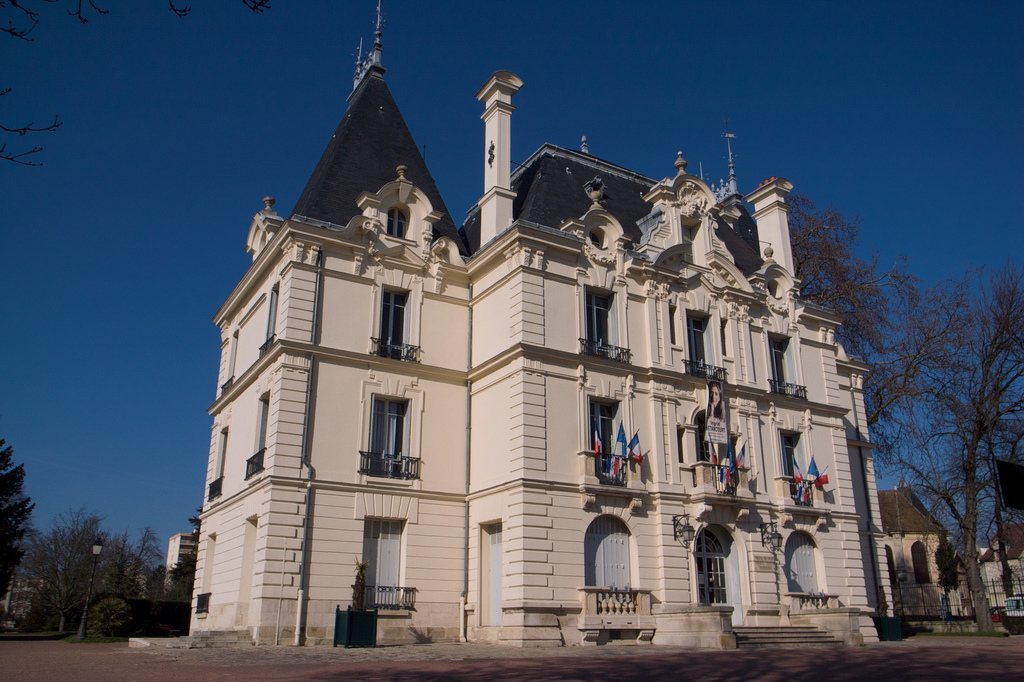
The municipality purchased the estate in 1971 to install the town hall there. Château de Chilly-Mazarin now serves as Chilly-Mazarin’s town hall. It stands in the historic town centre, in Hurepoix, on the northern slope and left bank of the Yvette valley, at the present town-hall square.
Remains
Water, bridge, and entrance
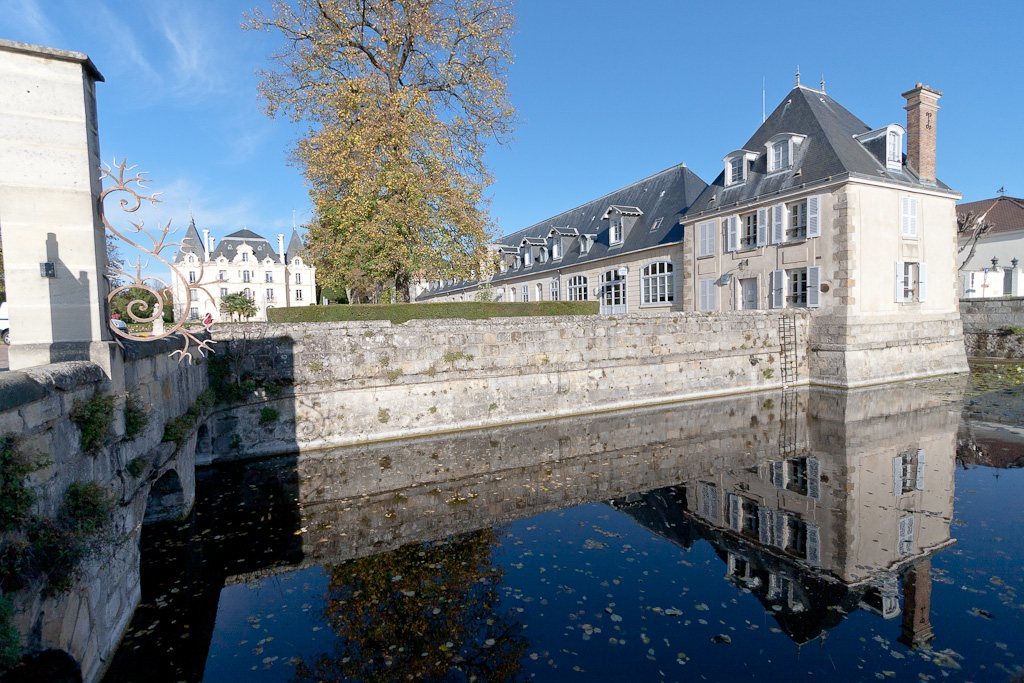
The surviving estate is arranged on a grassed platform enclosed by water-filled moats. These waters belong to the planned setting created during the seventeenth-century remodelling and continue to define the position of the château within its grounds.
Bridge and gateway
A bridge with three arches crosses the moats and supports a monumental gateway. The bridge forms the approach to the enclosed platform, while the gateway marks the entrance to the château precinct.
Canal and aqueduct pavilion
The park retains a canal on the south side. It also preserves a folly, a decorative park structure, that served as an inspection pavilion for the aqueduct carrying water to the estate’s basins. The pavilion is one of the protected elements of the surviving estate.
Courtyard and buildings
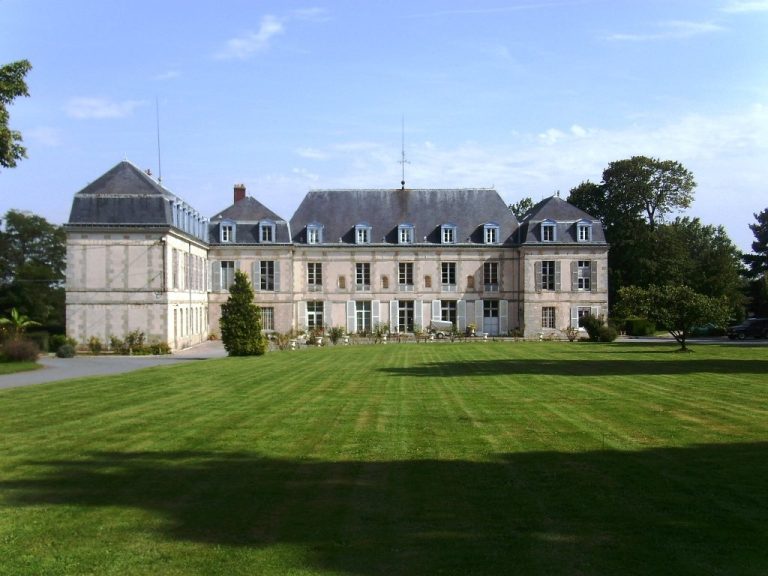
The seventeenth-century arrangement combined a principal residential block with large end pavilions, returning wings, and lower service buildings around the courtyard. The surviving buildings convey parts of that earlier organization, although the principal residence was demolished and rebuilt in 1822.
Service buildings
The north side of the courtyard is closed by two square service pavilions. Each has two storeys and a four-sided slate roof, and the pavilions are joined by a connecting building with a mansard roof, whose lower slopes are steeper than its upper slopes. Most of these service buildings survive.
Principal residence
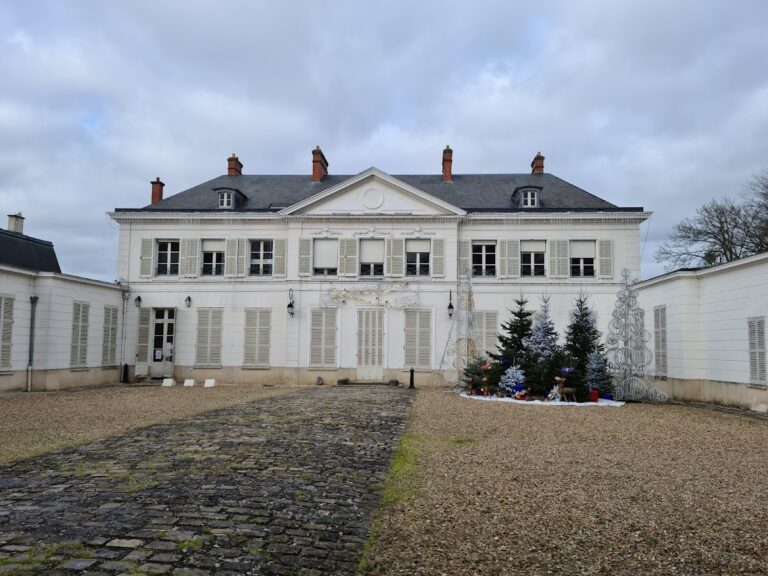
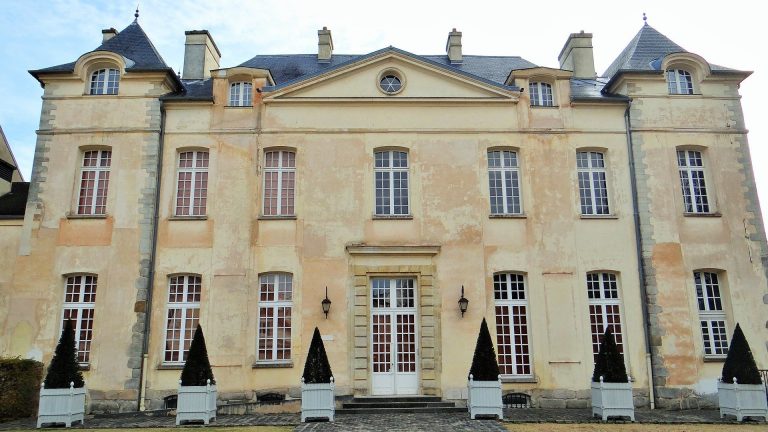
The present principal building is constructed of dressed stone and follows the Neoclassical rebuilding of 1822, with later remodelling in 1903. Its central block has three bays on each level and is flanked by two symmetrical pavilions set back from the facade. The building rises through four levels, with the uppermost level beneath a mansard roof.
Each lateral pavilion has one bay. Two oculi, or small round or oval openings, are positioned above the lateral windows beneath the four-sided roof. The roof is covered with slate and zinc, completing the surviving residential composition around the courtyard.