Castel Telvana: A Medieval Fortress in Borgo Valsugana
Site at a Glance
- Rating
- 3.4
- Popularity
- Low
- Country
- Italy
- Primary era
- Medieval
- Eras represented
- Medieval, Early Modern
- Civilizations
- Habsburg, Holy Roman Empire
- Site type
- Military
- Remains
- Castle
On this page12 sections
History
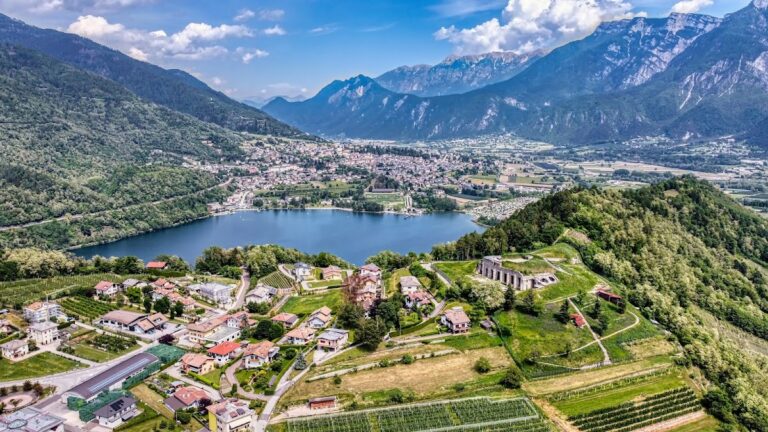
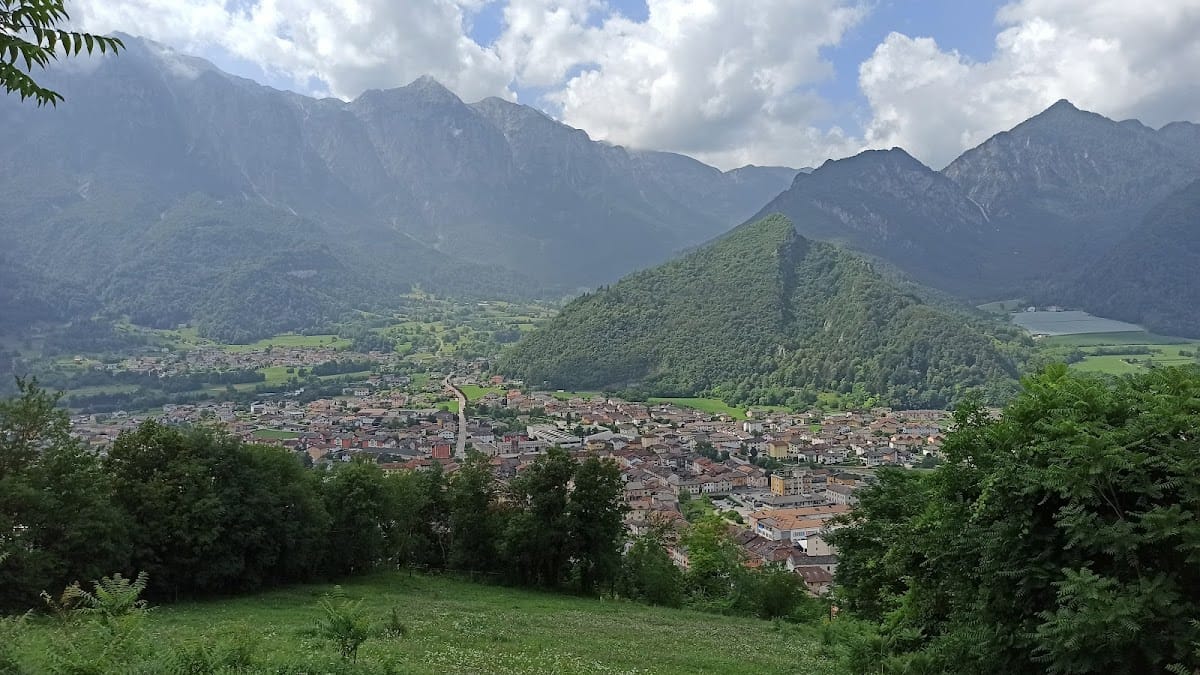
Castel Telvana is a medieval fortress in Borgo Valsugana, Italy, built on the slope of Monte Ciolino above the ancient route through the Valsugana. Its position controlled the Claudia Augusta Altinate, a Roman road linking the Alpine region with the eastern Po Plain. The fortification originated in the Early Middle Ages, while its oldest surviving core dates to the thirteenth century.
Medieval foundation and expansion
The site may have contained a Roman fortification before the medieval castle was established, although this remains a hypothesis. During the first half of the thirteenth century, Castel Telvana came into the possession of the lords of Caldonazzo-Castronovo. In 1314, they compelled the count-bishop of Feltre to grant them the jus gladii, or “right of the sword,” a jurisdictional privilege over serious criminal cases that could include capital punishment. Telvana then became the seat of a jurisdiction alongside the nearby castles of San Pietro and Ivano.
In 1331, Rambaldo di Castronovo acquired the jurisdiction of San Pietro and joined it to Telvana, creating a buffer fief in the Valsugana. He rebuilt and enlarged the castle and surrounded much of the hilltop with curtain walls, continuous defensive walls enclosing the fortified site.
Sieges and Habsburg control
Antonio della Scala, a Scaliger lord of Verona, besieged and heavily bombarded Castel Telvana. The fortress was rebuilt and embellished in 1385, after which it became the most important fortress in the Valsugana. When Siccone, its owner, died in 1412, his son Giacomo succeeded him. In the same year, while Giacomo was away, Duke Frederick IV of Austria, known as “the Empty-Pocket,” besieged Telvana and forced Lesina di Castelbarco to surrender.
From 1462, Castel Telvana passed among several Tyrolean lords, including the Austrian Archduke Sigismondo Welsperg. After an attack in 1526, Welsperg strengthened its defenses. The Welsperg family retained Telvana until 1632, when Sigismondo V, burdened by heavy debts, sold the jurisdiction and surrounding possessions.
Later ownership and decline
In 1662, ownership passed definitively to the Giovanelli counts of Venice, a prominent Venetian noble family. In 1788, the property was transferred to the municipality of Borgo Valsugana in an exchange.
After the castle was abandoned, popular tradition attributed its dismantling to an enraged crowd. Historically, the dismantling appears to have been ordered by imperial authorities. The uninhabited complex was largely demolished and later acquired by the Hippoliti barons, who undertook no restoration. Further damage followed from the military conflicts that affected the Valsugana.
In 1913, the Austrian Central Commission for the Conservation of Monuments approved a consolidation project, but the work was never carried out. The Battisti family of Telve acquired Castel Telvana in 1940 and sold it in 1965 to the lawyer Ugo Simonetti of Mestre. The castle remains privately owned and is listed as Italian national heritage. The surviving complex represents only a small part of the fortress at its greatest extent in the sixteenth and seventeenth centuries.
Remains
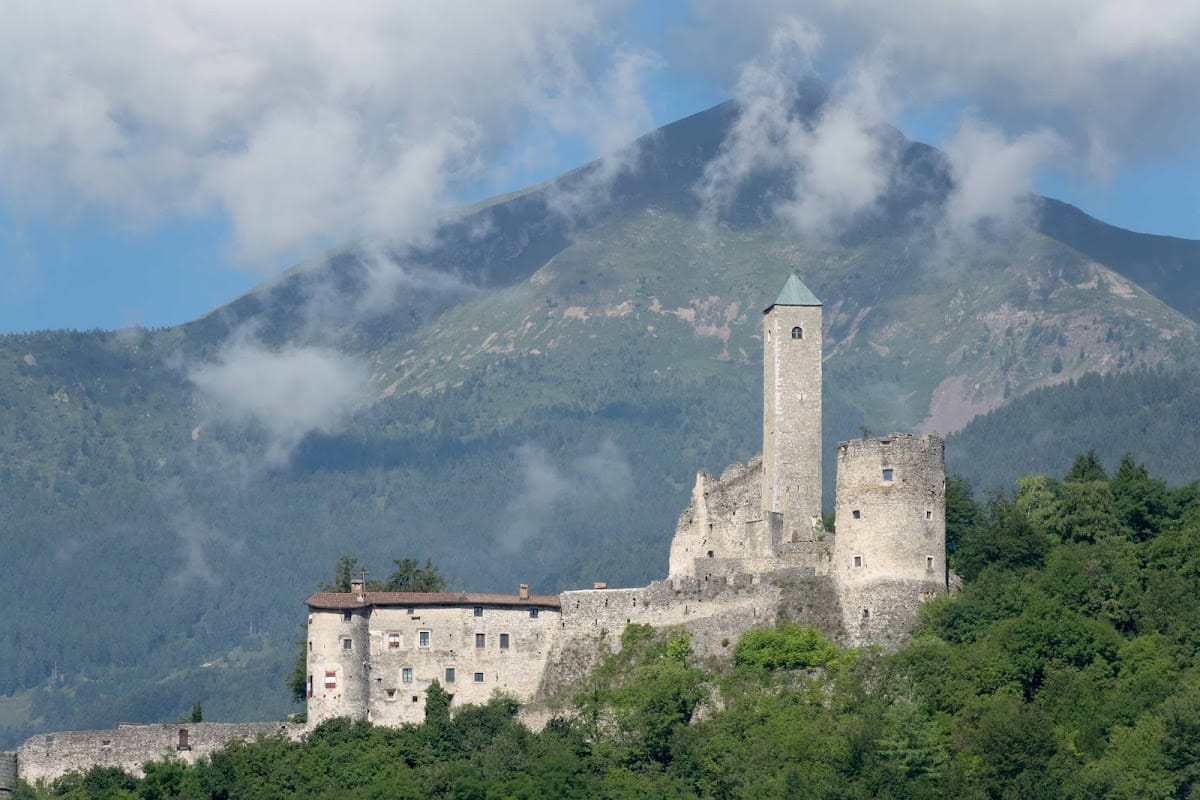
Castel Telvana occupies a rocky ridge at approximately 495 metres above sea level. Its irregular plan is trapezoidal, with the broad base facing south and the shorter side toward the north. The complex consists of an upper castle, representing the medieval core, and a lower castle that developed during the fifteenth and sixteenth centuries for military purposes. By the sixteenth century, the defenses had been adapted to firearm warfare through additional works on the valley side.
Upper castle and medieval defenses
Square watchtower
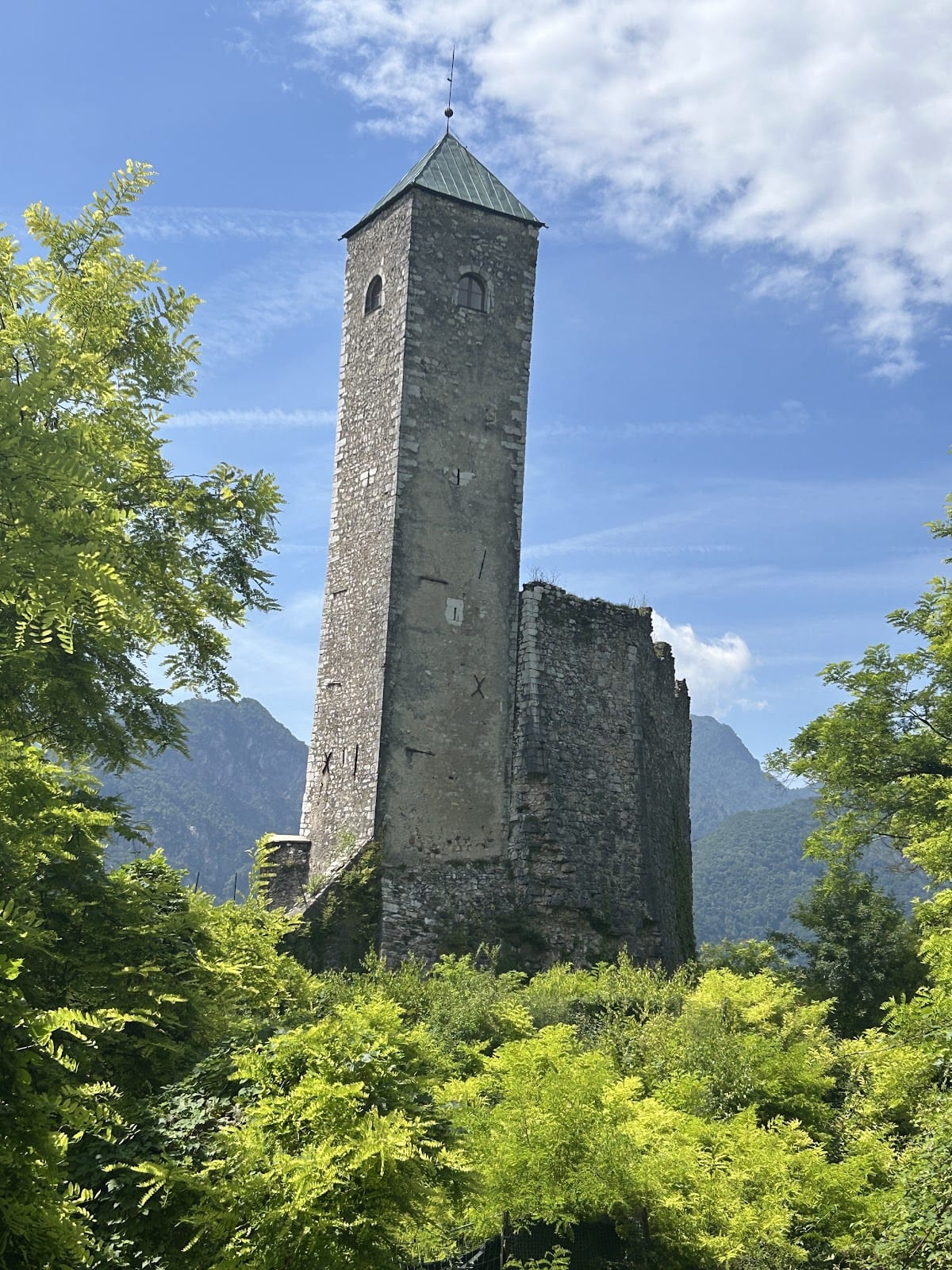
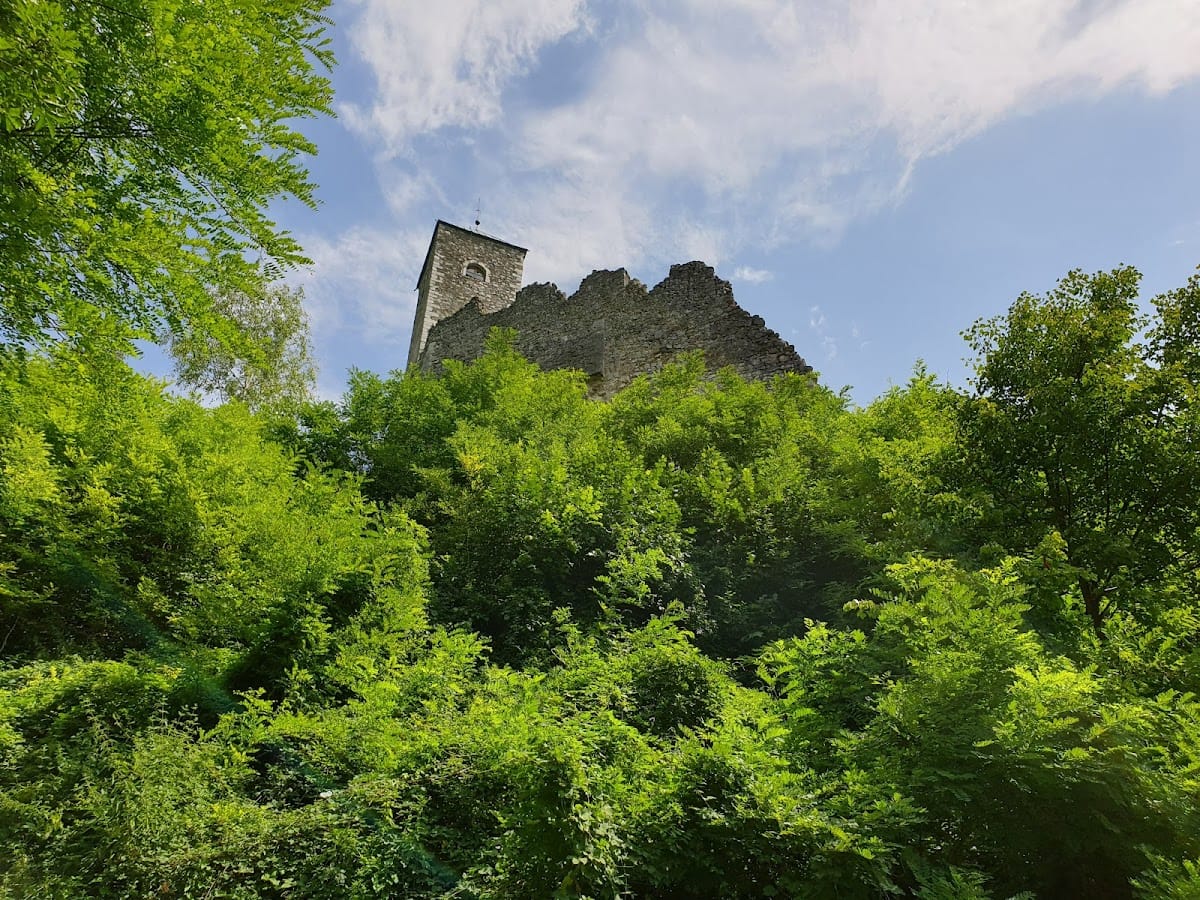
The upper castle is arranged around a square watchtower about 25 metres high, with sides measuring approximately 5.3 metres. It stands at the highest point of the ridge beside the massive surviving wall and is the principal surviving element of the upper castle. The tower is also the only surviving part of the first baronial palace. Its base is cut at an angle and reinforced by substantial barbicans, outer defensive works. Two spine-shaped buttresses strengthen the structure, and its western side has a single Romanesque doorway.
Western entrance and curtain wall
The original entrance lay on the western side, toward Trento. The Castelnuovo family fortified it, and the Welsperg family strengthened it further during the sixteenth century. Until that period, a high curtain wall protected the castle on every side. The only surviving section of the medieval wall stands on the northwestern side, where one buttress remains upright.
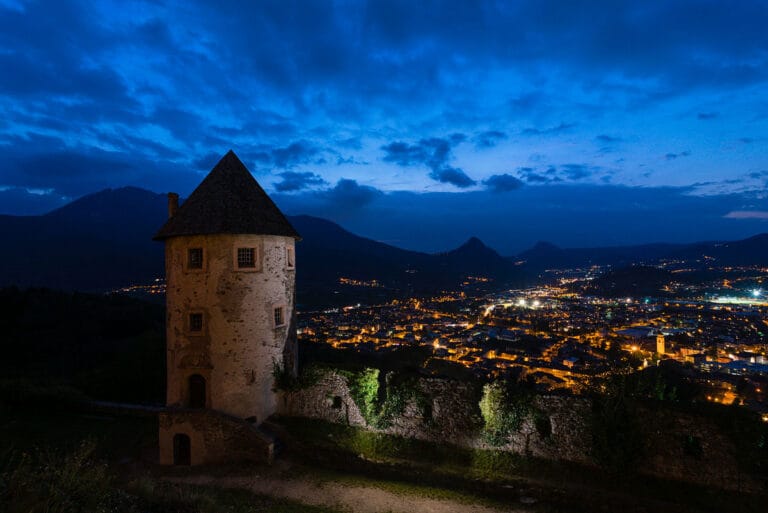
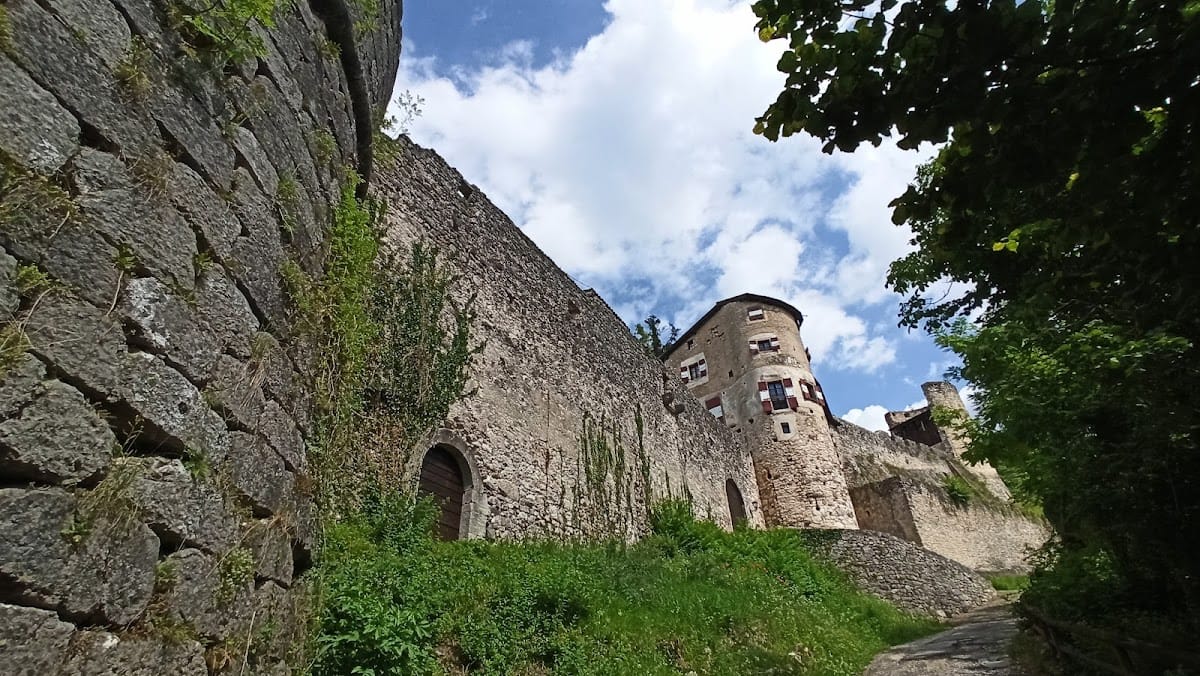
An arched doorway at the base of the northwestern wall is now blocked and bears the carved date 1673. From there, the wall runs toward a circular tower that defended the former entrance, which opened directly onto the Claudia Augusta Altinate. The entrance defenses included a drawbridge, a ravelin, or detached outer fortification, and an outer wall with a bridge across the defenses. The wall that once linked the square tower to the semi-cylindrical tower collapsed in the early twentieth century.
Lower castle and residential buildings
Gasperetti Tower
The principal defensive feature of the lower castle is the Gasperetti Tower, a massive tower with a truncated-conical form. A second, low and elongated wall encloses the southwestern side of the lower castle and connects the Gasperetti Tower with the defenses of the former entrance.
Palaces and interior features
The upper and lower palaces formed the residence of the lords of Telvana. The lower palace remains standing and is still inhabited. From the large upper baronial palace, rebuilt by the Welsperg family between the fifteenth and sixteenth centuries, only part of the northwestern curtain wall and traces of the foundation walls survive.
The inner facade of the lower palace retains mural paintings with the coats of arms of the House of Austria, the counts of Tyrol, and the Welsperg family. These dynasties and the Welspergs, a Tyrolean noble family, reflect the political powers connected with the castle during its later history.
Wellhead, milestone, and tower rooms
The inner courtyard contains a rustic fifteenth-century wellhead and a Roman milestone. One first-floor room in the tower-palace has a fresco showing a coat of arms, a deer, an armoured warrior, and a cross. The tower also contains three additional rooms and the muda, the castle prison.