Castle of Segonzano: A Medieval Fortress in Italy


Site at a Glance
- Rating
- 4.3
- Popularity
- Low
- Country
- Italy
- Primary era
- Medieval
- Eras represented
- Medieval
- Civilizations
- Habsburg, Holy Roman Empire
- Site type
- Military
- Remains
- Castle
On this page9 sections
History
Castle of Segonzano is a thirteenth-century medieval fortress in Italy, positioned near Piazzo and Saletto in the Cembra Valley. Its history is tied to the Prince-Bishopric of Trent, where a prince-bishop exercised both religious authority and political rule. The castle later passed through the hands of Tyrolean officials, noble families, and military administrators before becoming a ruin.
Early references and feudal foundation
Local historians Carl Ausserer and Berengario Gerola proposed that a fortified site existed here several centuries after the beginning of the Christian era. They associated the southwest tower with a Roman watchtower and interpreted the wider site as a prehistoric hillfort, a fortified settlement or defensive enclosure on elevated ground. That interpretation remains unconfirmed.
The castle first appears in written history on 16 February 1216, when the Codex Vangianus, a medieval administrative record of the Prince-Bishopric of Trent, recorded Prince-Bishop Federico Vanga’s feudal investiture of Rodolfo Scancio. This formal grant established Scancio’s position as a feudal lord and authorized him to build a castle on his lands. The fortress is generally dated to the thirteenth century.
Tyrolean administration
In 1288, control of Tyrol passed to Mainardo II, a medieval count of Tyrol. In 1304, his son and successor Ottone entrusted the castle and the jurisdiction of Segonzano to the Rottenburg family. From the 1390s, ownership and administration changed repeatedly during the conflict between Federico IV of Habsburg and Giorgio of Liechtenstein, the bishop of Trent. In 1424, Giorgio’s successor, Alessandro of Masovia, definitively ceded the castle to Federico IV. Until 1500, various captains and procurators administered it on behalf of the counts of Tyrol.
Renaissance connections and sixteenth-century ownership
Albrecht Dürer, the German Renaissance painter, printmaker, and draughtsman, stayed at the castle as the guest of Captain Giorgio di Pietrapiana during his journey through the Cembra Valley toward Venice in 1494–1495.
During this period, Maximilian of Habsburg appointed Paolo Lichtenstein as captain of the castle. Paolo’s son, Cristoforo Filippo, sold the fortress in 1535 to the Italian captain Giovanni Battista a Prato, with the authorization of Prince-Bishop Bernardo Clesio, who held both religious and secular authority in the Prince-Bishopric of Trent.
Damage, decline, and preservation
The castle roof suffered severe damage during the Battle of Segonzano in 1796. The a Prato family no longer lived at the fortress, residing instead in Trento or in its palace at Piazzo, and the damage was not repaired. The castle consequently deteriorated. Landscapes produced between 1830 and 1845 record this decline, and by 1845 only a few ruins remained.
In 1865, the a Prato family allowed local farmers to remove stone from the castle. The material was reused in nearby works, including field walls and the enclosure of the cemetery at Piazzo. The surviving ruins were made safe in 2006 and formally inaugurated in 2007 during a historical commemoration of the Battle of Segonzano. The castle is designated Italian national heritage and is occasionally used for outdoor cultural events.
Remains
Fortifications and rocky setting
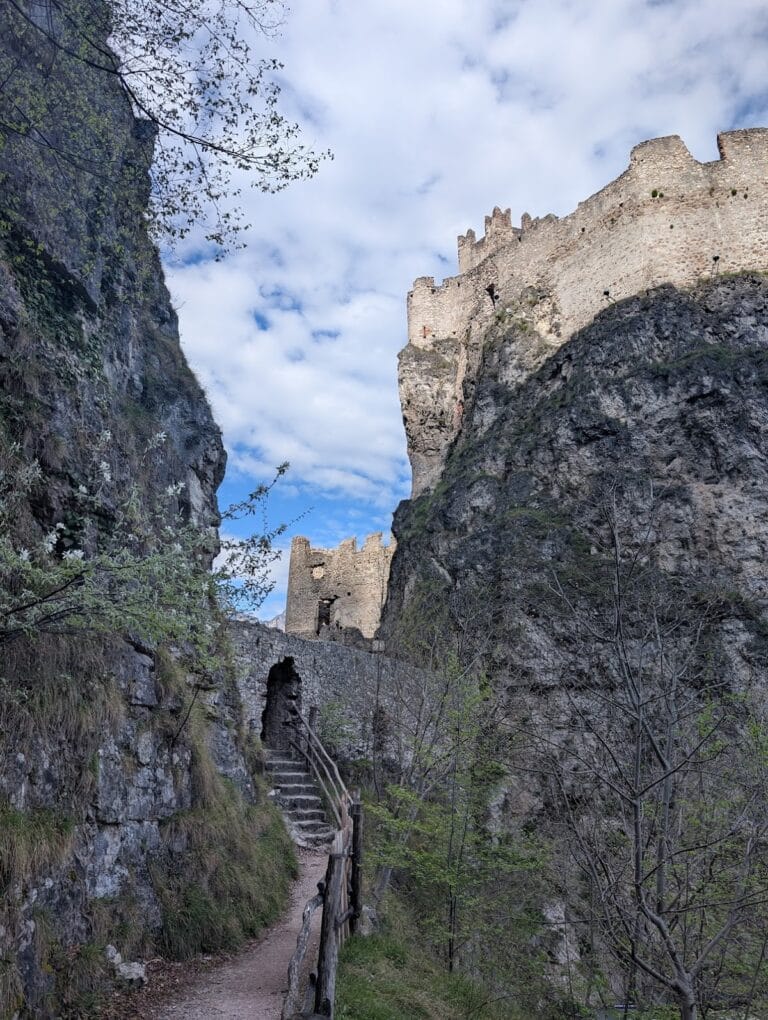
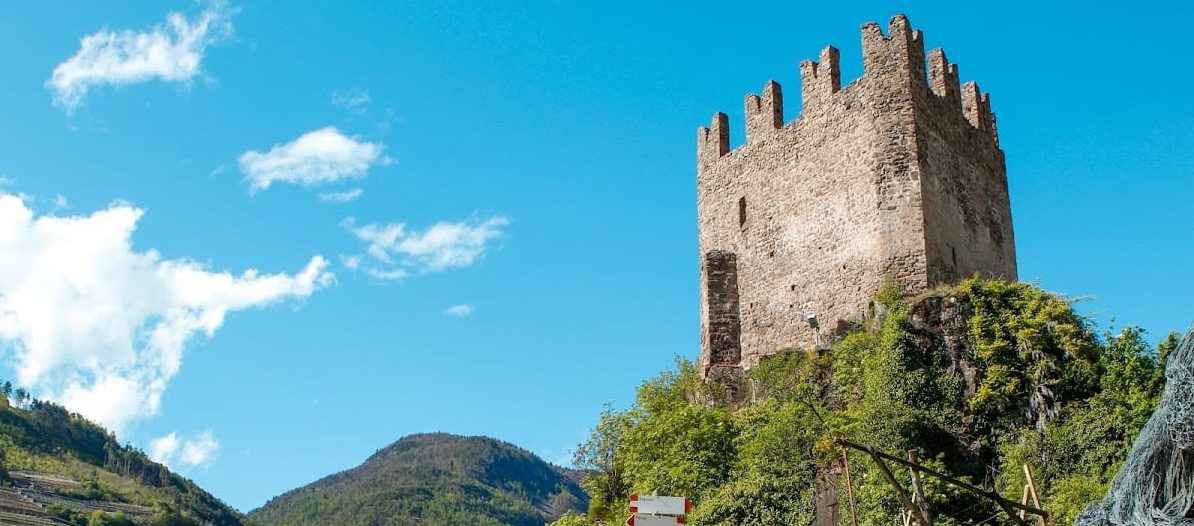
The castle occupies a rocky spur near Piazzo and Saletto. Its northern side falls steeply toward the Avisio stream, while the ground descends more gradually to the south. The surviving fabric consists of part of the southern walls and a tower, preserved as a secured ruin. The southwest tower has been proposed as a Roman watchtower, although that attribution remains unconfirmed.
Chapel of Saint Rocco
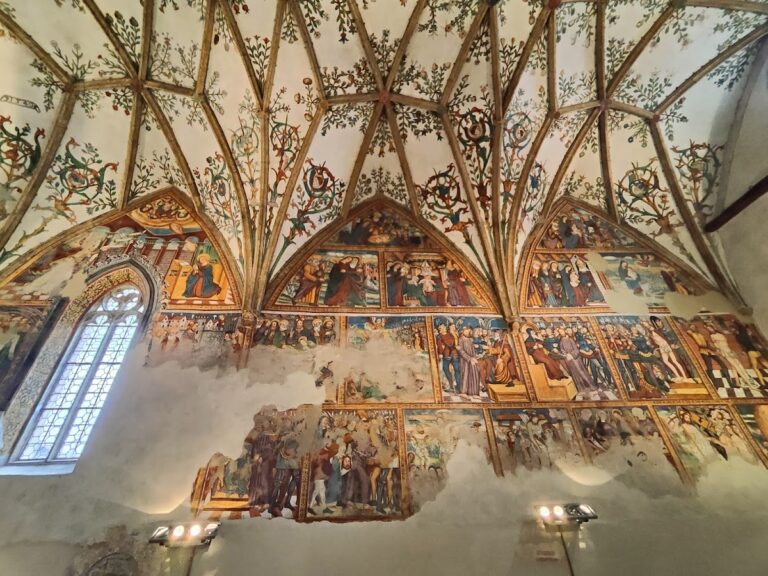
A chapel dedicated to Saint Rocco formed part of the castle complex. It was built around 1467, adding a religious structure to the fortified site during the period when the castle was administered by captains and procurators serving the counts of Tyrol.
Dürer’s views of the castle
Two watercolours by Albrecht Dürer depict Castle of Segonzano. One view was made from the north, near the Cantilaga bridge, while the other was taken from the southwest, from Faver. The paintings are probably connected with Dürer’s passage through the Cembra Valley in 1494–1495.