Buonconsiglio Castle: The Prince-Bishops’ Fortress and Residence in Trento



Site at a Glance
- Rating
- 4.5
- Popularity
- High
- Country
- Italy
- Primary era
- Medieval
- External website
- Open
- Eras represented
- Medieval, Early Modern
- Civilizations
- Holy Roman Empire
- Site type
- Military
- Remains
- Castle
On this page19 sections
History
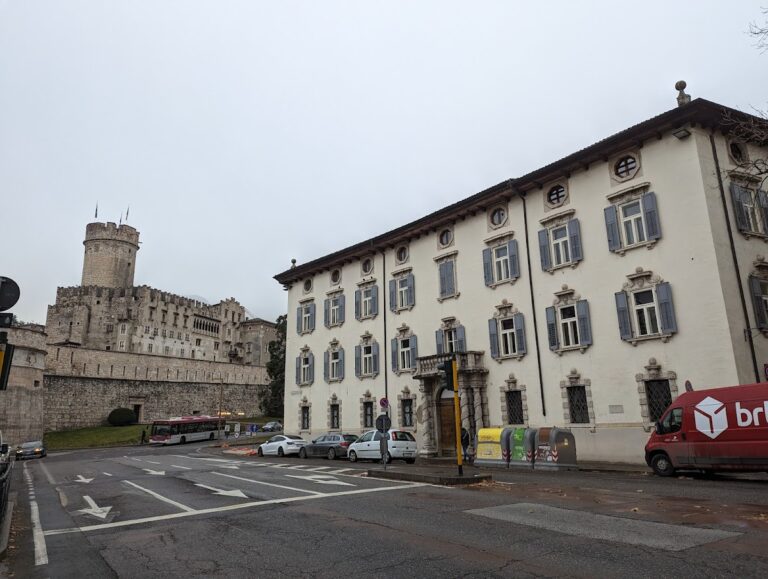
Buonconsiglio Castle is a fortified complex in Trento, Italy, developed by the medieval Prince-Bishops of Trent from the twelfth or thirteenth century on a rocky rise previously occupied by a Roman castrum, a fortified settlement or military camp. It served as the residence of the Prince-Bishops, rulers who combined religious authority with territorial government, from the thirteenth century until the end of the eighteenth century. Its successive expansions turned the defensive site into an episcopal residence, a military stronghold, and eventually a museum.
Medieval Fortress and Episcopal Residence
The hill was once called Malconsey, a name still used by Bishop Albert of Ortenburg in 1381. From the fourteenth century, the castle acquired the more favorable name Buonconsiglio, meaning “Good Counsel.” The earlier seat of the bishops was the present Palazzo Pretorio beside Trent Cathedral, but the castle became their principal residence as its medieval buildings expanded.
Castelvecchio, the oldest residential section, was rebuilt in 1440, while further work was carried out under Prince-Bishops George of Liechtenstein and Johannes Hinderbach. George connected Castelvecchio with the Eagle Tower and commissioned the Cycle of the Months around 1400. Hinderbach added substantial battlements, completed the Castelvecchio chapel in 1475, and ordered a water conduit in 1484 to carry spring water from the nearby mountains to the residence.
The castle also became involved in the political conflicts of late medieval Trent. In 1407, an uprising by nobles and citizens against George of Liechtenstein widened into unrest and peasant revolts across Trentino. Duke Frederick “with the Empty Purse” invaded the region and expelled the bishop from Trent. From the rule of Prince-Bishop Alexander of Masovia onward, the castle was reinforced both to defend Trent and to exert control over the city.
Trent and the castle stood along routes linking German-speaking lands with Italy. Albrecht Dürer visited Trent in 1495 and made an artistic record of the castle’s appearance, providing an early visual connection between the complex and the wider world through which travelers, artists, and political figures moved.
The Renaissance under Bernardo Clesio
Bernardo Clesio became Prince-Bishop of Trent in 1514. Also known as Bernhard von Cles, he was a cardinal, Habsburg diplomat, and statesman who promoted Renaissance culture in Trent and later played a major organizing role in the Council of Trent, the sixteenth-century Catholic council concerned with doctrine and church reform. He enlarged the castle in preparation for the council and commissioned the Renaissance Magno Palazzo.
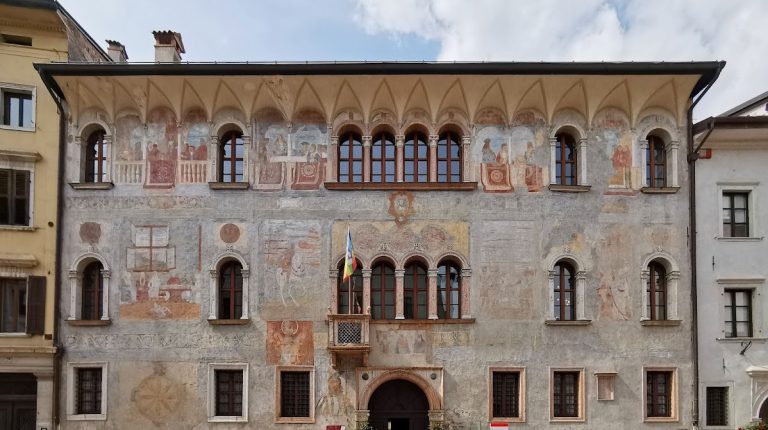
Clesio invited Dosso Dossi, Battista Dossi, Marcello Fogolino, and Girolamo Romanino to decorate the new residence. Their work presented his political authority, his relationship with the Habsburg dynasty, and his interests in science, history, and the arts. Between 1530 and 1532, Romanino painted the frescoes of the loggia and its arcades, giving the complex an extensive program of mythological, biblical, Roman historical, and courtly imagery.
Prince-Bishop Francesco Alberti di Poja commissioned the Giunta Albertiana around 1680 as a direct link between Castelvecchio and the Magno Palazzo. Many interiors were redecorated in the Baroque style during the seventeenth and eighteenth centuries, adding another layer to the complex’s medieval and Renaissance development.
Military Occupation and the First World War
French troops occupied Trent and the castle in 1796 during the First Coalition War, the European conflict formed against revolutionary France. The last Prince-Bishop, Pietro Vigilio Thun, left the castle and took refuge in his family fortress in Val di Non. The complex was converted into military barracks, and Napoleon Bonaparte spent several days there in the same year.
Following the secularization of the Prince-Bishopric of Trent and its incorporation into Tyrolean and Habsburg territories, the former episcopal residence remained an Austrian military barracks for more than a century. From the later nineteenth century until 1916 or 1918, it also housed the Austro-Hungarian high command of the Fortress of Trent. Its final commander was Major General Franz Seraphin Edler von Steinhart.
During the First World War, the Stua della Famea was used as the tribunal for the 1916 trial of the Italian irredentists Cesare Battisti, Fabio Filzi, and Damiano Chiesa. Italian irredentism sought to incorporate Italian-speaking territories under non-Italian rule into Italy. After their conviction for high treason, the three men were held in cells made from the loggia. Chiesa was executed by firing squad on 19 May 1916, while Battisti and Filzi were hanged on 12 July 1916 in the area called the Fossa dei Martiri.
State Museum and Provincial Collections
After the First World War and the Treaty of Saint-Germain, the castle passed with Trent to the Kingdom of Italy. The Italian state became its owner, and extensive restoration directed by Giuseppe Gerola took place from 1920 to 1933. The work sought to remove alterations made chiefly after the eighteenth century and recover the appearance associated with the sixteenth century, while retaining the seventeenth-century Giunta Albertiana. The Magno Palazzo received particular attention.
The castle and its art objects were transferred to the Autonomous Province of Trento in the 1970s. A provincial art museum opened in 1973, and in 1992 the complex formally adopted the name “Buonconsiglio Castle: Monuments and Provincial Collections.” It is a protected historic monument and now houses provincial collections of archaeology, ancient, medieval, modern, and contemporary art, together with historical collections. The complex forms part of a wider Trentino exhibition network that also includes Stenico Castle, Beseno Castle, and Thun Castle. A memorial to Battisti, Filzi, and Chiesa remains part of the castle complex.
Remains
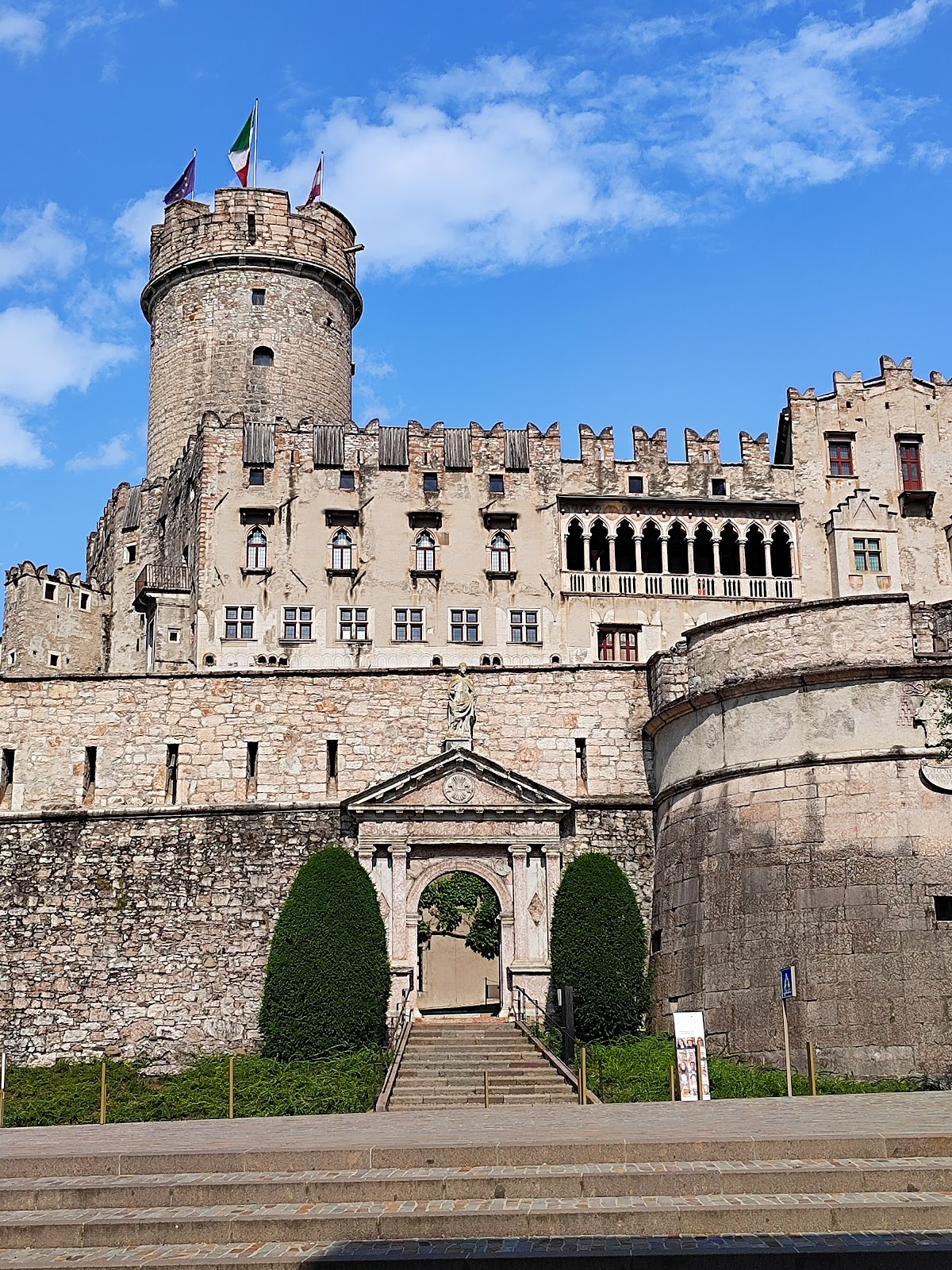
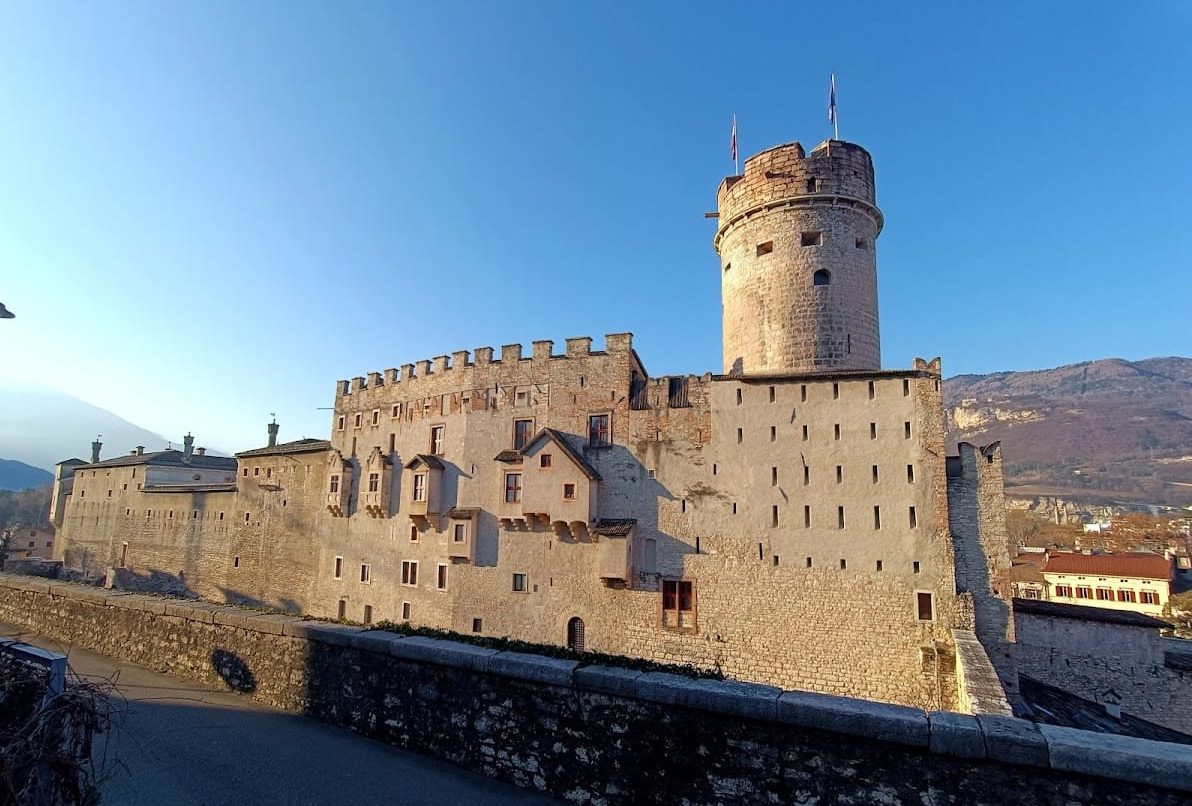
Buonconsiglio Castle occupies a rocky spur northeast of Trento’s historic center, slightly above the city. Defensive walls enclose a large, multi-period complex whose buildings developed around the medieval keep and extend through residential, military, religious, and garden areas. Romanesque, Gothic, Renaissance, and Baroque elements survive together, while the principal buildings preserve extensive fresco cycles, sculptural decoration, historic interiors, and museum collections.
Medieval Fortifications and Towers
Castelvecchio and the Mastio
The oldest medieval components are grouped around the cylindrical keep known as the Mastio or Augustus Tower. Castelvecchio extends from this central area and incorporates Romanesque and later Gothic features. Its medieval nucleus was rebuilt in 1440, and the complex includes a chapel with frescoes completed in 1475. A Gothic-Venetian loggia connects the residential and defensive parts of the older castle.
The walls facing the city were strengthened with four rounded artillery turrets, of which three survive. These defenses belong to the castle’s transformation from a medieval residence into a more heavily protected stronghold. The surviving structures retain the relationship between the central keep, the older residential buildings, and the outer defensive walls.
Eagle Tower
The Eagle Tower stands at the southern end of the complex and is linked to Castelvecchio. Its interior contains the Cycle of the Months, commissioned around 1400 and regarded as an internationally important example of International Gothic, a late medieval courtly style known for elegant figures, elaborate detail, rich color, and aristocratic subjects.
Eleven panels survive because the March panel was destroyed by fire. Twisted columns frame each scene, which brings together the courtly life of nobles and the agricultural and pastoral work of rural inhabitants as the seasons change. The cycle therefore combines aristocratic imagery with depictions of activities associated with the surrounding countryside.
Falcon Tower
The eastern Falcon Tower was built around 1390. Before 1560, its interior was probably decorated with extensive hunting frescoes attributed, with uncertainty, either to Hans Bocksberger the Elder or to Bartlmä Dill Riemenschneider. The tower forms part of the eastern defensive structures associated with the older castle.
Magno Palazzo and Renaissance Interiors
Bridge, Chapel, and Atrium
The Renaissance Magno Palazzo was added to Castelvecchio in the sixteenth century. An elegant suspended bridge, supported by candelabrum-like columns, leads from the older castle to an atrium before the chapel. The chapel vault contains terracotta figures by the Tuscan sculptor Zaccaria Zacchi. In the atrium, frescoes by the Dossi brothers include Olympian deities in the lunettes and putti carrying Bernardo Clesio’s large cardinal coat of arms among the clouds.
State Rooms and Library
The Dossi brothers decorated the Sala Grande, the Hall of Mirrors, the room of the Black Chimney, the Stua della Famea, and the library. In the Sala Grande, a frescoed frieze beneath the coffered ceiling contains monochrome caryatids, putti, the gold letters of Clesio’s name, and references to the heraldic animals of Cles and Trentino.
The room of the Black Chimney has a stuccoed vault with a circular fresco of putti painted using sotto in su, an illusionistic technique that makes figures appear to project toward viewers below. The corners contain the cardinal virtues, while the lunettes show the seven liberal arts and ancient sages associated with them.
The large library has a monumental wooden coffered ceiling decorated by the Dossi brothers with figures of ancient sages. The Stua della Famea was originally a refectory and later became an Austrian tribunal room. Its frescoes show landscapes and moralized episodes from the fables of Phaedrus, a first-century Roman fabulist known for Latin verse adaptations of Aesop. Subjects include the Fox and the Grapes and the Fox and the Stork. Monochrome classical statues stand between the lunettes, and the paintings are in poor condition.
Lions’ Court and Romanino’s Loggia
The central Loggia of the Lions’ Court serves as a communication space between different parts of the Magno Palazzo. Romanino’s fresco cycle covers the vault panels, triangular compartments, pendentives, and lunettes. It combines secular, mythological, Roman historical, and biblical scenes, including Judith and Holofernes, the killing of Virginia, the suicides of Lucretia and Cleopatra, Samson and Delilah, the Three Graces, Venus and Cupid, flute and country concerts, and the Rape of Ganymede.
The central vault depicts Phaethon losing control of the horses drawing the solar chariot. Personifications of the four seasons surround the scene, while Apollo and Selene appear in adjoining lunettes. Phaethon belongs to Greek mythology, Apollo is associated with the sun in this artistic tradition, and Selene personifies the moon. Nude figures occupy the blue celestial background.
Romanino also painted a portrait of Bernardo Clesio with his secretary in the Audience Hall, surrounded by family and princely arms. Portraits of Habsburg rulers on the walls face portraits of Roman emperors, creating a visual connection between the Roman Empire and the Holy Roman Empire. On the loggia landing and the staircase toward the garden, Romanino depicted courtly daily life and comic or satirical subjects, including the payment of workers, a court fool with a monkey, a soldier courting a woman, and the castration of a cat.
Fogolino’s Frescoes and the Lower Rooms
Marcello Fogolino’s original frescoes on the walls of the central Lions’ Court are largely lost. Terracotta roundels that survive there show profile portraits of Maximilian I, Philip the Fair, Charles V, and Ferdinand I of the Habsburg dynasty. Fogolino also painted a well-preserved fresco of Charlemagne in the Castelvecchio courtyard. In an upper room of Castelvecchio, he is credited with fresco portraits of the bishops of Trent beginning around the year 1000, above which runs a gallery of Holy Roman Emperors.
The ground-floor refectory was used as an antechamber to the cellars and for wine tasting. Fogolino decorated its yellow-ground vault with grotesques, floral and fruit garlands, concerts, and banquets rather than the commemorative imagery found in other rooms. The circular vault of the Camera terrena del Torrion da basso is covered with refined white vegetal stucco, frescoed ovals and lunettes, ancient Roman subjects, portraits of ancient emperors, male and female nudes, and fantastic figures.
Scenes from the life of Julius Caesar include Ptolemy presenting Pompey’s head, the Triumvirate, Caesar in the Senate, and a torchlit nocturnal triumph. Caesar was a Roman military commander and statesman whose political rise became a major subject of later European art.
Memorial, Garden, and Collections
Fossa dei Martiri
The Fossa dei Martiri lies east of the castle and its walls. Memorial stones commemorate Cesare Battisti, Fabio Filzi, and Damiano Chiesa at the execution area associated with their deaths during the First World War.
Castle Garden
The castle garden lies between the principal residential buildings and the western outer wall. Bernardo Clesio laid it out in the sixteenth century, and it was remodeled several times during the nineteenth and twentieth centuries.
Museum Collections
The museum’s collections include Roman and medieval archaeological material, manuscripts and early printed books, a lapidarium, coins, stone and wooden sculpture, paintings from the sixteenth to the twentieth centuries, and graphics and drawings from the fifteenth to the nineteenth centuries. The Tabula Clesiana, a first-century bronze tablet found during earthworks near Cles in 1869, is displayed in the museum. It preserves an edict issued by Emperor Claudius in AD 46. Six volumes of the Trento Codices are also preserved there.
A legendary secret passage is said to connect the castle with Trent Cathedral, although its existence has not been established.