Burg Piberstein: A Medieval Rock Castle in Austria
Site at a Glance
- Rating
- 4.6
- Popularity
- Low
- Country
- Austria
- Primary era
- Medieval
- External website
- Open
- Eras represented
- Medieval, Early Modern
- Civilizations
- Duchy of Austria, Habsburg, Holy Roman Empire
- Site type
- Military
- Remains
- Castle
On this page10 sections
History
Burg Piberstein is a rock castle in Austria, probably built during the thirteenth century as a fortified residence and border stronghold. Its exact construction date is uncertain, with proposed dates ranging from about 1200 to 1250 or shortly before 1285. The original tower castle is associated with Ruga and Arnold von Piberstein, feudal dependants of the lords of Griesbach and Waxenberg. Its construction formed part of efforts to protect the border against Bohemia and to clear and settle the surrounding forest.
The Piberstein family and changing ownership
Rüdiger and Ottokar von Piberstein were recorded as owners around 1285. After the Piber family died out, Ulrich von Tann acquired the castle, which had become a territorial possession of the ruling authority. Walchum Haderer obtained it in 1350, and Duke Rudolf IV of Austria, a Habsburg ruler, granted it to Zacharias Haderer in 1362.
Ownership changed repeatedly from 1386. The successive holders included Heinrich Aichberger, Wolfgang Aschauer, Friedrich von Stahaleck, Heinrich von Puchberg, Jobst Haderer, and Heinrich III von Falkenstein. Heinrich von Stall also claimed rights to Piberstein and attempted to take the castle by force. In 1394, Governor Reinprecht von Wallsee captured him and forced him to surrender his claim.
Hussite incursions and the Schallenbergs
Hussite forces, followers of the Bohemian religious reformer Jan Hus, unsuccessfully besieged Piberstein in 1427. The following year, Kaspar and Balthasar von Schallenberg acquired the castle. They moved there after their former seat at St. Ulrich had been destroyed during the Hussite campaigns, which affected many fortifications in the region.
By 1594, Piberstein was regarded as one of the best-defended fortresses in the country. It was also viewed as a stronghold against the Ottoman threat in the Mühlviertel, the historic region of northern Upper Austria north of the Danube, although neither Hungarian nor Ottoman forces besieged it.
Renaissance expansion and later estate history
Around 1620, Georg Christian von Schallenberg expanded the castle in the Renaissance style. Imperial troops occupied it in 1625. Between 1635 and 1636, Georg Christoph von Schallenberg attempted to mediate with rebellious peasants from the lower Mühlviertel. In 1645, the Schallenbergs converted the former feudal holding, property held in return for obligations to a superior lord, into freehold property held without those obligations.
The Schallenberg family retained Piberstein until 1675, when Christoph Ehrenreich von Schallenberg sold the castle and its associated regional court to the counts of Seeau. In 1702, Johann Ehrenreich Seeau incorporated Piberstein into the Helfenberg estate and placed both properties under a hereditary entail, a legal arrangement that restricted the sale or division of an estate within a designated family succession. A rebuilding plan prepared by the Linz master builder Johann Matthias Krinner in 1752 was never implemented.
Decline, restoration, and present use
The uninhabited castle subsequently deteriorated into a ruin. The hereditary entail was revoked in 1885, enabling Count Otto von Seeau’s daughters to sell Helfenberg and Piberstein to the counts of Revertera-Salandra in 1893. During the 1930s, a guesthouse and inn operated in the castle park while the castle continued to decay.
Restoration began in 1964 under the academic restorer Harald Seyrl but was soon interrupted. Work resumed under Hubert Taxenecker from 1971, and restoration efforts from 1975 onward helped prevent further decay. A fire in 2002 caused only minor delays. Burg Piberstein now serves as a regional cultural centre for concerts, exhibitions, readings, and music festivals. It is protected as an Austrian monument under inventory number 16688 and is listed in Austria’s cultural-heritage database under identification number 20385.
Remains
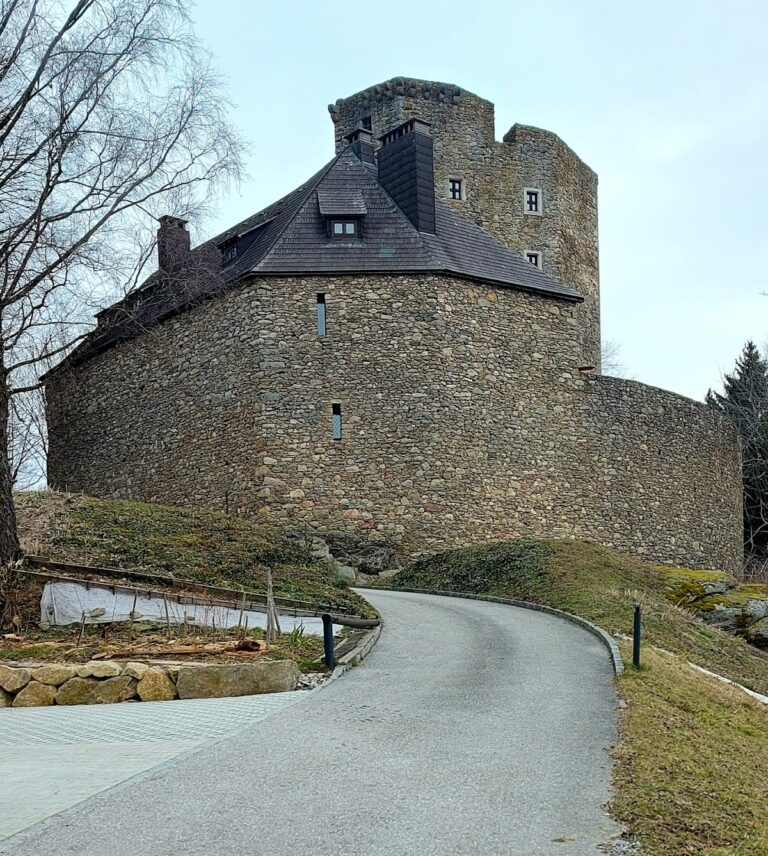
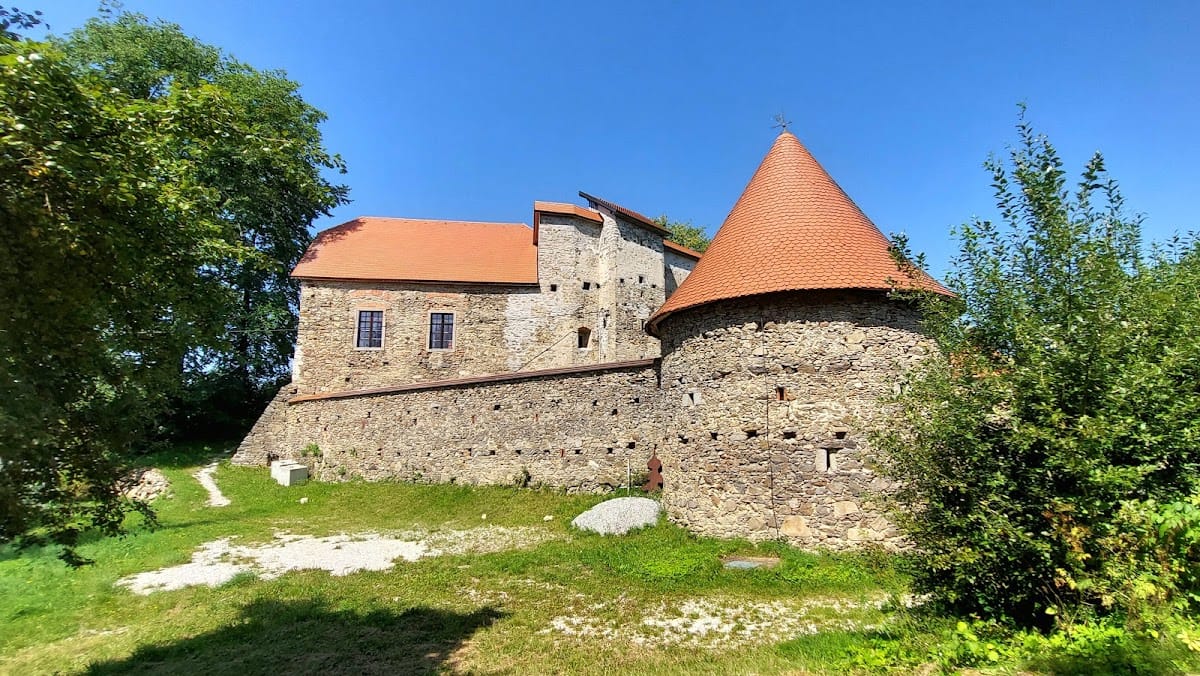
Burg Piberstein occupies a rocky site at approximately 760 metres above sea level. The complex combines a roughly triangular core castle with a large outer courtyard. The core covers about 784 square metres, while the outer bailey, the enclosed area containing additional buildings and functions, covers approximately 2,730 square metres. Quarry-stone masonry forms the buildings, with door and window surrounds made from carefully dressed granite blocks.
Outer defenses and courtyard buildings
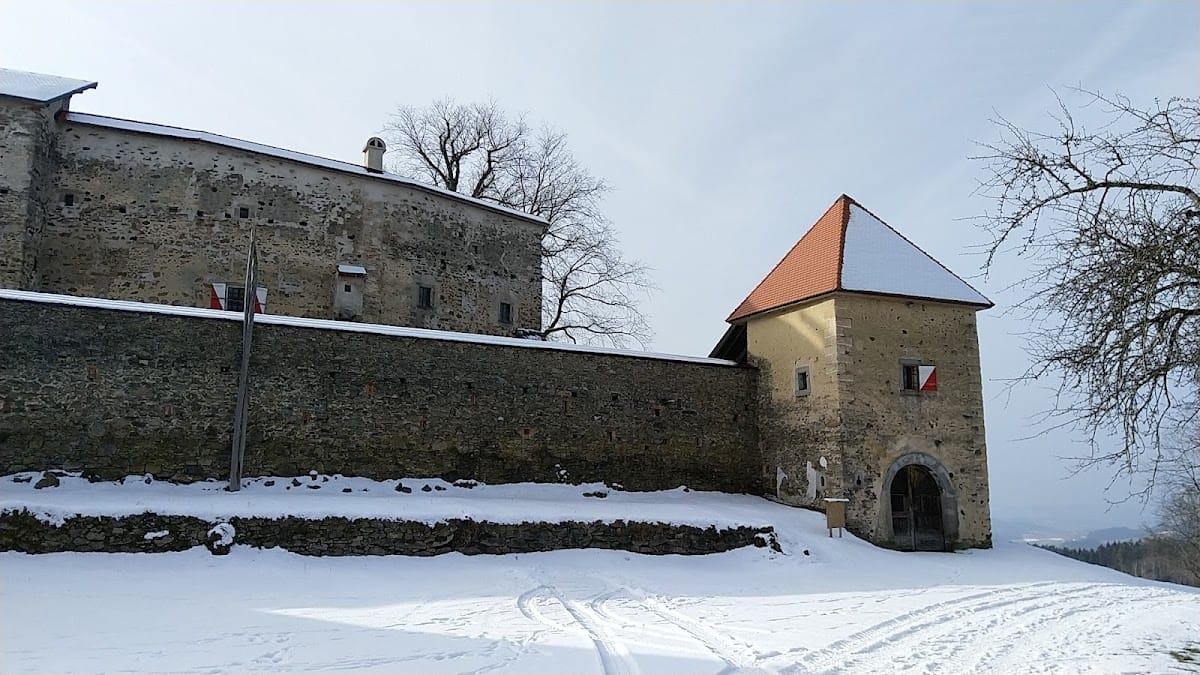
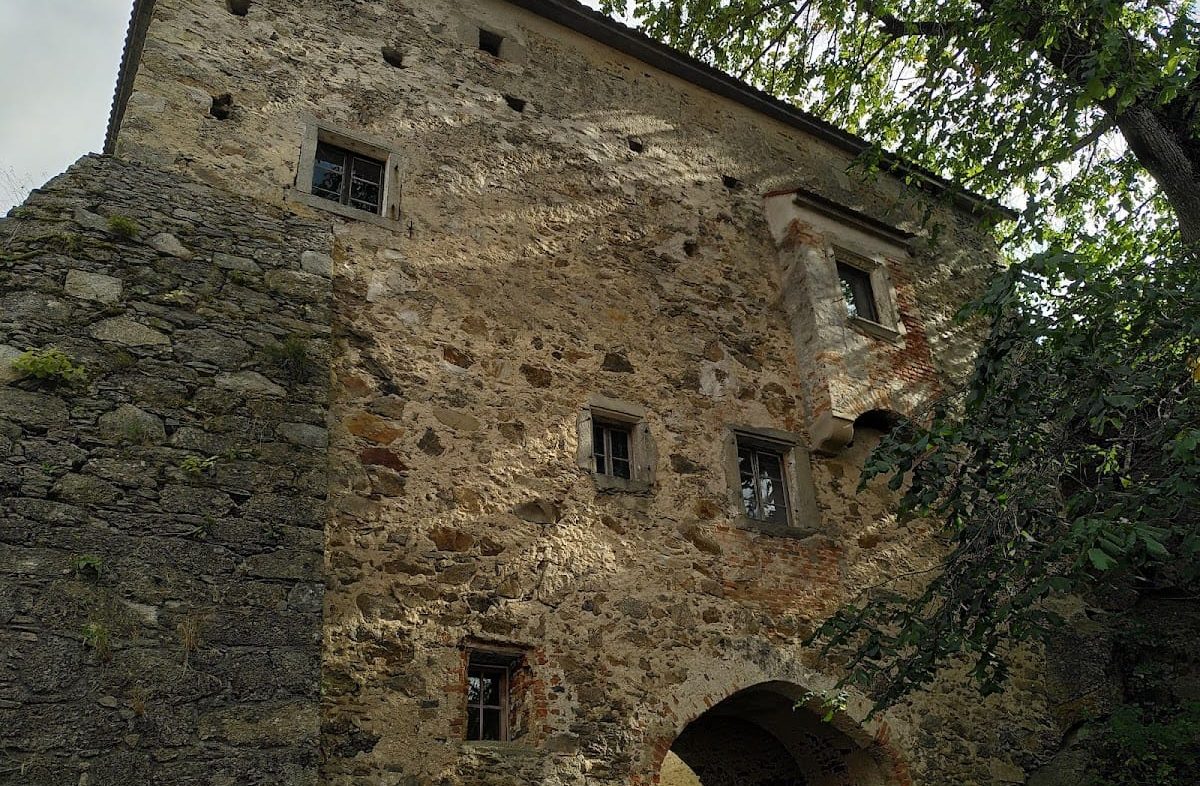
A circular perimeter wall between four and six metres high encloses the complex. Four three-quarter-round defensive towers and a square gate tower reinforced it, and numerous loopholes survive in the defensive fabric. The tower roofs are modern reconstructions. A small chapel dating from 1730 stands to the left of the projecting gate tower and was built independently of the castle. To the right of the gate, agricultural buildings, including stables and hay barns, occupy the space inside the perimeter wall. A large brewery formerly stood in the southern part of the outer courtyard.
Core castle and entrances
The roughly triangular core castle is enclosed by a wall about two metres thick and fifteen metres high. Traces of battlements remain near the top, and two latrine projections, projecting medieval sanitary features, are set into the exterior. The medieval entrance was placed in a tower on the eastern side. Around 1620, its arched portal was bricked up and access to the main castle was moved to the north-west side.
A high arched gateway now leads into the central courtyard. An oriel window, a projecting upper-storey window supported by brackets, extends from the first floor of the gate passage on three brackets. The adjoining building contains a ground-floor hall that opens onto the courtyard through two arcades carried by a rusticated Gothic pillar.
Inner courtyard and Renaissance arcades
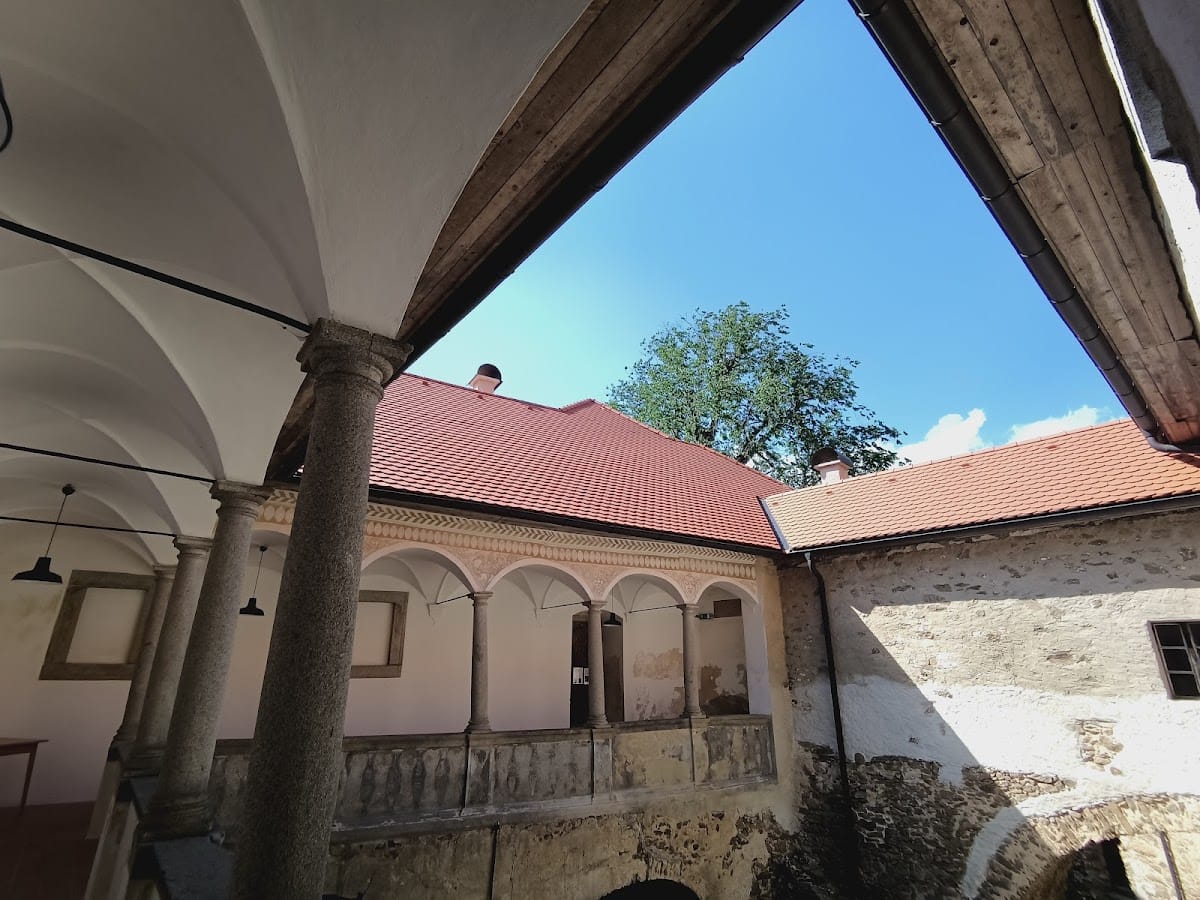
A staircase opposite the hall leads to an upper-level arcade bordering two sides of the inner courtyard. An inscription above the staircase refers to building work under Georg Christian von Schallenberg and gives the year 1620. The arcades rest on Tuscan-style columns, a simplified classical column type. Their restoration revealed sgraffito paintings again, made by scratching through contrasting plaster layers. The spandrels, the roughly triangular spaces between the arches and their surrounding frames, depict trophies, animals, and masks.
The arcade corridor leads to the former reception rooms and the Knights’ Hall, which was reconstructed after 1992. An open arch separates the central courtyard from the inner courtyard.
Residential structures and traditions
The irregularly planned residential building rests directly on rock along two sides. A large granite block beside the arcaded courtyard forms the highest point of the complex. The square residential tower associated with the lords of Piber measured approximately 7.5 by 7.5 metres and was already a ruin in 1752.
Local tradition tells of an underground escape tunnel leading from the castle to the neighbouring forest. The story remains part of the castle’s historical traditions, while the tunnel’s existence has not been established.
Nearby sites