Rožmberk Castle: A Medieval Aristocratic Stronghold in Czechia


Site at a Glance
- Rating
- 4.7
- Popularity
- Medium
- Country
- Czechia
- Primary era
- Medieval
- External website
- Open
- Eras represented
- Medieval, Early Modern, Modern
- Civilizations
- Habsburg, Holy Roman Empire, Kingdom of Bohemia
- Site type
- Military
- Remains
- Castle
On this page14 sections
History
Rožmberk Castle is a medieval castle in Czechia, at Rožmberk nad Vltavou, founded before the middle of the thirteenth century by Vok I of Rožmberk or, according to another attribution, by his father Vítek III of Prčice and Plankenberk. The first written reference dates from 1250. Built for the powerful Bohemian Rožmberk aristocratic family, whose heraldic emblem was a rose, it became an administrative and economic centre of their lands.
Foundation and Rožmberk rule
In 1259, Vok donated a substantial part of his property to the newly founded Cistercian monastery at Vyšší Brod. His elder son, Jindřich I of Rožmberk, inherited the castle in 1262. Rožmberk remained Jindřich’s principal residence until 1302, when he inherited Český Krumlov and established it as the family’s main seat. Rožmberk continued to be maintained and enlarged after this transfer.
The castle was administered by burgraves, officials responsible for governing and defending a castle and its surrounding domain. Their recorded terms extend from 1272 to 1515 and include Benata and Václav of Větřní, Markvart of Pořešín, Jindřich of Svržno, Bohuslav of Petrovice, Petr of Mladotice, Jan of Mezipotočí, Buzek of Velhartice, Zachař of Trautenberk, Petr Stupenský of Houžná, Jošt of Pruk, Jan of Vlksice, Jan Sokolík of Dubá, and Markvart of Doubravice.
The Hussite Wars and fifteenth-century conflicts
During the Hussite Wars, the religious and political conflicts between Hussite followers of Jan Hus and their Catholic opponents, Oldřich II of Rožmberk first sympathized with the Hussites under the influence of his guardian, Čeněk of Vartenberk. He later returned to Catholicism and supported King Sigismund. After the unsuccessful siege of Tábor, Oldřich arrested Hussite priests in his territories and imprisoned some of them at Rožmberk.
In 1420, Oldřich pledged Rožmberk, its town, and ecclesiastical treasures to Reinprecht of Walsee to finance his army and garrisons. The payment was 4,000 kopas of groschen, with a kopa being a historical counting unit of sixty. Oldřich’s sons Jošt II, Jan II, and Jindřich IV redeemed the castle on 24 April 1456, while negotiations involving Anežka of Schaunberg and Count Michael of Hardegg continued until 1462.
Jan II pledged the castle to Jan Popel of Lobkowicz in 1464. During the conflict between the Bohemian nobility and King George of Poděbrady, Zdeněk of Šternberk besieged Rožmberk in October 1467. Prince Henry of Münsterberg relieved the castle, but Zdeněk captured it by treachery on 9 January 1469. Jan Popel and his son Děpolt were imprisoned, and the castle was later returned to Jan II after payment.
After Jan II died in 1472, his sixteen-year-old son Jindřich V became head of the family. He released Děpolt in 1473 and redeemed the Lobkowicz claim two years later. Jindřich kept Rožmberk as his residence after transferring the title of family ruler to his brother Vok II. The castle was subsequently captured by Řehoř Třeboňský and soon recovered by the Rožmberks. Castellans during this period included Sigmund Schallenberg, Ctibor of Kvasejovice, Heřman of Zelenice, Jošt of Pruk, and Jan of Vlksice.
Fire and Renaissance transformation
A fire on 9 April 1522 destroyed the Upper Castle. Much of it was then demolished and it was never fully rebuilt. When Alexander Škol of Grynsperk took office as governor in 1556, he found the castle in poor condition. Vilém of Rožmberk ordered repairs to provide suitable accommodation for the governor.
The same year marked the beginning of the Lower Castle’s transformation into a Renaissance residence. The work repaired deteriorated medieval buildings, altered the interior arrangement, and added sgraffito, a decoration made by scratching through one layer of plaster to expose a contrasting layer below. Low buildings with a gate towards the town were also constructed in the outer bailey. Petr Vok of Rožmberk later had some interiors redesigned in the Italian Renaissance style.
In 1597, Petr Vok gave Rožmberk and its associated estates to his nephew Jan Zrinský of Seryn, with a provision that they would revert if Jan died first. The Rožmberk family became extinct when Petr Vok died in 1611. Jan Zrinský died the following year, and the estate passed to Jan Jiří of Švamberk under an earlier inheritance agreement. By then, the Lower Castle had undergone an extensive Renaissance reconstruction.
Buquoy ownership and the modern monument
During the Bohemian Revolt, an uprising of the Bohemian estates against the Habsburg monarchy, imperial forces under General Karel Bonaventura Buquoy captured the town in May 1619. The castle garrison surrendered after a short siege in September because it could not withstand heavy artillery. On 6 February 1620, Emperor Ferdinand II granted Rožmberk to Buquoy as compensation for the cost of maintaining his army.
Rožmberk remained in Buquoy ownership from 1620 until 1945, although Nové Hrady served as the family’s principal residence. Albert Heinrich Karl Buquoy made major alterations to the Lower Castle in 1710–1716. Jiří Jan Jindřich Buquoy then directed an extensive neo-Gothic reconstruction between 1840 and 1857, with work in the Upper Castle area continuing through 1870. Neo-Gothic architecture revived medieval Gothic forms and belonged to the nineteenth-century Gothic Revival.
The Buquoy family held the castle until 1945, when it was nationalized under the Beneš Decrees. Rožmberk is now owned by the Czech Republic and administered by the National Heritage Institute. It is protected as a National Cultural Monument of the Czech Republic. The castle opened to the public in the mid-nineteenth century and is regarded as one of the first museums in Bohemia.
Remains
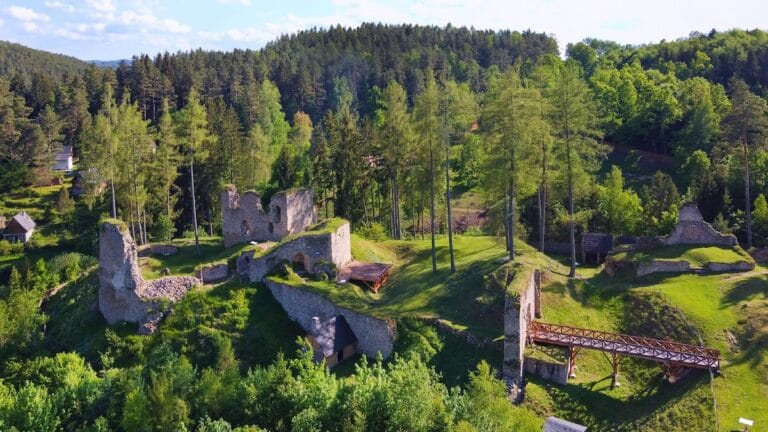
The complex brings together buildings belonging to two originally separate castles, known as the Upper Castle and the Lower Castle. Their sequence remains debated. Emanuel Poche considered the Upper Castle, including the Jakobínka Tower, to be the older complex, while Tomáš Durdík regarded the Lower Castle as one of the oldest aristocratic castles in Bohemia.
The Lower Castle
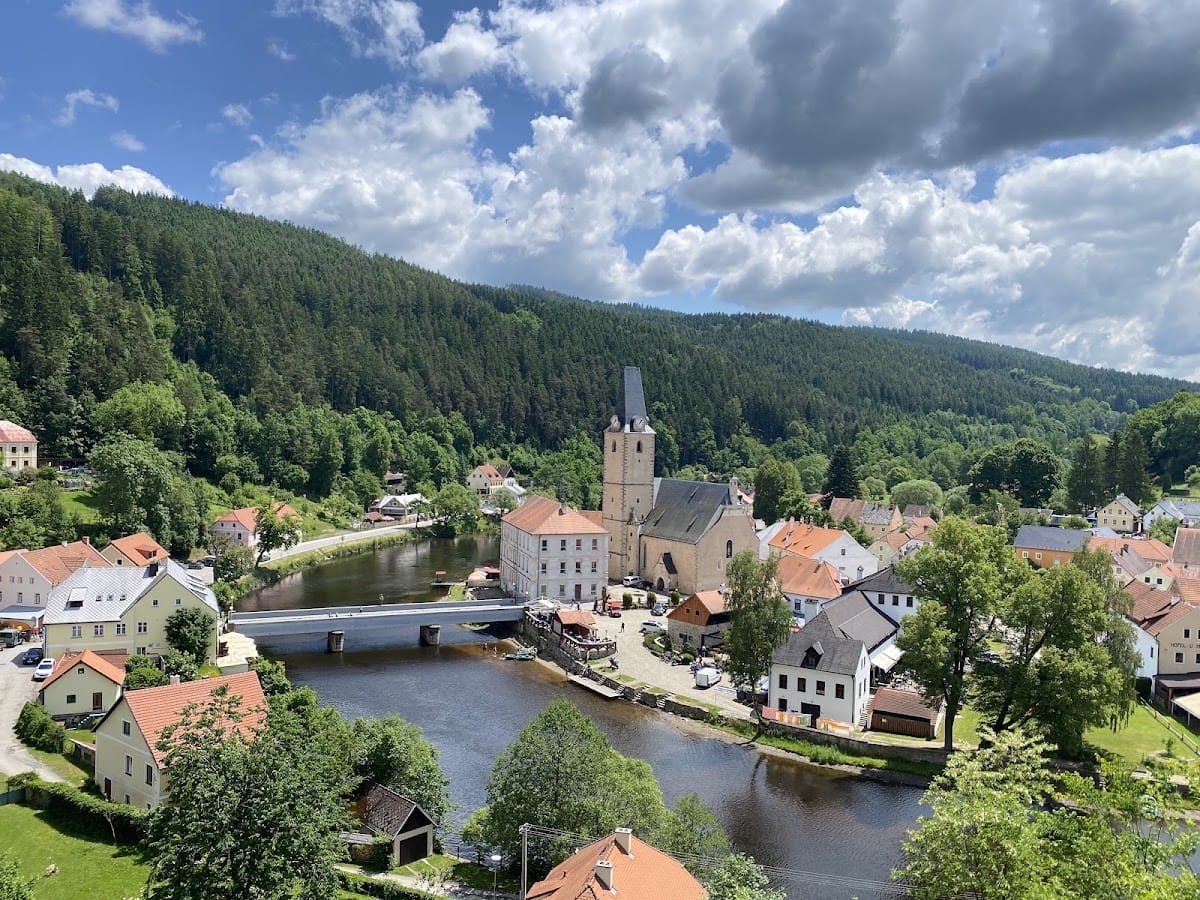
The Lower Castle occupies a rocky spur surrounded by the Vltava on three sides. A ditch cut across the neck of the spur protected the site. Historical records refer to a latrán, a settlement or suburb associated with a castle, below the fortification, while the surviving approach crosses the ditch from the north.
Southern tower and medieval defenses
The probable oldest part of the Lower Castle is the square southern tower known as the English Tower. Its masonry preserves a Romanesque window, and its square form may reflect the Rožmberks’ contacts with the Danube region. The original entrance may have stood beside the tower at the southern end of the castle. A smaller tower was later built at the northern end, and a palace with a complex construction history occupied the eastern wall.
Entrance and residential buildings
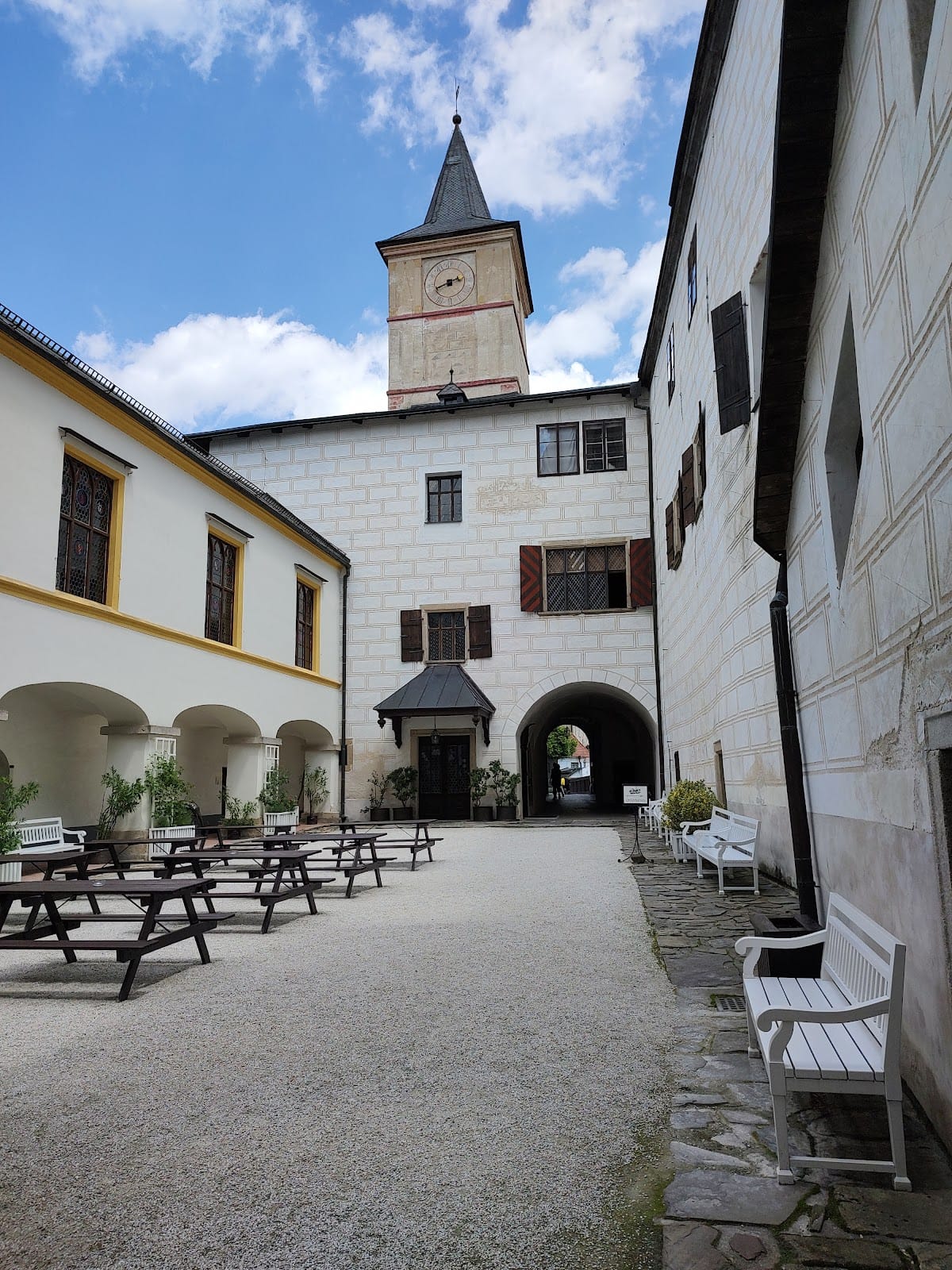
The later northern entrance consists of a Renaissance rusticated semicircular portal with remnants of painted Mannerist architectural decoration. It leads into a passage covered by a barrel vault with lunettes. The courtyard façades are largely plain. Along the eastern side, the principal residential wing ends in a rectangular tower with a neo-Gothic battlement. Opposite the palace stands the Crusader Gallery, decorated in the neo-Gothic manner and fitted with an open, richly carved roof structure.
Renaissance interiors
The so-called armory on the first floor of the palace has an irregular trapezoidal plan and a Renaissance panelled ceiling supported by central pillars. The rectangular Knights’ Hall has a coffered ceiling with carved pinecone ornaments and Mannerist paintings based on designs by L. Kilian dated 1607. Trophy designs were created by J. Vredeman de Vries, while allegories of human character were designed by Marten de Vos and engraved by R. Sadeler. Wall paintings bearing the arms of Jan Zrinský and Marie Magdalene of Kolowrat date from the early seventeenth century.
The Upper Castle
The Upper Castle was probably built in the fourteenth century as a residence for a member of the Rožmberk family. It originally included the Jakobínka Tower, a palace, ramparts, and a surrounding wall and ditch. Its connection with the Lower Castle remains uncertain.
Jakobínka Tower
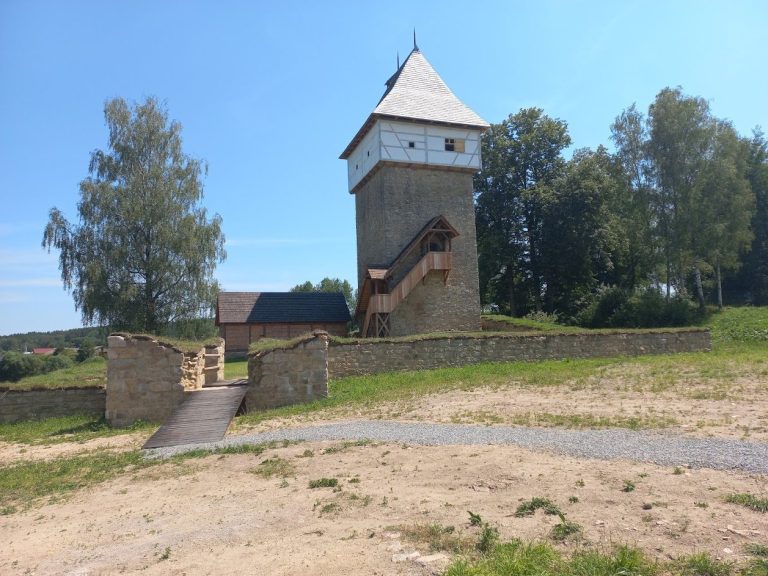
The round Jakobínka Tower has a diameter of approximately 9.6 metres. Its entrance position suggests that it was not structurally connected with the Lower Castle. Vladislav Razím proposed that the tower belonged not to an earlier castle but to an unfinished fortification built in 1524–1526. Dendrochronology, which dates wooden structures through annual growth rings, places some of its timber in trees felled in 1523. Its masonry roof certainly belongs to that period, while other wooden elements rest on ledges in the masonry and cannot securely date the tower’s original construction.
Later Upper Castle building
A long two-storey building occupies part of the former Upper Castle area. It was created during Jiří Jan Jindřich Buquoy’s neo-Gothic reconstruction between 1840 and 1870. Its southern side connects with a lower Renaissance wing, linking the later building to the surviving architectural fabric of the complex.
Collections and courtyard features
The interiors are predominantly neo-Gothic in appearance. They contain custom-carved wooden furnishings, Baroque furniture, and paintings by Bartolomeus Spranger, Karel Škréta, Jan Kupecký, and Norbert Grund. The collections also include weapons, firearms, military relics, and heraldic emblems. A picture traditionally identified as a portrait of Perchta of Rožmberk, the “White Lady,” forms part of the castle’s picture collection.
The Knights’ Hall contains a wall inscription translated as “Love disappears, colours disappear.” Spanish soldiers reportedly carved it in the seventeenth century, and it was discovered in 2004. A bronze elephant stands in the courtyard. It is a 2003 copy of an original made in 1916. The original was taken from its owners by the Nazis, brought to the castle, and later returned to them in Switzerland.