Žerotínský zámek: A Renaissance Castle in Nový Jičín
Site at a Glance
- Rating
- 4.6
- Popularity
- Low
- Country
- Czechia
- Primary era
- Early Modern
- External website
- Open
- Eras represented
- Medieval, Early Modern, Modern
- Civilizations
- German, Habsburg, Holy Roman Empire
- Site type
- Domestic
- Remains
- Castle
On this page18 sections
History
Žerotínský zámek is a castle in Nový Jičín, Czechia, whose origins probably reach back to the last quarter of the fourteenth century, when the Moravian Lords of Kravaře built a stone stronghold in the northwestern corner of the town fortifications. It became a fortified Renaissance residence in the sixteenth century and later served royal, Jesuit, military, municipal, and museum functions. The castle stands within Nový Jičín’s historic centre, designated an urban heritage reserve in 1967, and is a cultural monument of the Czech Republic.
Medieval foundation and expansion
The earliest castle probably arose during the rule of Vok III of Kravaře, although a separate foundation tradition connects it with an earlier wooden town stronghold and the legend of Jitka, who lived at Starý Jičín. The original stone building was a defensive tower integrated into the northwestern part of the town walls.
The castle expanded during the later fifteenth century. A southwestern wing had been attached to the tower by 1465, while at least part of the northeastern wing was probably in place by the end of the century. These additions transformed the isolated defensive structure into a larger fortified complex.
The Lords of Žerotín and the Renaissance transformation
In 1500, the estate of Nový Jičín and Štramberk, including Old and New Jičín, was jointly purchased by Jan, Viktorin, Jiří, Bartoloměj, and Bernart, sons of Jan of Žerotín of Fulnek. The Lords of Žerotín, a Moravian noble family, shaped the castle more than any other owners.
Under Viktorin of Žerotín, the northeastern wing was probably completed by 1529. His successor, Bedřich of Žerotín, then transformed the Gothic castle into a fortified Renaissance residence between 1532 and 1541. This castello-type building combined the defensive arrangement of a castle with the residential and representational purposes of a palace. After Bedřich died in 1541, construction probably slowed, and his son Jan sold the castle, town, and estate in 1558.
Royal, municipal, and Jesuit administration
After the estate passed to Ferdinand I, a Habsburg king of Bohemia and Holy Roman Emperor, the castle ceased to function as a noble residence. Nový Jičín became a royal chamber town, meaning that it came under the Crown’s direct authority and financial administration. In 1586, Emperor Rudolf II authorized the town administration to use the castle, and the arrangement was finalized in 1593.
The town’s role changed after Nový Jičín took part in the Bohemian Revolt, the early seventeenth-century uprising against Habsburg rule. The town and estate were then placed under the administration of the Jesuit college in Olomouc. The Jesuits, members of a Catholic religious order, used the castle as the administrative centre of the estate and adapted it for granaries, offices, and apartments for officials.
The town council was expelled from the castle in 1624 and subsequently worked from the houses of successive mayors. In the 1640s, it received permission to use two rooms there, while the Jesuits fulfilled a promise to provide a new town hall only in 1659. The castle also hosted notable travellers. In August 1637, the Polish king Ladislaus IV Vasa and his fiancée, the Austrian archduchess Cecilia Renata, spent a night there on their journey to Poland. A fire in 1680 led to repairs during the continuing Jesuit administration.
Military and nineteenth-century reconstruction
The abolition of the Jesuit order in 1773 brought a rapid succession of owners. The castle first became state property, was briefly held by an educational institution for the nobility in Olomouc in 1777 and 1778, and then passed to a noble foundation in Brno. The Theresian Military Academy, a Habsburg institution associated with officer training and military administration, became its owner in 1781. A military hospital operated in the castle from 1779 to 1796.
A comprehensive reconstruction extended from the 1830s to 1869. Ignác Kloss of Nový Jičín directed the work from 1836 to 1869 and strongly influenced the building’s present appearance. The reconstruction altered the interior spaces, added two staircases, installed new roofs and plaster, and created the left-hand flight of the exterior staircase leading to the first courtyard. It also removed most of the Renaissance defensive features.
The academy’s most prominent late guests were Archduke Charles, the future Emperor Charles I, and his wife, Zita of Bourbon-Parma. They spent the night of 12–13 March 1912 in the academy’s inspection rooms while Charles travelled with his 7th Dragoon Regiment from Brandýs nad Labem to Austrian Galicia.
From state estate to museum
After the establishment of Czechoslovakia, the military academy could no longer operate at the castle. In 1925, the building and its land were incorporated into the Straka Count Foundation’s endowed estate at Nový Jičín under the supervision of the Ministry of Education. A school used several rooms during the First Republic. The building’s poor condition prompted proposals in the second half of the 1930s for partial or complete demolition, but none was carried out.
Following the Munich Agreement of 1938, Nový Jičín became part of Nazi Germany. The city acquired the castle in 1940 and intended to move the Museum of the Kuhländchen region there. Only part of the planned wartime installations was completed, although the occupation brought major alterations to the building.
After the Second World War, the museum plan was fully implemented. Museum use had already been renewed in 1949 with the creation of the Hat-Making Museum in cooperation with the TONAK national enterprise. The Museum of the Kuhländchen region opened independently in 1953, became the District Museum of Nový Jičín in 1954, and passed through further institutional changes before the present Muzeum Novojičínska name was adopted in 2003. The district and hat museums merged in 1959.
A general reconstruction around the turn of the 1960s and 1970s changed the entrances and courtyards and created the New Gallery. The castle’s exhibitions have also changed over time. Hat displays were reinstalled in 1967, 1983, and 2000, while exhibitions on natural history, nativity scenes, the castle, and the revolutionary struggles of the working class occupied other rooms. After the Velvet Revolution, exhibitions on the history of Nový Jičín and Biedermeier interiors were introduced.
The permanent exhibition Nechte na hlavě opened in December 2000. The first part of Ve znaku zavinuté střely, devoted to the history of the town and region, opened in 2008, followed by its second part in 2010. Žerotínský zámek now houses a branch and the directorate of Muzeum Novojičínska.
Remains
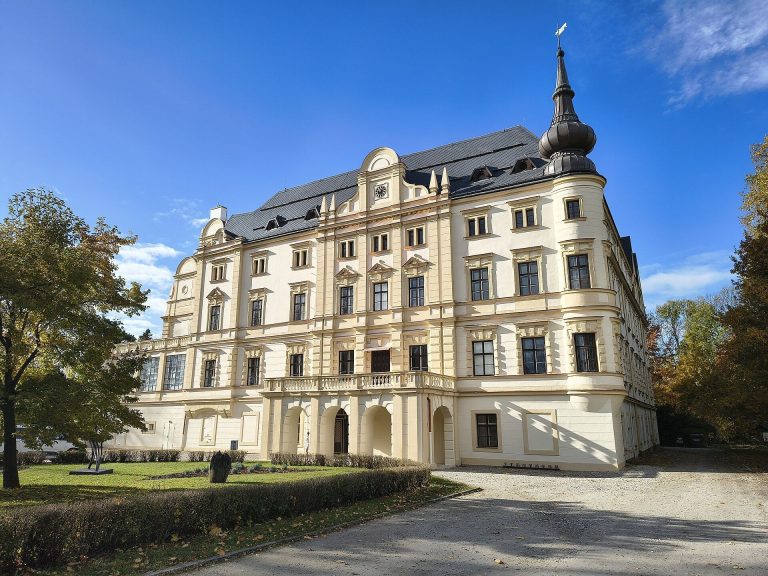
Žerotínský zámek is a four-wing Renaissance building on an F-shaped plan, formed through successive additions to a medieval defensive tower. Its surviving fabric combines Gothic halls and portals, Renaissance courtyards and fortified elements, Jesuit-period adaptations, nineteenth-century institutional changes, and later museum reconstruction. The complex is organized around a first and second courtyard, with the principal wings and surviving medieval features preserving evidence of its gradual expansion.
Medieval wings and courtyards
Southwestern wing
The southwestern wing, attached to the original defensive tower and completed by 1465, retains three tall vaulted Gothic halls on its ground floor. Its construction represents the first major enlargement of the stone castle beyond the original tower and established part of the later courtyard arrangement.
Northeastern wing
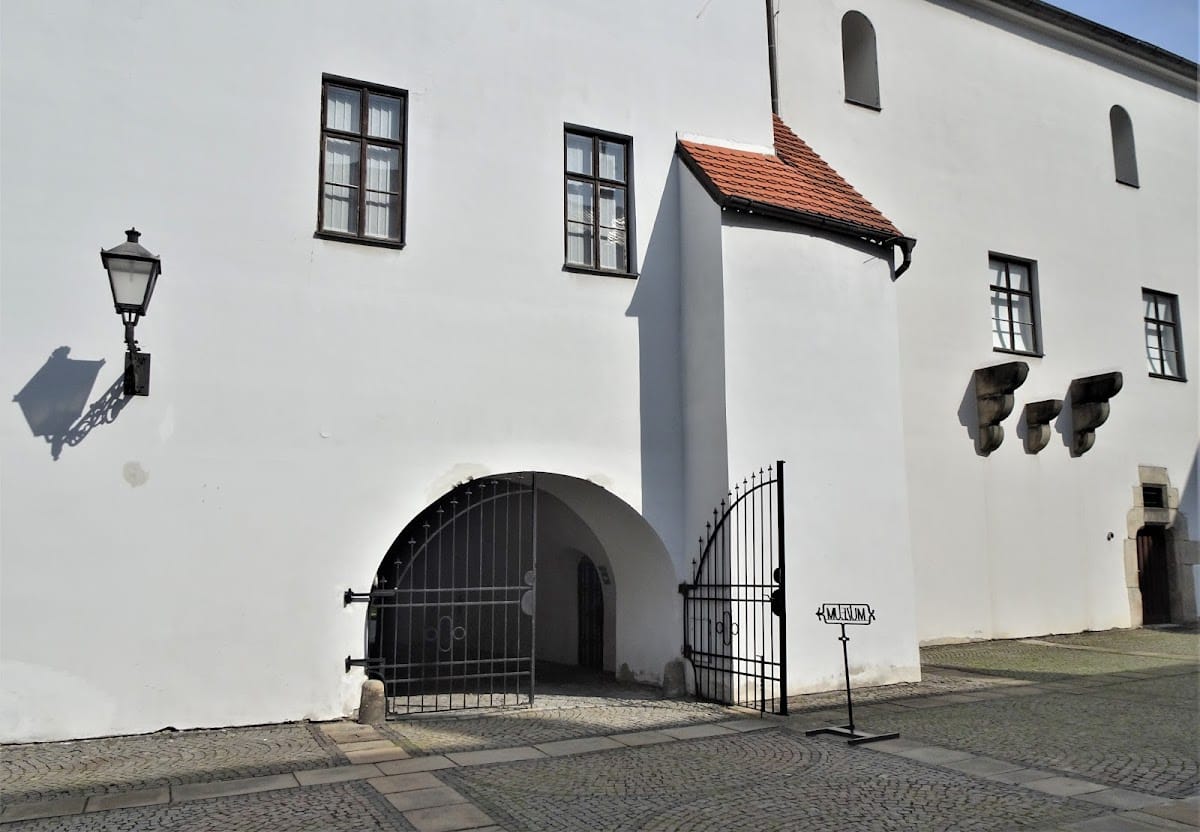
The northeastern wing was probably at least partly built by the end of the fifteenth century and completed by 1529. It contains the present Knights’ Hall, Stone Hall, and Beam Hall. In the second courtyard, a late Gothic portal and corbels that once supported a bay window preserve elements of this phase.
Renaissance residence and fortifications
Western wing and Renaissance stables
The Renaissance rebuilding added a western wing along the line of the former town fortifications. Renaissance stables occupy the ground floor of the southeastern wing on the first courtyard. During the Jesuit period, an additional storey was built above the stables. The entire floor served as a residential unit and now contains Ve znaku zavinuté střely I.
Parapet, turrets, and loggia
Except for the stables, the Renaissance complex was enclosed by a parapet, a low protective wall, with loopholes for defensive weapons and small Renaissance turrets above it. A town view from 1729 shows six turrets, while the total number was probably no more than twelve. A photograph from 1865 still shows the parapet and four towers.
The nineteenth-century reconstruction removed most of these defensive features. Two large turrets remained at the northern end of the western wing, together with a fragment of the parapet, and a small turret with an intact parapet survived in the northeastern wing facing the first courtyard. Kloss altered this small turret by blocking the loopholes and adding a small-arch frieze referring to Romanesque architecture. An alliance coat of arms of Bedřich of Žerotín and his wife, Libuše of Lomnice, remains set into the Renaissance loggia, an open roofed gallery, on the first courtyard.
Jesuit and nineteenth-century interiors
Theresian Hall
The fresco decoration of the so-called Theresian Hall probably dates from the Jesuit administration. A fresco is a wall painting applied to fresh plaster. The hall now displays works of Baroque art from Nový Jičín, including religious art from the High and Late Baroque periods.
Inspection rooms
Part of the former military-academy inspection rooms was opened with reconstructed period decoration from the second half of the nineteenth century and partly preserved flooring. These rooms now form Ve znaku zavinuté střely II, the second part of the historical exhibition.
Twentieth-century alterations and museum spaces
During the Nazi occupation, the servant houses in the first courtyard were demolished, and the southeastern wing received a new upper storey. Predominantly Baroque partitions were removed from the northeastern wing, exposing the vaults and giving the Knights’ Hall and Stone Hall much of their present form. Some second-courtyard windows received new stone pseudo-Renaissance surrounds, while older stone elements, including original window surrounds and the late Gothic portal, were uncovered.
The reconstruction around 1960 to 1970 demolished the buildings that had enclosed the entrances to the first and second courtyards. A modern wall was built to form the entrance to the second courtyard, and the blind upper storey of the northeastern wing was converted into the New Gallery.
In the second half of the 1990s, the Renaissance Beam Hall was reconstructed after having been divided into smaller rooms from the Baroque period until the mid-twentieth century. Part of its seventeenth-century painted decoration, featuring vine motifs on the beams, was restored. At the beginning of the twenty-first century, the first-floor ceilings of the southeastern wing were completely replaced, and period painted decoration discovered in one room was subsequently restored. Its second floor now contains Nechte na hlavě.
Collections and exhibitions
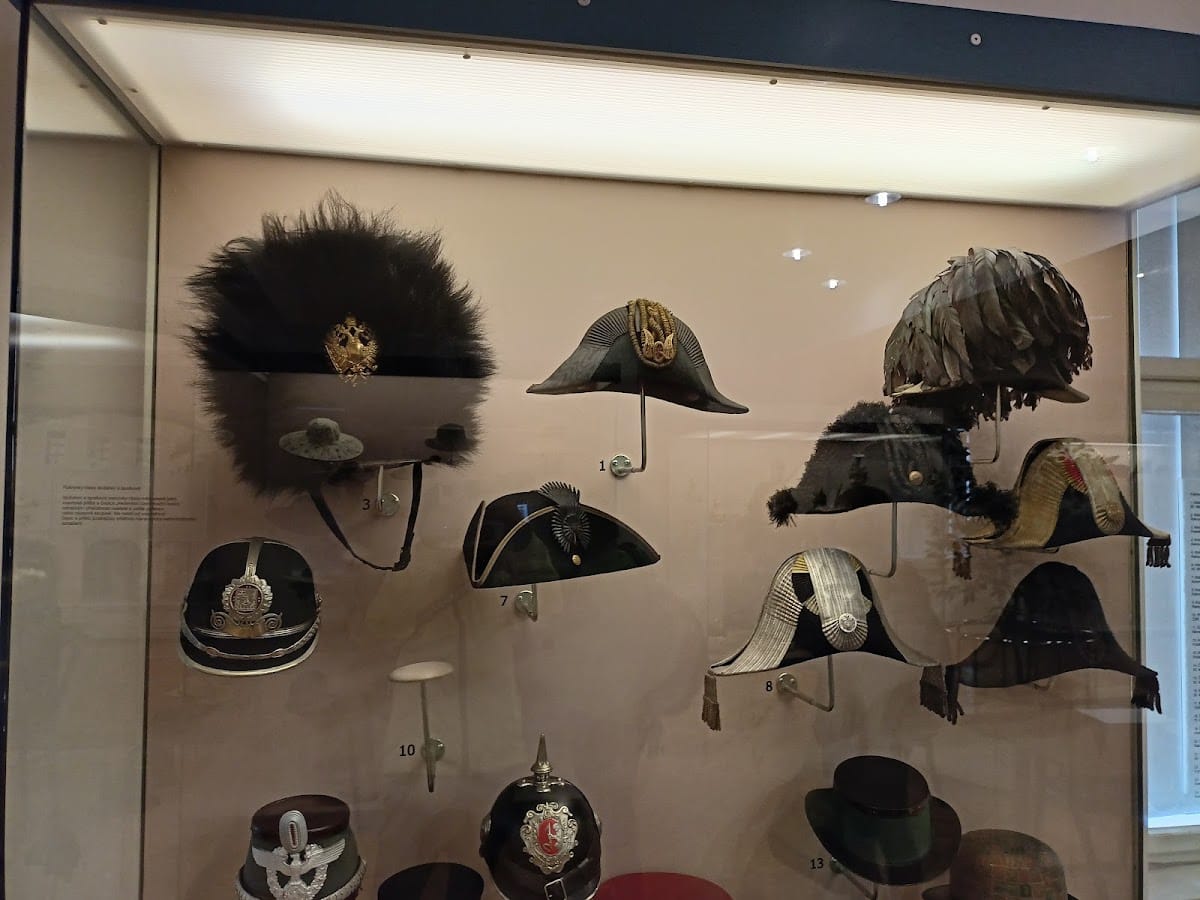
The permanent hat exhibition contains almost 600 hats and other head coverings dating from the mid-nineteenth to the late twentieth century, most manufactured in Nový Jičín. It traces changes in fashion through staged settings, including a café scene from the 1930s.
Ve znaku zavinuté střely brings together archaeological finds, town views, paintings, a town seal, and a church bell. Its presentation in the Theresian fresco hall includes religious art from the High and Late Baroque. The second part also contains the oldest surviving steam engine in Czechia, paintings by Eduard Veith and Hugo Baar, and an ethnographic section devoted to the former Kuhländchen region.