Oron Castle: Seat of the Lordship and Bailiwick of Oron
Site at a Glance
- Rating
- 4.5
- Popularity
- Low
- Country
- Switzerland
- Primary era
- Medieval
- External website
- Open
- Eras represented
- Medieval, Early Modern
- Civilizations
- Duchy of Savoy, Holy Roman Empire
- Site type
- Military
- Remains
- Castle
On this page14 sections
History
Oron Castle is a medieval fortress in Switzerland, located in Oron-le-Châtel, whose earliest construction dates to the late twelfth century. Built during conflicts among regional families for control of territories in the Kingdom of Burgundy, it became the seat of the Lordship of Oron and later the Bailiwick of Oron. The castle is first documented in 1261.
The lords of Oron
The lords of Oron initially served as castellans and advocates of Saint-Maurice Abbey, a longstanding religious institution whose medieval possessions included the villages around Oron. They were also ministeriales, dependent nobles or administrative officers serving a major ecclesiastical or secular lord. Guillaume II of Oron, who died before 1215, is the earliest documented member of the family. His son Rudolf used the title “lord of Oron” in 1214.
During the High Middle Ages, the d’Oron family acquired or inherited several lordships, including Attalens, Vevey, Corsier-sur-Vevey, Bossonnens, Pont, Arconciel-Illens, and Vuisternens-devant-Romont. Their influence consequently developed around two centers, Fribourg and Oron. When Rudolf’s sons divided the inheritance, Amédée d’Oron received Bossonnens and Attalens.
The family were initially vassals of the counts of Geneva and later entered the service of the counts of Savoy. Members of the d’Oron family repeatedly served as castellans and as bailiffs of Vaud. In 1381, the Lordship of Oron became a fief of Savoy, having previously been held as a free allodial lordship rather than as a feudal property.
Co-lordship and dynastic change
Saint-Maurice Abbey retained half of Oron Castle and part of the lordship in 1330. The abbey administered its share separately through a canon and sacristan. This co-lordship produced repeated conflicts over jurisdiction and complicated the medieval administration of Oron. The arrangement was resolved in 1537, while the abbey’s remaining rights in the Oron area ended after Bern acquired them in 1671 and 1675.
The male line of the Oron family ended in the late fourteenth century. Marie of Gruyère, the widow of François I of Oron, inherited the lordship in 1383. Henri II of Montfaucon also used the title Lord of Oron for a period, but after his death in 1396 the lordship was sold to Percival Le Royer in 1399. Le Royer transferred it to Gaspard of Montmayeur in 1402.
François of Gruyère reacquired the Lordship of Oron in 1457. The castle underwent extensive remodeling during the second half of the fifteenth century, particularly between 1475 and 1485. During this work, the keep was adapted for residential use, changing the role of the principal fortified tower within the castle complex.
Reformation and Bernese administration
From 1536, Oron-le-Châtel became a refuge for Catholics during the Italian Wars, a series of conflicts among European powers over control of Italy that lasted mainly from the late fifteenth to the mid-sixteenth century. Bern nevertheless required Jean of Gruyère to make his subjects adopt the Reformation, the sixteenth-century religious movement that challenged established Western Christian institutions and practices, as a condition for securing his lordship in 1539.
After the Gruyère family became bankrupt, Oron passed in 1555 to the canton of Obwalden, which was a creditor of Michael of Gruyères. Hans Steiger purchased the castle in 1556 and then sold it to the city of Bern. Bern established the castle as the seat of a third-class bailiwick in 1557. A bailiwick was a territory governed by a bailiff on behalf of a higher lord or state.
Forty-three bailiffs resided at Oron, and the residential parts of the castle were remodeled to serve the administration. The bailiwick ended with the French invasion in 1798. The castle then served as a prison from 1798 to 1801 and subsequently remained within the District of Oron until 2006.
Private ownership and conservation
The Roberti family of Moudon acquired the castle in 1801. Adolphe Gaiffe acquired it around 1870, beginning a period in which the castle remained in private ownership for more than a century. A school occupied an attic above the castle entrance from 1830.
The Association for the Conservation of Oron Castle was founded in 1934 and purchased the building in 1936. Restoration carried out over several decades supported continued cultural and institutional uses, including conferences, civil weddings, exhibitions, concerts, receptions, and banquets. Oron Castle and its library are listed as Swiss cultural property of national significance under inventory number 6392.
Remains
Fortress setting and plan
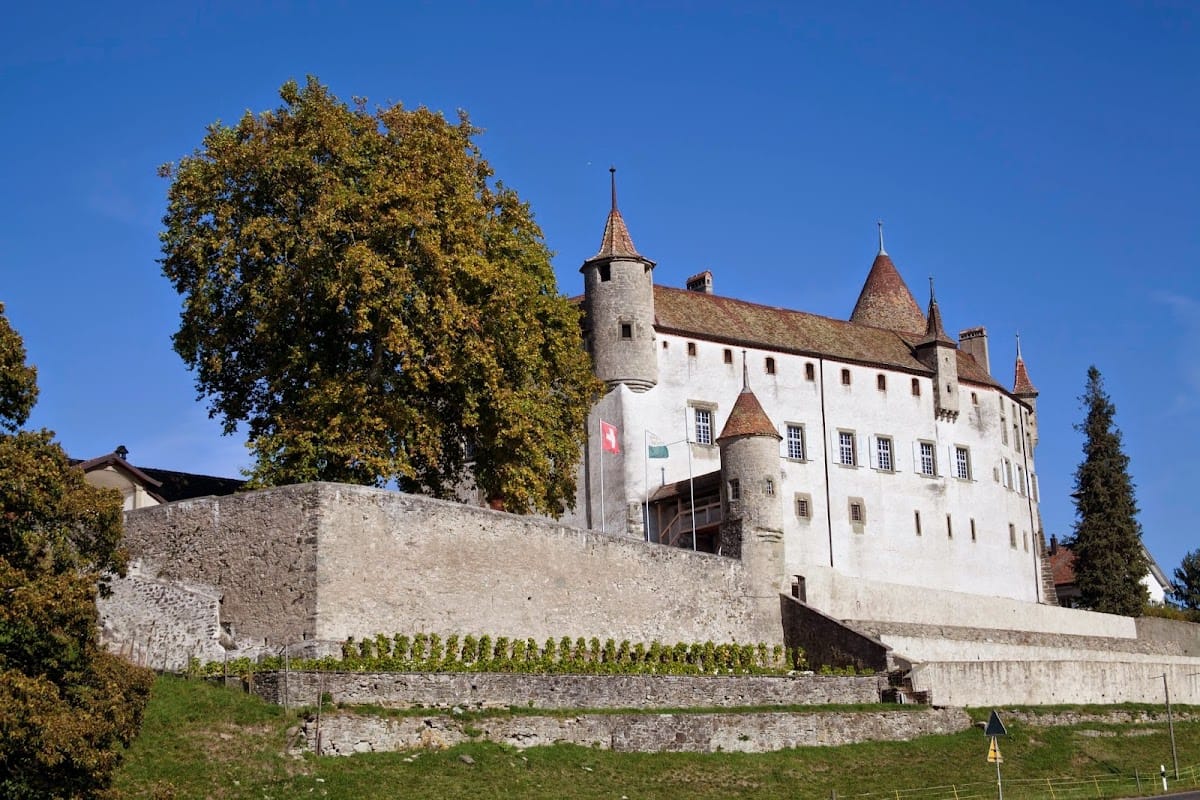
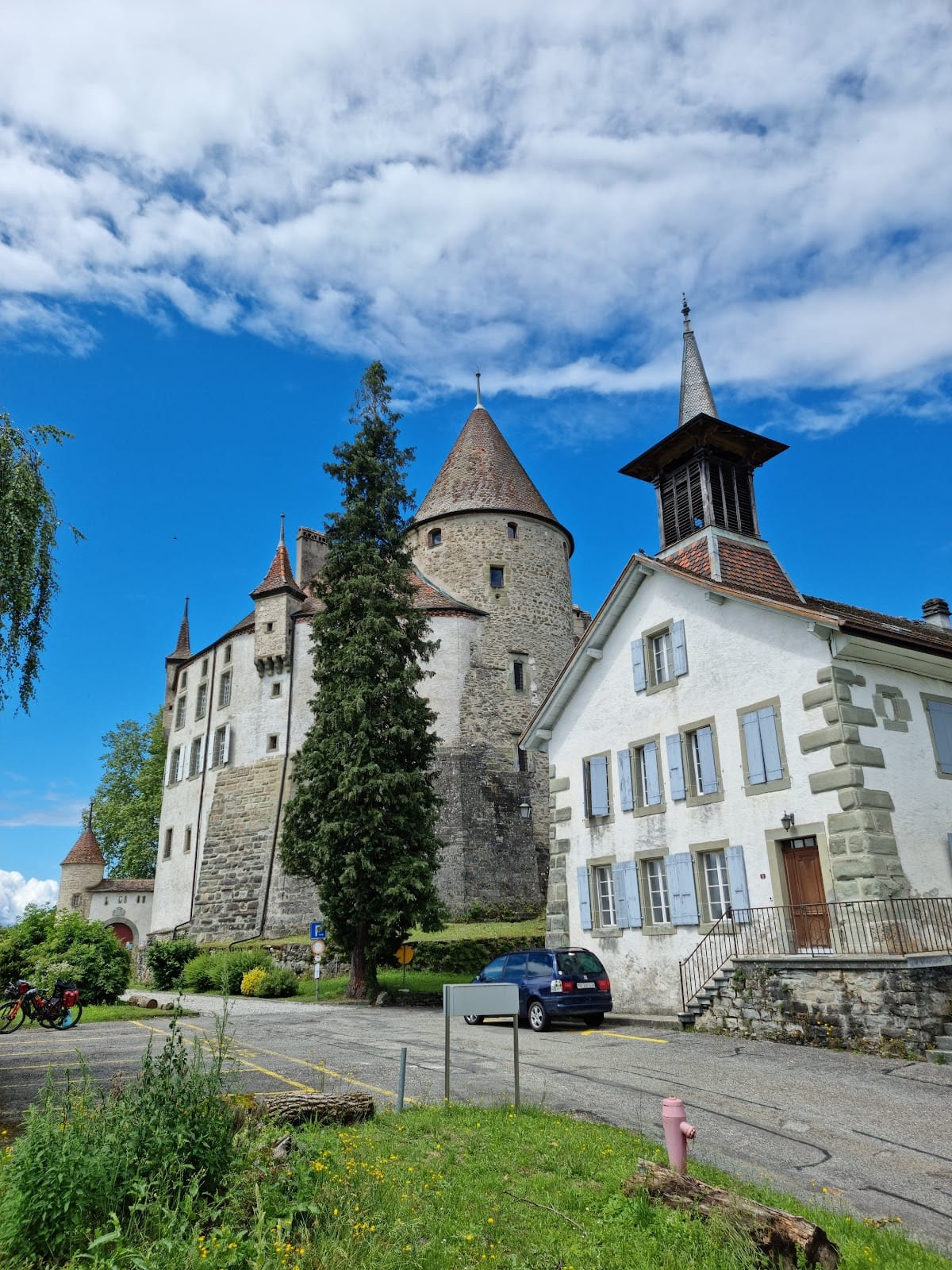
Oron Castle occupies a hill spur west of Oron-le-Châtel and east of Oron-la-Ville, between the Le Flon stream to the north and the historic Roman road from Vevey to Avenches to the south. The itinerary of this road mentions Uromago around AD 280. The central fortress has an elongated, approximately oval polygonal plan. Its medieval core preserves the twelfth-century fortress, with the thirteenth-century keep at the eastern end and the principal fortifications and entrance concentrated on the west.
Residential wings and curtain wall
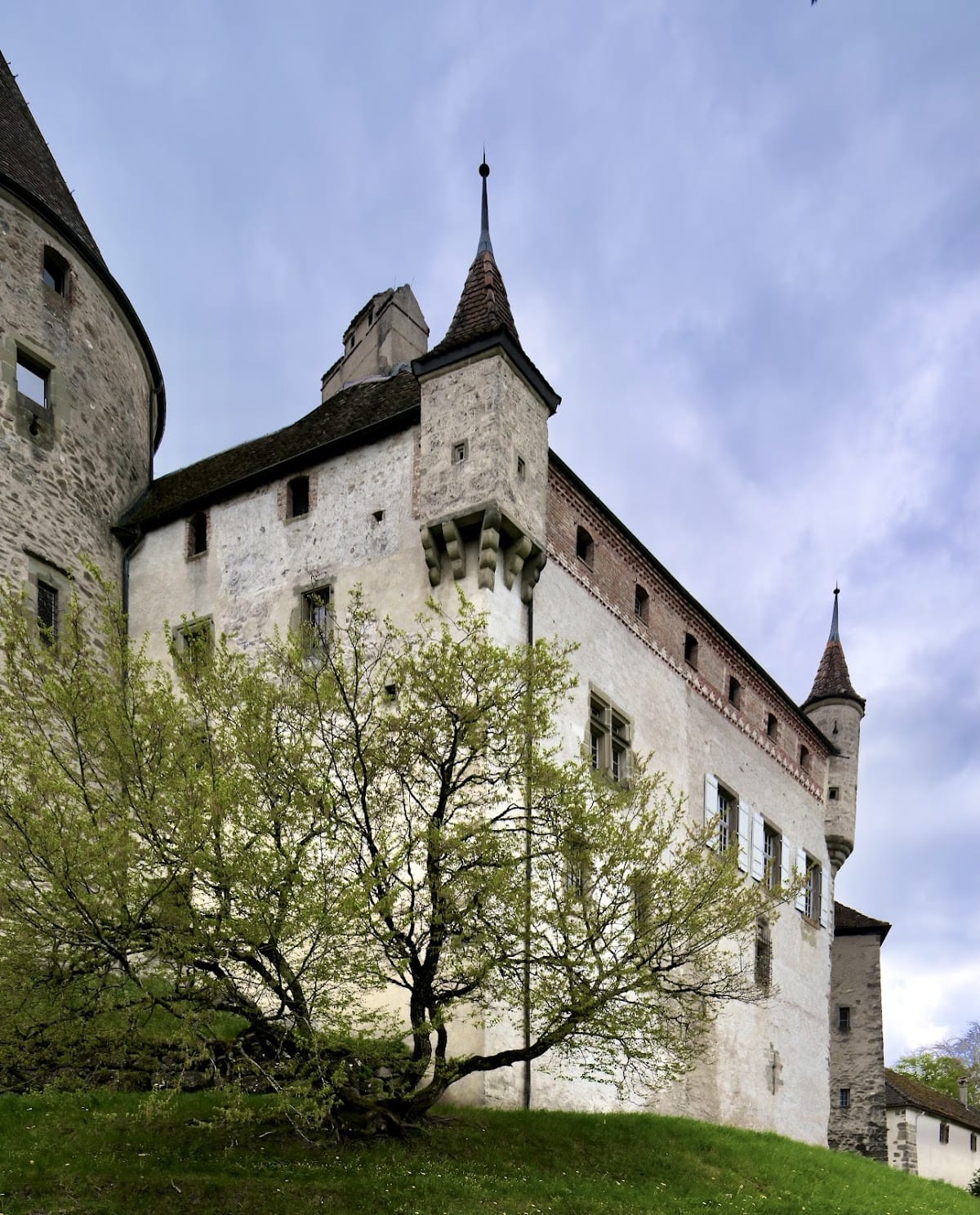
The principal residential buildings stand along the west and east sides and connect with additional towers and turrets. The curtain wall carries several round pepper-pot turrets, small projecting turrets capped by steep roofs. Their openings combine keyhole loopholes with ordinary windows, and their roofs have kinked profiles. Three other projecting turrets are square and have machicolations, projecting openings through which defenders could attack people below the walls. Two of these are on the east side and one stands at the northwest corner.
Chimneys interrupt the roofs of the residential wings. Rows of windows beneath the roofs may derive from a wall-walk connecting the pepper-pot turrets. Some of these upper windows are built of brick and have their own frieze, while the former great hall in the northwest also has a frieze beneath its windows. The upper openings have segmental arches, unlike the larger rectangular row below them. The lowest row is smaller and consists largely of slit windows or cross-shaped loopholes.
Keep and former great hall
The keep, or donjon, is the principal fortified tower of a medieval castle and often combined defensive and residential functions. At Oron it stands at the eastern end of the fortress and dates from the thirteenth century. Its conversion for residential use during the remodeling of 1475 to 1485 forms part of the castle’s later medieval transformation.
The former great hall in the northwest contains a late Gothic coffered ceiling. It houses the Potocki collection, a library of approximately 17,000 volumes dating from 1779 to 1825 and devoted to eighteenth-century French novels. Helena Apolonia Massalska began the collection, and her marriage to the chamberlain Wincenty Potocki accounts for its association with the Potocki name, a prominent Polish magnate family. Adolphe Gaiffe later acquired the library, which includes some unique works.
Gates, courtyards, and defensive works
Southeast gate
At the southeast corner, an externally attached gate projects at a right angle to the castle wall. It contains keyhole loopholes, slit windows, a heraldic stone, and an internal wooden stairway. The gate led into an outer defensive enclosure south of the castle and onward toward the former outer bailey.
Outer forecourt
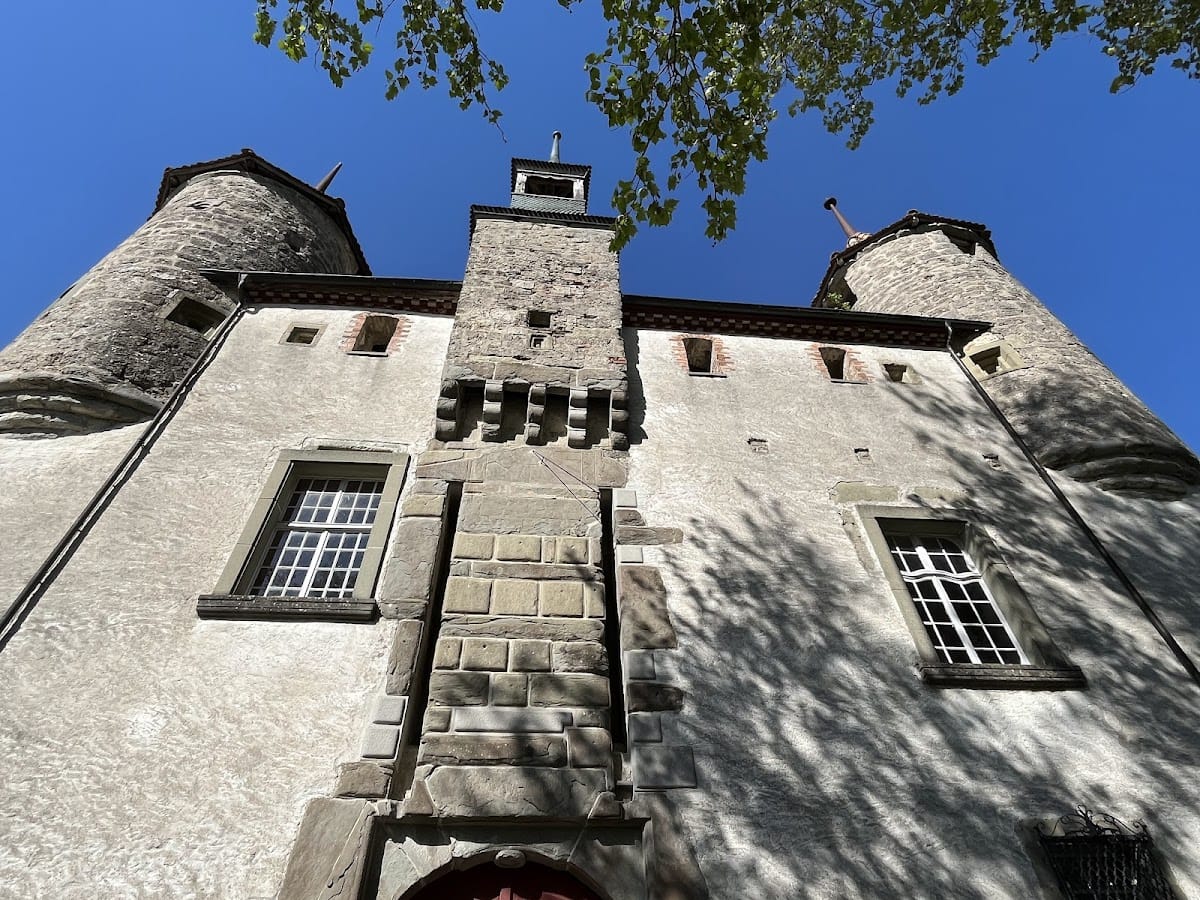
The outer forecourt was surrounded by service buildings and linked to the inner courtyard by a bridge. The approach passed beneath the bridge before rising by a ramp onto it. An engraving of 1744 shows a drawbridge, while a view from 1749 shows a stone bridge. In 1731, the interior of the entrance was converted into a vestibule.
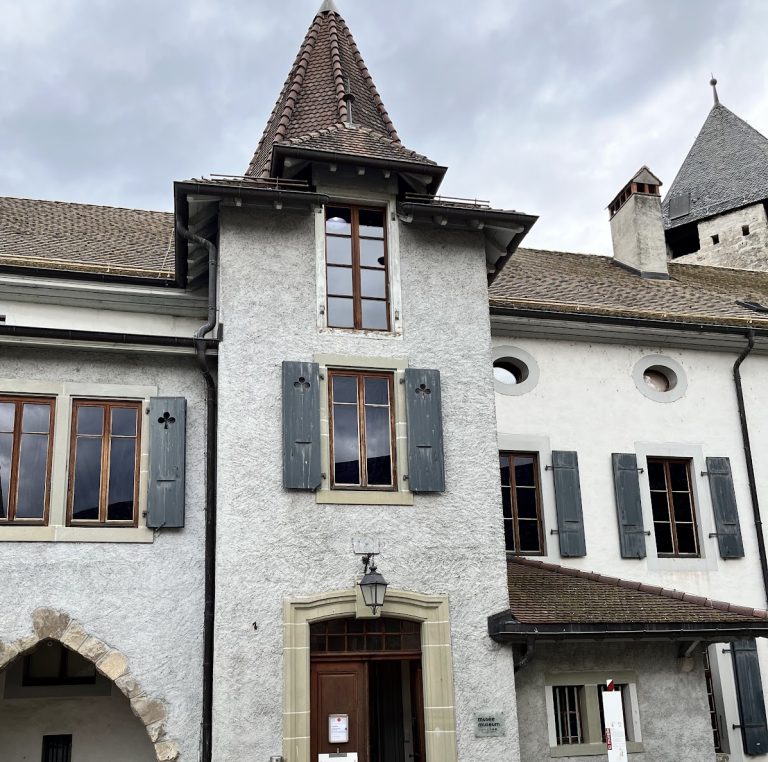
Two pepper-pot turrets protected the forecourt at the southeast gate, with additional turrets at the southwest and southeast corners of the courtyard. The southwest courtyard turret survives. The southeast turret appears in a view from 1713 but not in one from 1744. Including the southwest corner turret and a projecting turret above the inner-courtyard gate, seven towers and turrets surrounded the outer forecourt. Ditches flanked the approach and courtyard, and some were later converted into gardens.
East-side towers
The east side has a southeast pepper-pot turret, a central projecting turret, and a northeastern projecting turret. The bridge-tower projection carries a turret roof with a lantern and clock. A further southwest tower is a latrine tower with a three-sided tent roof and may represent a later enlargement of a garderobe projection.
Interior furnishings
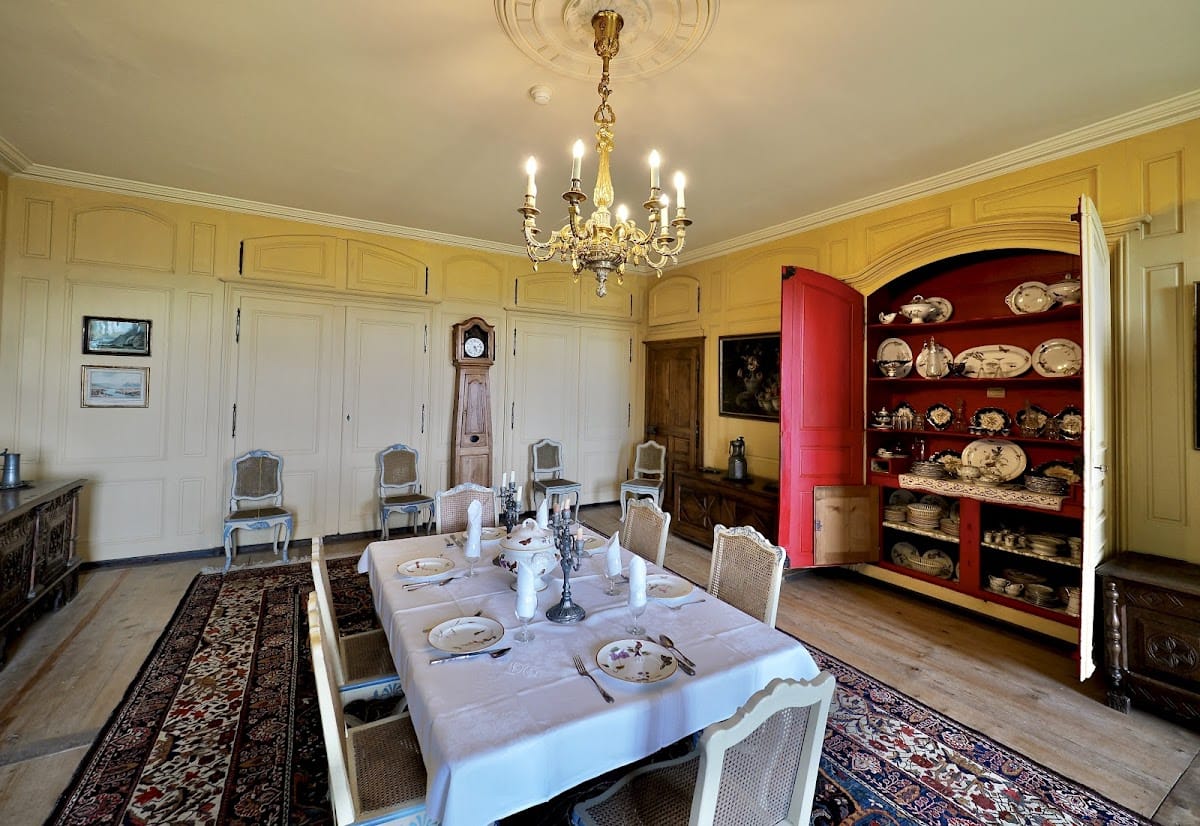
The castle also contains an eighteenth-century apartment and restored eighteenth-century stoves decorated with thematic motifs. A glass roof now covers the inner courtyard, supporting the building’s continued institutional and cultural uses while retaining the courtyard within the historic complex.