Château de Blain: A Medieval Fortress of Brittany



Site at a Glance
- Rating
- 4.3
- Popularity
- Low
- Country
- France
- Primary era
- Medieval
- External website
- Open
- Eras represented
- Medieval, Early Modern, Modern
- Civilizations
- Duchy of Brittany, French
- Site type
- Military
- Remains
- Castle
On this page14 sections
History
Château de Blain, also known as Château de la Groulais, is a medieval fortress in Blain, France, founded by the Breton Duke Alain IV Fergent around 1108. It formed part of the defensive system of the Duchy of Brittany and helped protect the duchy against neighboring feudal powers and later interventions by the kings of France. The castle became the center of the lordship of Blain and passed through the Houses of Blain, Clisson, Rohan, and Rohan-Chabot.
Foundation and the House of Clisson
Alain IV Fergent, who was both Duke of Brittany and Count of Nantes, ordered the first castle at Blain around 1108. The lordship and its fief were granted to the knight Guégon, the earliest known representative of the House of Blain. In 1225, a marriage transferred the castle to the powerful Breton House of Clisson.
After Olivier I de Clisson revolted against the duke, the castle was razed in 1260. His son, Olivier II de Clisson, later received permission from the duke to rebuild it. During the fourteenth century, the Clissons progressively enlarged the fortress, and under Olivier V de Clisson it became a formidable stronghold within Brittany’s defensive network.
Rohan ownership and the Wars of Religion
The House of Rohan acquired Château de Blain in 1407 and retained it until 1802. The Rohans were among France’s leading Protestant aristocratic families during the Reformation and the Wars of Religion. In the sixteenth century, their affiliation made Blain a center of the Reformation in Brittany, where Huguenots, French Protestants many of them Calvinists, from the County of Nantes sought the family’s protection.
The castle was drawn into the Eighth War of Religion, a conflict between Catholic League forces and supporters of Henri IV during the French Wars of Religion. Spanish troops commanded by Juan d’Aguila besieged Blain, and the castle was set on fire on 21 November 1591 amid fighting between Philippe-Emmanuel of Lorraine, Duke of Mercœur and governor of Brittany and Nantes, and Jean de Montauban, known as the knight de Goust, who commanded the garrison. Mercœur’s Catholic League forces opposed Henri IV, while the Rohans supported the king.
After peace returned, Catherine de Parthenay restored the castle and settled there with her children, Catherine, Henri, Benjamin, and Anne. Catherine was a prominent Calvinist noblewoman. The mathematician François Viète, who had been her tutor in the 1560s, stayed at Blain several times during the 1570s and 1580s. Louis de Rohan-Chabot, Duke of Rohan, was later buried at the castle.
Dismantling and revolutionary upheaval
In 1628, Henri II de Rohan’s position as the leading Protestant prince led Cardinal Richelieu to order the castle’s dismantling. Parts of the enclosing walls were demolished, ending Blain’s military role, although substantial ruins remained. The Logis de la Reine was destroyed during this period, and the Tour du Donjon des Armes was destroyed in 1629.
The lordship of Blain ended as a legal institution when the French Revolution abolished seigneurial rights in 1789. The Rohans nevertheless retained ownership of the former seigneurial reserve, including the castle. During the Revolution, the site was pillaged and burned, and the Rohan family archives were destroyed by fire. The castle was later used first as a barracks and then as a prison.
Private ownership and conservation
Château de Blain was sold to a Parisian banker in 1802 and passed through several owners. The Barons de Lareinty held it from 1892 to 1918. Marie Bonaparte, the wife of Prince George of Greece, acquired the castle in 1918 and restored it as a residence. During the work, she stayed at Château de Pont-Piétin, owned by the aviation commander Jules de Lareinty-Tholozan. Her decision to acquire Blain was partly connected to her attachment to Aristide Briand, the Nantes-born politician who had lived there as a child while his mother worked at the castle as a laundress.
At the beginning of the Second World War, the castle narrowly avoided requisition by a British general stationed in the region, who intended to use it as a fuel depot. Instead, refugees from Paris occupied the site. Marie Bonaparte sold the castle in 1950 after wartime losses had reduced her fortune. Later owners remodeled the Logis du Roy and the Tour du Moulin. Between 1991 and 2005, volunteers from the Chantiers histoire et architecture médiévales association carried out restoration work.
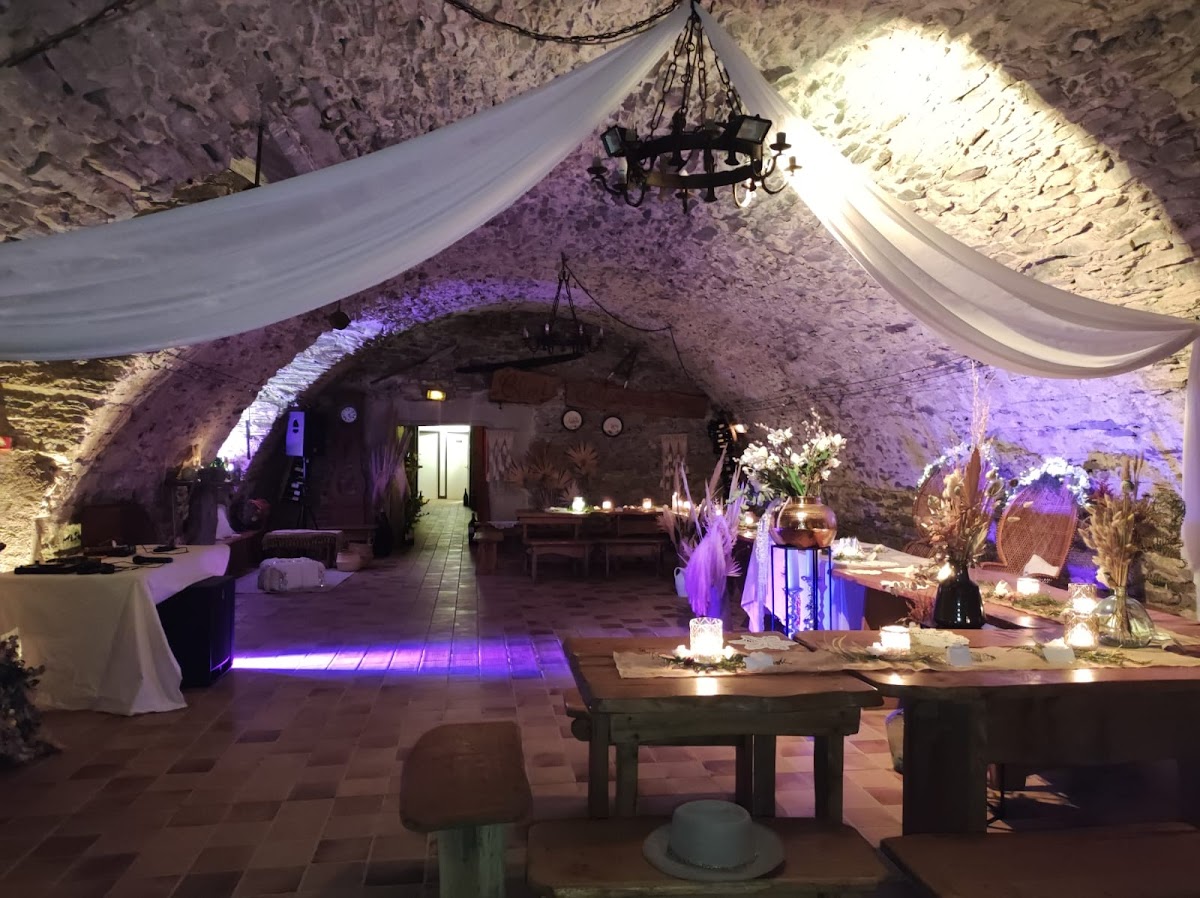
The commune purchased the classified portions of the castle on 15 June 1977, while the remaining privately owned sections were listed for protection in the same year. The moats, park, and gateway received protection in 2009. In 2011, Yvon and Laurence Morin purchased the privately owned sections, restored the roofs, brought the electrical installation up to standard, and repaired the Tour du Moulin. The castle is now divided between public and private ownership, with its buildings accommodating cultural and event uses, including an ancient-printing museum managed by Amagraph, a fresco center, historical reenactment activities, markets, fairs, weddings, and seminars.
Remains
Château de Blain occupies a domain of approximately 4.4 hectares, including its moats and ditches. It stands south of the Isac, now incorporated into the Nantes–Brest Canal, outside Blain. The site lies between the canal-side port to the north-northeast, the Laval–Saint-Nazaire road to the west, and the Groulaie Forest to the south. Before the canal was constructed in the nineteenth century, the Isac supplied the moats.
The outer fortress
The former fortress consisted of a large outer enclosing wall surrounding a courtyard and the group known as the Petit Chastel. The outer wall was partly demolished during Richelieu’s dismantling of the seventeenth century, but substantial sections survive as ruins. The area within the wall is now arranged with lawns and paths and is used for medieval historical reenactments. Much of the former courtyard of honor is occupied by a car park serving the private part of the estate.
Outer towers
As many as twelve towers once stood on the outer wall or the Petit Chastel, and nine remain visible in varying states of preservation. Five belong to the outer fortress. The northeast tower, the east tower, and the southeast artillery tower date from the sixteenth century and each measures 22 metres in diameter. The east tower is horseshoe-shaped, as is the southwest tower, which protected the drawbridge.
Drawbridge and Prison Towers
The fourteenth-century Drawbridge Tower measures 40 by 15 metres and is covered by a conical slate roof. Together with the southwest tower and buildings on either side, it forms the present entrance complex in the drawbridge area. The former principal entrance was a monumental gateway on the northwest side, at Les Pavés on Rue Olivier V de Clisson.
The southeast artillery tower is surmounted by the fourteenth-century Prison Tower, which measures 25 by 8.5 metres. More than seven metres of rubble gradually filled its center, and the resulting weight weakened the structure. Archaeological excavations in spring 2019 uncovered various sixteenth-century objects within the tower.
The Petit Chastel
The Petit Chastel formed the inner building group of the former fortress and contained the Logis du Roy and the Logis de la Reine. Four towers were associated with it, combining medieval defensive construction with later changes to the residential buildings.
Tour du Moulin and Tour du Connétable
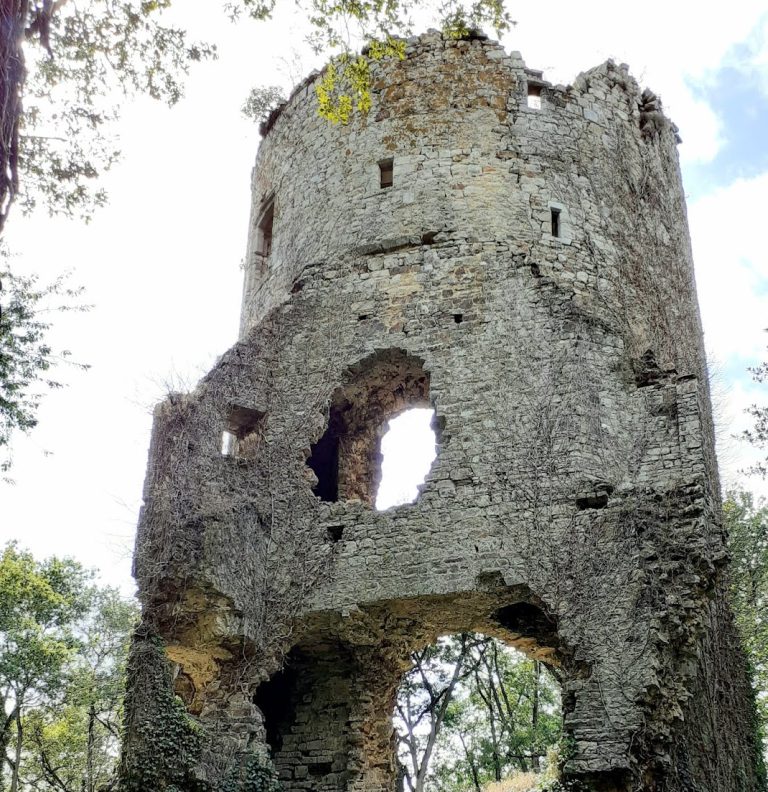
The northwest Tour du Moulin is round, has a terrace roof, and retains machicolations, projecting defensive structures with openings through which objects could be dropped onto attackers below. The northeast Tour du Connétable dates from 1386. It is round, measures 45 by 15 metres, and has a conical slate roof with a projecting square stair turret covered in slate. Later owners remodeled the Tour du Moulin, and its roof was repaired during the restoration undertaken after its private purchase in 2011.
Logis du Roy
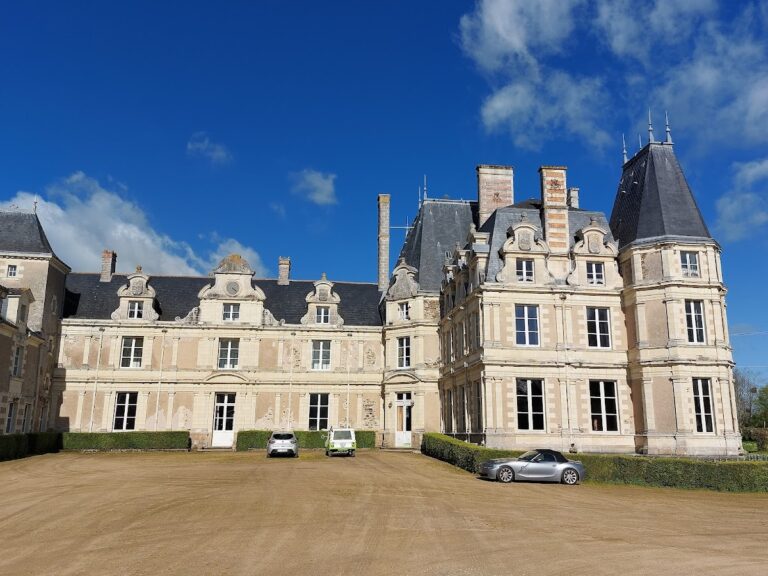
The fifteenth-century Logis du Roy stands between the Tour du Connétable and the Tour du Moulin. Its exterior includes a formal French garden. Marie Bonaparte restored the building in a Renaissance style, adding tall dormers crowned with pinnacles, gargoyles, and chimneys decorated with brick and slate patterns. Its north wing was remodeled in the nineteenth century, and a monumental entrance is recorded on the south façade.
Logis de la Reine and the chapel
The Logis de la Reine stood between the Tour du Moulin and the Tour du Donjon des Armes. Richelieu’s dismantling destroyed the building, while its lower sections and cellars survive as the Cellier de la Reine. The Tour du Donjon des Armes itself was destroyed in 1629, and the southeast Tour de l’Horloge was demolished in 1804, leaving only its foundations. From the sixteenth-century chapel, only the crypt survives.
Associated buildings and archaeological remains
The former farm buildings beside the monumental gateway have been converted into guest lodgings, and the former mill has also been adapted as a lodging facility. A hoard of 3,091 silver coins, weighing approximately 30 kilograms, was hidden in a chest at the bottom of a latrine pit during the 1591 siege. Archaeological excavations discovered the hoard in 1890, although it is no longer located.
The surviving fortifications, towers, entrance structures, and related remains include fabric from before the seventeenth century as well as elements from the fourteenth, fifteenth, and sixteenth centuries. The Logis du Roy and other surviving parts bring together medieval construction, Renaissance remodeling, and later alterations, preserving the layered physical history of the fortress.